


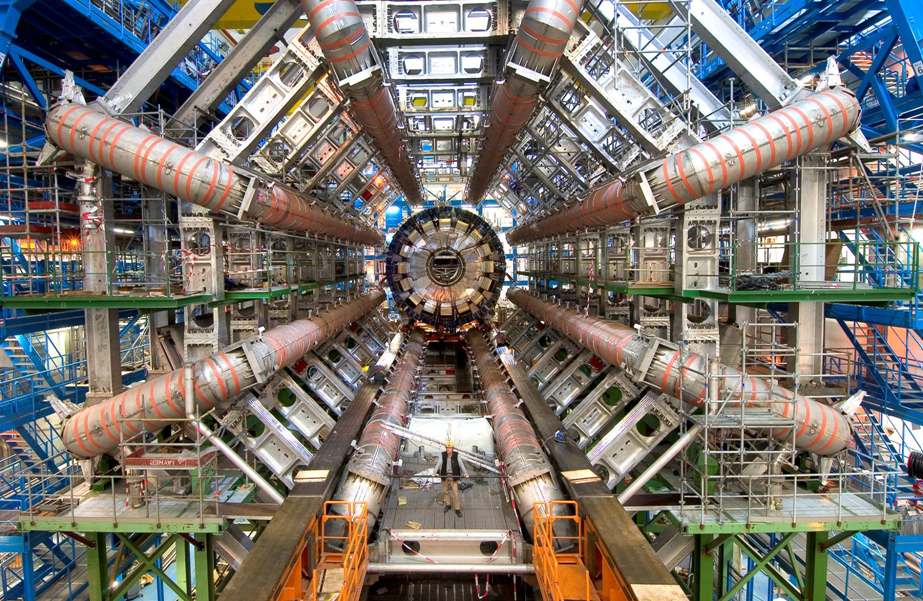
Atlas during construction (the person illustrates the sheer size of Atlas)
Atlas is one of the general purpose detectors which started operation in 2008 at the the CERN proton collider, to study the Higgs boson.
Goals:
Atlas is one of the two general purpose detectors installed at the LHC which started operation in 2008. Atlas brings experimental physics into new territory. Discovering new processes and particles that change our understanding of energy and matter would be most exciting. Atlas will learn about the basic forces that have shaped our universe since the beginning of time and that will determine its fate. Fundamental questions arrise: Why do fundamental particles have such different masses ? How do particles acquire their mass ? To explain these mysteries, theories predict a new particle, the Higgs boson whose field could give mass to all the other particles. The particle with a mass of about 125 GeV the discovery of which has been announced in 2012 has all the properties of the Higgs boson, or at least one of the Higgs bosons, as several variants of the Standard Model predict the existence of several such particles. The existence of new particles is also conjectured in models beyond the Standard Model, one of which is Super Symmetry; it postulates new particles related to the known particles where a matter particle (fermion) has a force carrier (boson) as partner, and vice versa. Possible implications are extra dimensions in space-time and mini black holes.
At the very beginning of the universe, equal amounts of matter and antimatter existed. If matter and antimatter were exact miror images of each other, they would have completely annihilated to leave only energy. But why was some of the matter left over to create galaxies, the solar system with our planet, and... us ? Atlas will explore the tiny diffeence that exists between matter and antimatter. LHC will recreate the conditions of the universe just after the Big Bang to understand why the universe is like it is today. Atlas will investigate why the matter of the universe is dominated by an unknown type called dark matter. If constituants of dark matter are new particles, Atlas should discover them and elucidate the mystery of dark matter.
Themes/Associated programs
- Elementary constituants of matter / Physics at LHC
- Magnets and accelerators / superconducting magnets
- Innovation in detection systems / Detecteurs development
- Signal processing and online systems

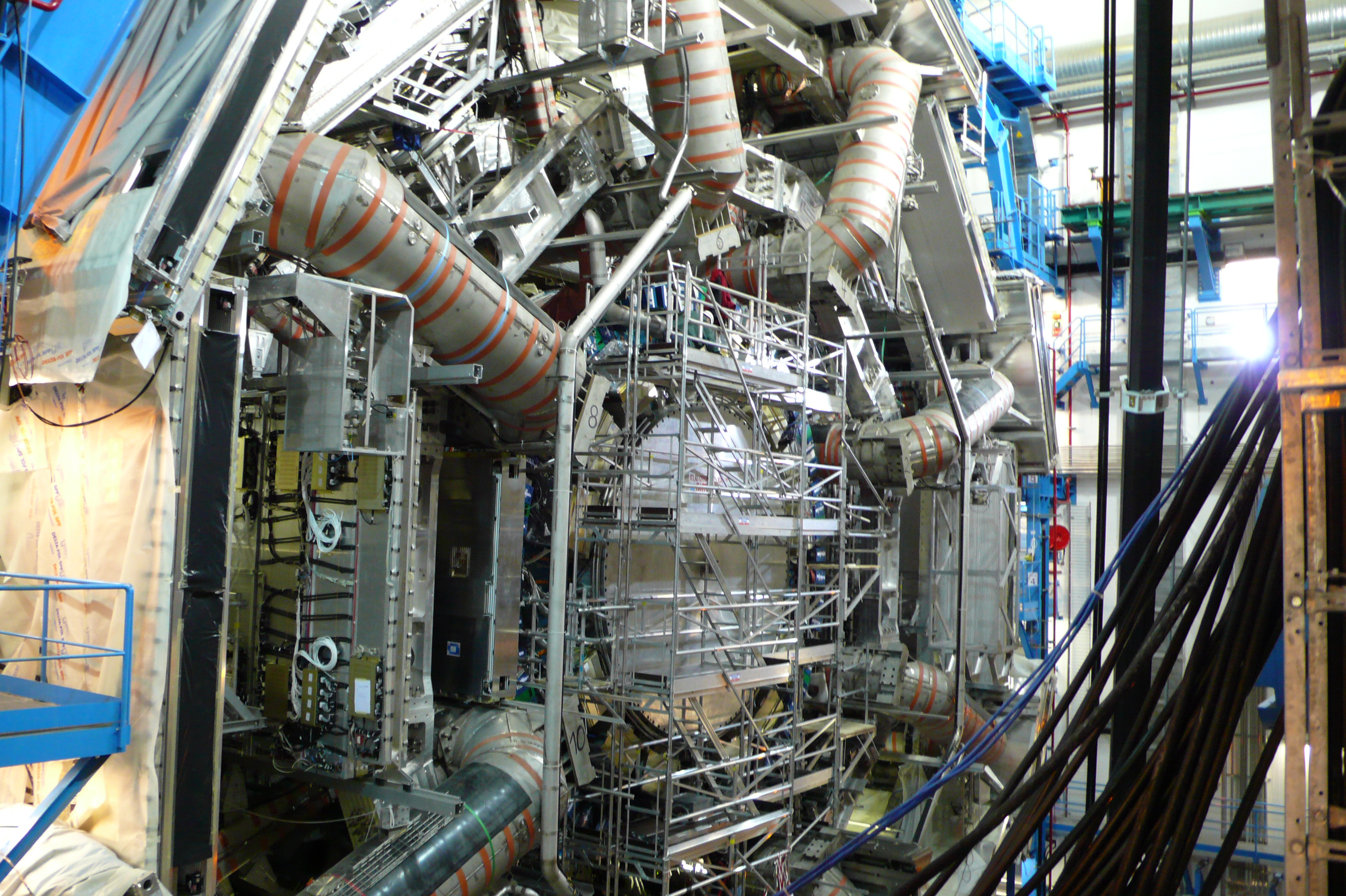
Partial view of Atlas, in mid-2007
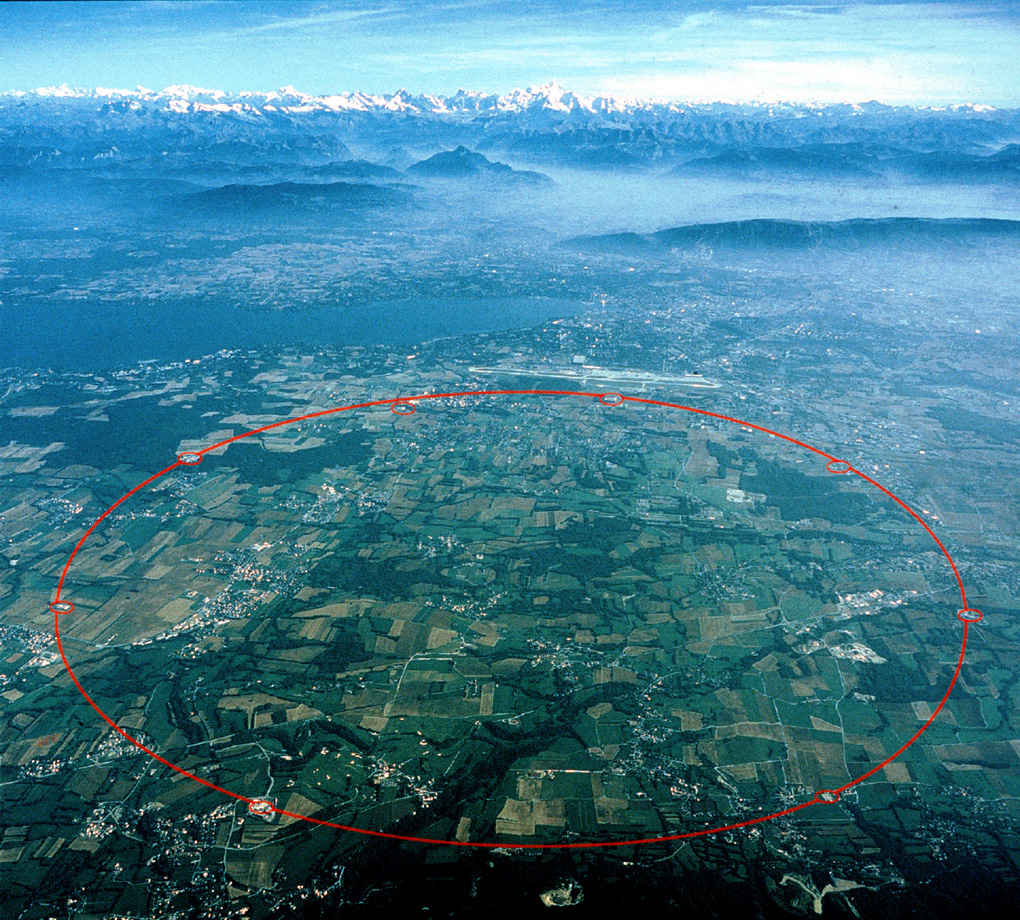
Areal view of CERN: the underground LHC ring is shown in red.
Context
Since 2010, Atlas has observed dramatic head-on collisions of pairs of protons with a total energy of 7 TeV until 2011, and of 8 TeV in 2012. After a break in 2013-2014 to improve the performances of the magnet system of the accelerator, the collision energy has been increased up to 13 TeV in 2015. The protons are accelerated to these record high energies by the Large Hadron Collider (LHC) - an underground accelerator ring 27 km in circumference located at the CERN laboratory near Geneva.
Atlas was approved in 1995, and is one of the large general purpose experiments operating at the LHC.
IRFU also contributes to the second large experiment with similar goals: CMS
Contributions by IRFU
Electromagnetic Calorimeter
Liquid argon and lead absorber
Fabrication and assembly of 40 % of the barrel calorimeter (mecanical engineering, cryogeny, control)
Electronics (analog signal summation and filters); radiation hard electronics (DMILL process)
Upgrade phase 1 (2018): Design and construction of part of the electronic cards which produce the improved level 1 trigger decision for the electromagnetic calorimeter (electron,photons)
Muon spectrometer:
Alignment System for muon chambers with optical devices (≈ 30 microns)
Measurement and mapping of the magnetic fields in Atlas
Upgrade phase 1 (2018): Construction with the MicroMegas technology, pioneered at Saclay) of 25% of the muon chambers of the new smal wheels in the forward part of the muon spectrometer. Strong participation in the global integration of the NSW and of its alignment.
Atlas Barrel Toroid
Software
Detailed detector description
Computation of the magnetic field map
Track reconstruction in the muon spectrometer
Detector end event display
Standard Model Physics
Study of the final states with a pair of gauge bosons (ZZ, WZ, WW, Wgamma, Zgamma).
Precision measurements of the top quark mass and the W boson
Search for the Higgs boson in the ZZ decay channel
Search for new particles: Heavy resonnances, dark matter candidate particles, top partners
Upgrade phase 2 (Horizon 2024: HL-LHC):
Research and development on thin fine grain pixels sensors in the HV/HR CMOS technology. Pixels detectors built with this technology may allow for rather low cost high resolution pixel detectors for the future ATLAS inner detector, while being suffiently radiation hard for the high luminosity expected at the HL-LHC starting in 2014.
Participation to the design and construction of the new Front End electronic boards for the liquid argon calorimeter.
Study of the possibility to use fast micromegas chambers (with very short drift distance and a cerenkov crystal and a photocathode to produce several photoelectrons per muon) to equip a muon tagger located at very large pseudorapidities beyond the acceptance of the muon spectrometer.
Contacts:
 1213_2.jpg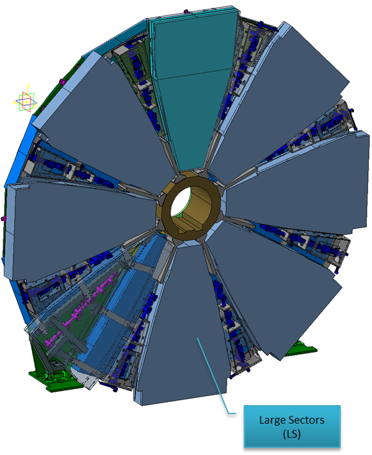
CAD view of a new small wheel of the upgraded muon spectrometer. IRFU builds half of the chambers of the large sectors.
• The ultimate constituents of matter
• Accelerators, Cryogenics and Magnetism Division (DACM) • The Electronics, Detectors and Computing Division • The Nuclear Physics Division • The Particle Physics Division • The Systems Engineering Division
• Laboratory of Mechanical Studies and Detectors Integration (LEMID) • ATLAS

