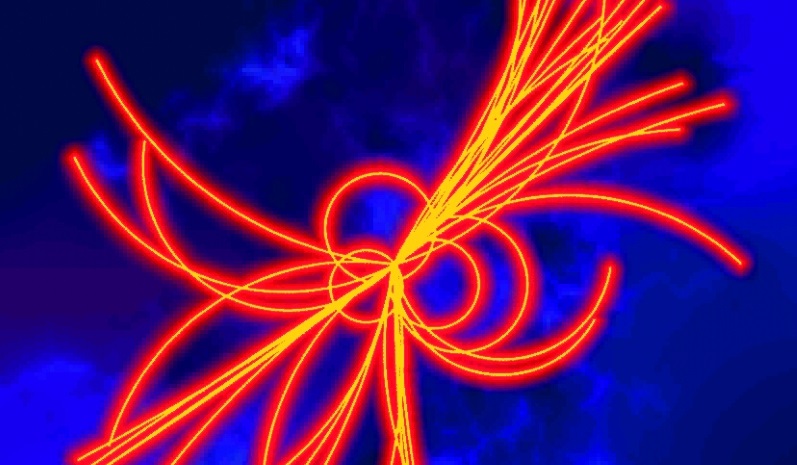
Basic research in the subnuclear realm deals with tiniest entities in our Universe. Dapnia strives to answer unsolved questions about these: What is the origin of mass? Is there a single, universal force? What are the properties of neutrinos?
maj : 07-02-2005 (528)
![]() | DAPNIA is closely involved in studying the structure of nucleons (i.e. neutrons or protons) and describing them in terms of their components, which are known as quarks and gluons. Its teams are helping to solve fundamental questions as to how these components define the quantum numbers which characterise nucleons and are investigating the contribution of strange quarks to electromagnetic structure, as well as the part played by gluons in nucleon spin structure. The recent concept of generalised parton distribution, ... Lire la suite » |
![]() | Neutrinos are quite remarkable elementary particles which are produced in great abundance in the sun, in the atmosphere and at the core of nuclear power reactors. DAPNIA has been interested in them for a very long time. It has now been established that although they are very light, neutrinos do not have zero mass. It remains to be determined how these masses are distributed among the three known varieties of neutrino: ne, nμ and nτ
Based on recent progress in experiments, it seems that these neutrinos ... Lire la suite » |
![]() | The Standard Model of elementary particles provides an incredibly precise description of matter and its interactions up to the highest energy explored so far. And yet, one of its predictions remains to be verified: the electroweak symmetry-breaking mechanism, which points to the existence of a new particle called the "Higgs boson". Furthermore, several extensions of the Standard Model, such as supersymmetric models, predict the existence of new particles. These theories will be extensively tested by the Atlas ... Lire la suite » |
![]() | Experiments using accelerators at the highest accessible energy can be used to perform precise tests on the Standard Model. At CERN, the LEP has obtained many results leading to more precise knowledge in this field. The degree of precision attained in measuring the mass of the W boson has been exploited to obtain an indirect upper bound for the mass of the Higgs boson through quantum corrections. The Tevatron accelerator at Fermilab (near Chicago) has yielded results on the physics and mass of the top quark. The HERA ... Lire la suite » |