CEA    Saclay    SACM    SAp    SPhN    SPP       drapeau

The Accelerators, Cryogeny and Magnetism Division

The Sacm

images_icon.jpg Gallery [+]
Photo du prototype RFQ de SPIRAL2 Photo du prototype RFQ de SPIRAL2
actus_icon.gif Headlines [+]
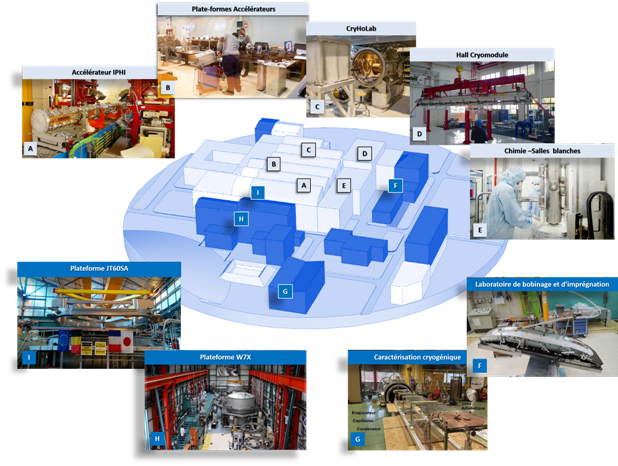
Accelerators, Cryogenics and Magnetism Department (SACM) Accelerators, Cryogenics and Magnetism Department (SACM) : SACM develops and builds particle accelerators, cryogenic systems, and superconducting magnets for IRFU's scientific programs and for those of the CEA in general. It is organized to manage large-scale projects. These are conducted within the IRFU project organizational structure, in close collaboration with the Institute's other physics and technology departments, and in particular with the Systems Engineering Department (SIS).   In 2009, 67 engineers and 50 technicians worked for SACM, together with five doctorate students, several visiting researchers, and more than fifteen students. The workforce is divided among four laboratories: Ø  the ... More »


vide_exp_icon.gif Projects

SPALADINPresentation of the project Physics & programmes Spallation reaction study, physics data for nuclear energy Goals of the experiment The measurement in coincidence and in inverse kinematics of the spallation (A+p at 1 GeV per nucleon) reaction in order to study in detail ...
T2KT2K (Tokai to Kamioka) is an experiment dedicated to the study of neutrino oscillations over a long distance using a µ-neutrino beam. The beam will originate from the J-PARC accelerator which is under construction in Tokai. The neutrino beam will be aimed at Super Kamiokande, a detector ...
Super Heavy Element StudiesObjectives While the heaviest element on earth is 238-uranium (with traces of Pu and Np in natural nuclear reactors) whose lifetime is 5 billion years, the last 60 years have seen the synthesis of dozens of new elements in laboratory, with shorter lifetimes. In 2007, The heaviest elements which ...