CEA    Saclay    SACM    SAp    SPhN    SPP     

The Accelerators, Cryogeny and Magnetism Division

« Research themes

« 

High-intensity ion linear accelerators 

High-intensity high-energy linear accelerators, capable of consistently reaching 1 GeV and several tens of milliamps, find numerous applications in nuclear and particle physics, and in condensed matter physics as well. The interaction of a proton beam, accelerated by a Linac of this kind, with a target, enables the production of particles such as radioactive ions, neutrons, neutrinos or muons. These particles then form secondary beams, which may be used for example in the transmutation of nuclear waste or for studying the structure of various materials.
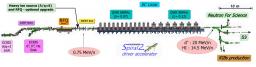
These future generation accelerators will apply technologies that are the subject of ongoing R&D programmes at SACM, such as the lphi (Injecteur de protons de haute intensité) project for the low energy part, and the programme for 700 MHz superconducting accelerator cavities for the high-energy part. Knowledge and experience gained in these two areas have enabled SACM to play an important role in the Spiral 2 project, a complete Linac designed for the study of a large range of exotic nuclei.


last update : 10-21 00:00:00-2005 (816)

Accelerating structures for superconducting proton accelerators

New programs (SLHC-PP, EuCARD and the French contribution at CERN) were launched in 2009 to continue development activities focusing on pulsed superconducting accelerators for intense proton beams, carried out as part of Europe's CARE/HIPPI program. These activities have also been spurred by the decisions taken by the SPL (CERN) and ESS-S project managers to adopt 704 MHz superconducting cavities as the reference solution for their proton linacs.

BETSI and ion source development

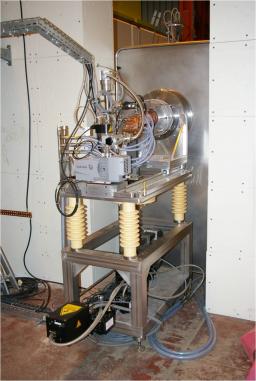
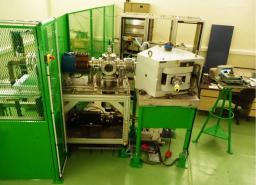
The ion source design and test bench, BETSI, has been in use since 2006 to produce and analyze intense beams, in pulsed or continuous mode, up to several tens of mA and at energies up to 50 keV. The source on this facility, operating at up to 50 kV, is supplied with radiofrequency power via a high-voltage switch. A solenoid focuses the beam at the exit of the accelerator tube, and a dipole is used to separate the extracted species. The beam is characterized by various diagnostics already in place or under development.

IFMIF accelerator complex
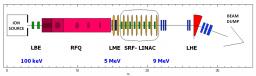
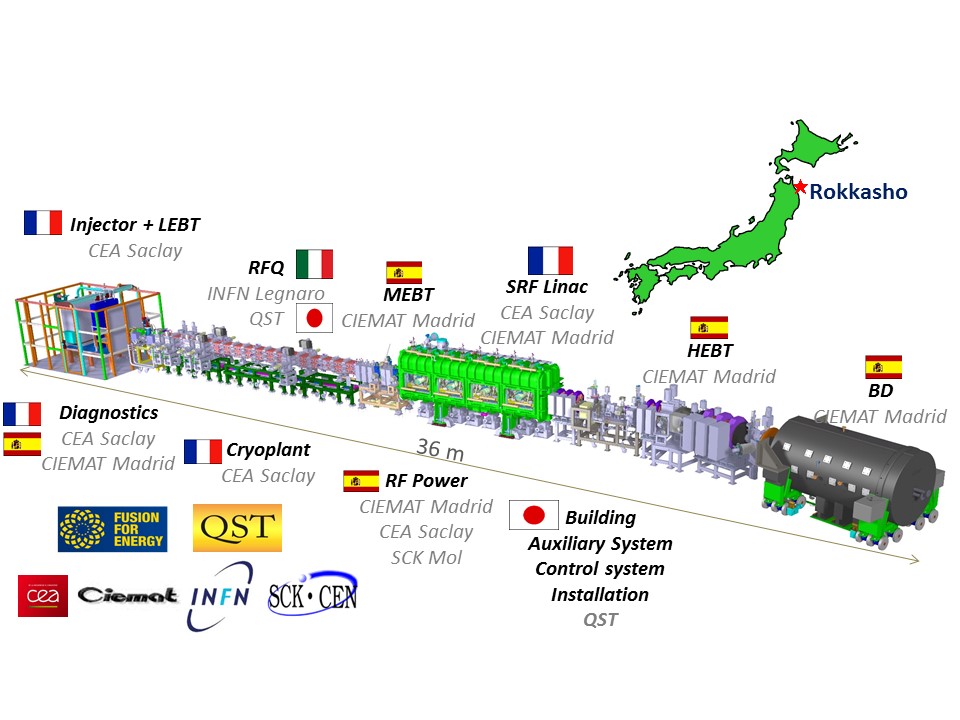
The International Fusion Material Irradiation Facility or IFMIF is designed to irradiate (with a neutron flux) and characterize the materials used to build future fusion reactors. It will consist of two accelerators, each generating a 125 mA continuous deuteron beam at an energy level of 40 MeV, aimed at liquid lithium target to produce an intense 14 MeV neutron flux (1018 n.m-2.s-1). In view of the high intensity and characteristics required of the beam, a preliminary phase, called EVEDA (for Engineering Validation and Engineering Design Activities) must be carried out. The phase includes the construction of a prototype accelerator (9 MeV at 1 MW) to be installed in Rokkasho, Japan.   ... More »
Radiofrequency quadrupoles

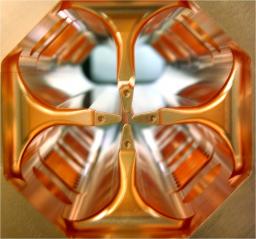
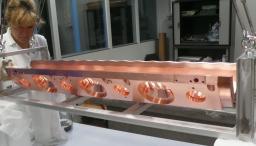
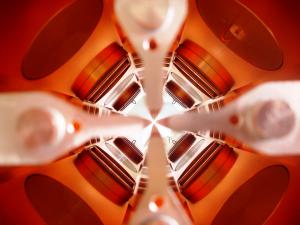
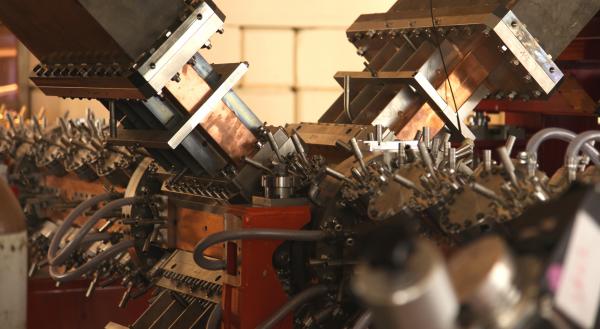
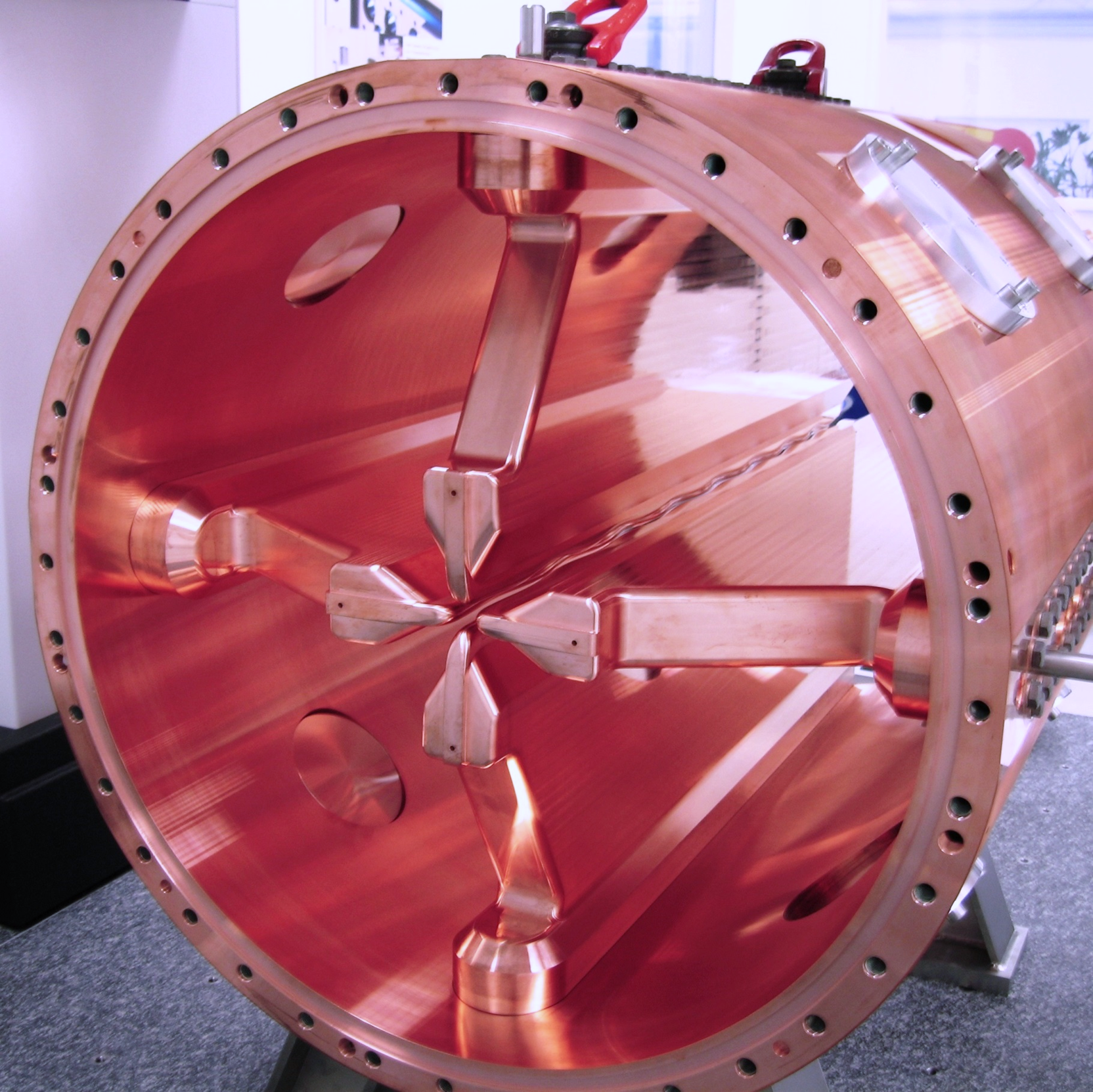
The radiofrequency quadrupole, or RFQ, is a vital structure for ion linear accelerators. It fulfills the beam bunching and pre-acceleration functions that are essential for effective energy transfer in the upper stages, while ensuring particle confinement. Efforts to optimize RFQs are aimed at achieving the most effective bunching possible, at minimum power consumption, and with very low sparking rate. Reproducing the optimized amplitude of the electromagnetic field to within a few per cent requires manufacturing tolerances in the region of a few tens of microns at the pole ends.

Spiral 2

With the detailed design phase completed at the end of 2005, the Spiral 2 project has now entered its construction phase. The low-energy ion beam injector, installed at the LPSC in Grenoble, and the proton and deuteron injector currently being installed at the Saclay site, began producing their first beams in 2009. SACM is involved in four aspects of the project: building the Saclay proton and deuteron injector, studying beam dynamics, with a focus on consolidating the accelerator and tuning procedures, building and testing the 12 low-energy cryomodules, and developing the S3 spectrometer.


Superconducting cavities for a proton Linac

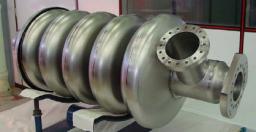
At high energy, protons can be accelerated by elliptical niobium superconducting cavities operating at the temperature of superfluid helium (< 2.17 K). This high energy part of the Linac is made up of several sections, made up of groups with multi-cell cavities of varying geometries, suitable for proton velocity relative to the speed of light (β = v/c = 0.47, 0.65, 0.85). Over the last three years, we have set up a number of “tools” allowing us to build and test these cavities.


The IPHI high-intensity proton injector

A high-intensity proton accelerator is a source of secondary beams - containing neutrons, muons, neutrinos, radioactive nuclei – that open up new fields of study and applications, in both fundamental and applied research. The proton injector built for these new-generation accelerators will be used to obtain design and experimental benchmarks for the particularly critical choices to be made for the low-energy line. The IPHI high-intensity proton injector, which is being built in collaboration with the CNRS National Institute of Nuclear Physics and Particle Physics (IN2P3) and CERN, meets these objectives.