News 2010
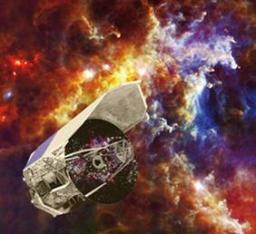
An international team of astronomers, including several French researchers, has just completed a precise measurement of the distance to five distant galaxies using the ESA Herschel Space Observatory together with ground-based data from the interferometer operated by the Institute for Millimetric Radioastronomy (IRAM)1 . The research team has shown that the light from these galaxies has travelled for around ten thousand million years before reaching Earth. In order to obtain these results, the team developed an entirely new technique, making use of the 'gravitational lens' effect for the first time in the sub-millimetric domain2 . Such a gravitational lens provides a form of magnifying glass on a cosmic scale that can be detected by Herschel. Until now very difficult to observe, these distant and rapidly evolving galaxies are a key component in improving our understanding of the history of the galaxies in our Universe. These results were published in the journal Science on November 5, 2010.
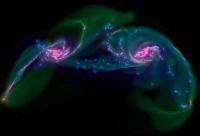
‘High-resolution’ numerical simulations carried out by scientists at the Astrophysics Department of the CEA-Irfu/AIM have just revealed that the most famous galactic collision ever, the Antennae collision, produces far more stars than observations suggested. When two galaxies meet, the resulting gas compression causes the ignition of new stars. Until now, it seemed that these new stars appeared only in high-density regions, mainly near the core of the collision. A computer re-creation of the collision, with a sufficiently high resolution to pick out the smallest gas clouds for the first time, shows that the starburst is in fact distributed far more uniformly inside the large number of star superclusters scattered across the disks of the galaxies. This important result helps scientists to understand why, in certain collisions, around 100 to 1000 stars per year can appear at the same time. This work was published in Astrophysical Journal Letters.
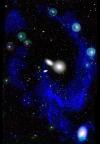
An international team led by astrophysicists from the Lyon Observatory (CRAL, CNRS/INSU, Université Lyon 1) and the AIM laboratory (CEA-Irfu, CNRS, Université Paris 7) has just shed some light on the origins of the giant gas ring in Leo. The astrophysicists were able to detect an optical counterpart to this cloud, which corresponds to stars in formation, using the Canada-France-Hawaii telescope (INSU-CNRS, CNRC, U. Hawaii). The scientists then carried out numerical simulations on the supercomputers at the CEA and suggested a scenario for the formation of this ring. This involved a violent collision between two galaxies. The researchers were able to identify the galaxies involved in the collision and estimate the date of impact. This discovery supports the assertion that the gas in the ring is not primordial, but of galactic origin. This work was published in Astrophysical Journal Letters.
An international team of astronomers led by Dr. Masato Onodera at the Astrophysical Department of the Commissariat a l'Energie Atomique in France [1] has used the Subaru Telescope [2] to take an infrared spectra of a very distant, extremely bright, massive elliptical galaxy. This galaxy is 10 billion light-years from Earth and is observed at time when the Universe was only about one-quarter of its current age. Paradoxically, and in contrast with some previous studies, this galaxy appears to be a similar to its cousins in the local Universe. This research deepens the puzzle as to how some elliptical galaxies seem to be "fully grown" early in the evolution of the Universe while other, very compact ones, can increase in volume a hundred times over the age of the Universe. The results are published in the The Astrophysical Journal of 20 Mai 2010
Do the massive elliptical galaxies change sizes ?
The most massive galaxies in the nearby Universe are giant ellipticals. They have a regular, oval shapes and do not have disks like spiral galaxies such as our own Milky Way.
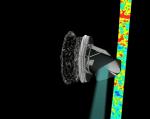
Following its launch on 14 May 2009, the Planck satellite [1] has been continually observing the celestial vault and has mapped the entire sky since 13 August to obtain the first very high resolution image of the dawn of the universe. The Planck satellite has just finished its first sky coverage. The preliminary images reveal undreamed of details of emissions of gas and dust in our own galaxy. Scientists from CEA-IRFU, as part of a broad international collaboration, are currently working on the extraction and exploitation of the catalogues of objects detected by Planck. These preliminary catalogues are essential to understanding and subtracting stray foreground emissions from the background light of the universe, a fossil trace of its earliest epochs. It is also improving understanding of the formation of the largest structures in the universe, clusters of galaxies. The first catalogue will be published in January 2011. In contrast, the definitive scientific publications on the first light of the universe are not expected until the end of 2012.
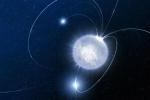
Magnetars form a class of neutron stars with a much higher (100-1000 times) magnetic field with respect to common rotation powered pulsars. This extreme magnetic field is currently believed to be the cause of their unpredictable and intense activity. But the observation by an international team, which includes a researcher from AIM/Service d’Astrophysique of CEA-Irfu, of the magnetar dubbed SGR 0418+5729 casts some doubts about this classification. By observing the rotation period of this object for more than one year, scientists have derived that the intensity of the surface magnetic field of this magnetar was much more fainter than that of other objects of this class, and similar to the one of ordinary pulsars. The magnetar-like activity could then be a phase in the life of some pulsars, and magnetars could be potentially much more numerous within our Galaxy. This study has been published in Science Express Magazine on the 14th of October 2010.
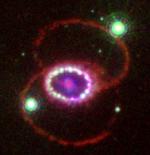
An international team of astronomers/astrophysicists that includes a member of the Service d'Astrophysique (CEA-Irfu, Saclay) has obtained new data of the spectacular surroundings of the famous supernova SN 1987A using the recently refurbished Hubble Space Telescope. New spectroscopic data, long awaited since the failure of the STIS instrument in 2004, allow pursuing the study of the inner equatorial ring, of its hot spots, and of the shocks induced by the explosion. The scientists observe, as predicted, a significant brightening of the emissions from the supernova, and report that radiation from the hot spots towards the center of the supernova interacts with neutral hydrogen and gets reflected back out. They also discovered possible ultraviolet emissions from quadrupled-ionized nitrogen ions, very sensitive to the still very poorly known surrounding magnetic fields. These new results, which appear in the September 2 issue of Science Magazine, illustrate the success of the last servicing mission of the Hubble Space Telescope.
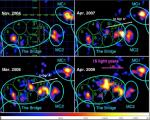
The central black hole of the Galaxy, today surprisingly quiet, has undergone, several hundred years ago, a violent phase of activity. This is the conclusion reached by an international team led by astrophysicists of the APC laboratory and including scientists of the Service d'Astrophysique of CEA-Irfu, by studying the high energy emission of molecular clouds located in the central regions of the Galaxy. The scientists have indeed discovered complex variations of this emission, with some of them showing propagation velocity greater than the speed of light. They reveal that a giant outburst, most probably generated by the black hole, took place about 400 years ago. The powerful flare is visible today after reflection by the molecular clouds that play the role of celestial mirrors. The recent history of the region retraced in this way shows that the black hole of the galactic centre is not so different from the supermassive black holes of the active galactic nuclei. This work, based on two long term observing programs of the XMM-Newton and Integral satellites, is the object of two complementary publications in The Astrophysical Journal.
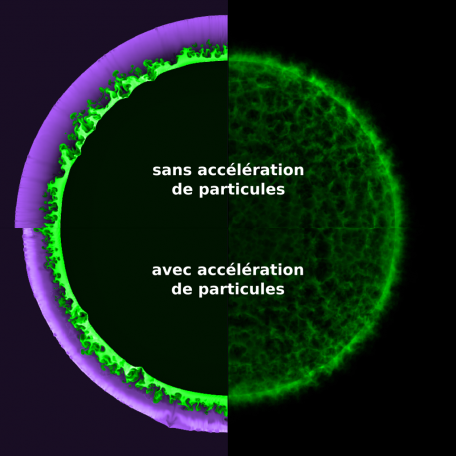
For the first time, the events following the explosion of a star have now been simulated in three dimensions by a team from the Astrophysics Division of CEA-IRFU. The simulation includes the significant contribution of particles accelerated by the shock that is produced in the expansion. Until now, these complex simulations have concentrated either on calculating movement of the expanding ejected material, or on calculating particle acceleration. The evolution of the structure resulting from the explosion of the star, which has survived for over 500 years, shows that the accelerated particles appreciably diminish the size of the shock zone. The results can be compared to X-ray observations carried out in 2005 at the position of the stellar explosion observed in 1572 by the Danish astronomer Tycho Brahe. These simulations come from the COAST computer program and they improve our understanding of the complex acceleration mechanisms of "cosmic rays", particles which flood across the Galaxy at velocities approaching the speed of light.
 See the animation of the expansion following explosion of a star
- see the animation of the expansion (Web version)
- see the animation of the expansion (mov)
- see the animation of the expansion (high def version/ mov)
For more détails on the method and results, see : Les restes de supernovae accélérateurs de particules (in french)
An international team of astronomers, including several French researchers, has just completed a precise measurement of the distance to five distant galaxies using the ESA Herschel Space Observatory together with ground-based data from the interferometer operated by the Institute for Millimetric Radioastronomy (IRAM)1 . The research team has shown that the light from these galaxies has travelled for around ten thousand million years before reaching Earth. In order to obtain these results, the team developed an entirely new technique, making use of the 'gravitational lens' effect for the first time in the sub-millimetric domain2 . Such a gravitational lens provides a form of magnifying glass on a cosmic scale that can be detected by Herschel. Until now very difficult to observe, these distant and rapidly evolving galaxies are a key component in improving our understanding of the history of the galaxies in our Universe. These results were published in the journal Science on November 5, 2010.
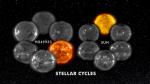
An international team[1] led by a CEA astrophysicist of the AIM Laboratory- Astrophysics Department of the CEA-Irfu has observed, for the first time, the cycle of magnetic activity in a star using stellar seismology - the study of vibrations in a star. The observations of HD49933 by the CoRoT[2] satellite revealed an cycle of magnetic activity identical to that seen in the Sun, but much shorter. This result paves the way for many stars to be examined using the techniques of asteroseismology, for a better understanding of the mechanisms responsible for activity cycles, including the Sun’s. The results were published in the journal Science on 27th August 2010.
An international team led by astrophysicists from the Lyon Observatory (CRAL, CNRS/INSU, Université Lyon 1) and the AIM laboratory (CEA-Irfu, CNRS, Université Paris 7) has just shed some light on the origins of the giant gas ring in Leo. The astrophysicists were able to detect an optical counterpart to this cloud, which corresponds to stars in formation, using the Canada-France-Hawaii telescope (INSU-CNRS, CNRC, U. Hawaii). The scientists then carried out numerical simulations on the supercomputers at the CEA and suggested a scenario for the formation of this ring. This involved a violent collision between two galaxies. The researchers were able to identify the galaxies involved in the collision and estimate the date of impact. This discovery supports the assertion that the gas in the ring is not primordial, but of galactic origin. This work was published in Astrophysical Journal Letters.
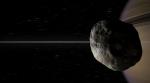
Numerical simulations peformed by a group of astrophysicists of the AIM-CEA Saclay Laboratory (University Paris Diderot, CEA, CNRS) and the Nice observatory, based on images collected by the Cassini mission, show that some tiny moons of Saturn are still forming now from material of the Saturn's rings, some billion years after the end of the formation of planets and satellites inside the Solar system. The simulations can also give some clues about the formation of the Earth's moon. These results are published in the June 10th issue of the Nature magazine.
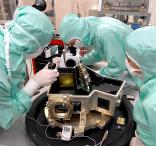
The Astrophysics Department of CEA-Irfu, which has scientific and technical responsibility for the MIRIM imager (Mid Infrared Imager) on the MIRI spectro-imager, one of the major instruments of the forthcoming James Webb Space Telescope (JWST), has just delivered the final model of the imager to the Appleton Rutherford laboratory in England, who will carry out the final test before the delivering it for integration into the JWST at the start of 2011 [1]. The JWST, a joint mission of the American (NASA), Canadian (CSA) and European (ESA) space agencies, is a satellite weighing more than 6 tonnes and containing a 6.5 m diameter telescope whose launch, on an Ariane 5 rocket, is planned for mid-2014.
The MIRIM camera is a key instrument for achieving the main objective of the JWST which is to explore the universe as it was 13 billion years ago, at the moment when the first luminous objects were formed. MIRIM should be able to make major new discoveries in understanding the formation of stars and galaxies, as well as contributing to the search for remote planets thanks to a very innovative device, the phase mask coronagraph, which allows the light from a star to be "extinguished" in order that any potential planet close to the star can be seen more easily.
View the animation showing the "extinguishing" of a star in the coronagraph

