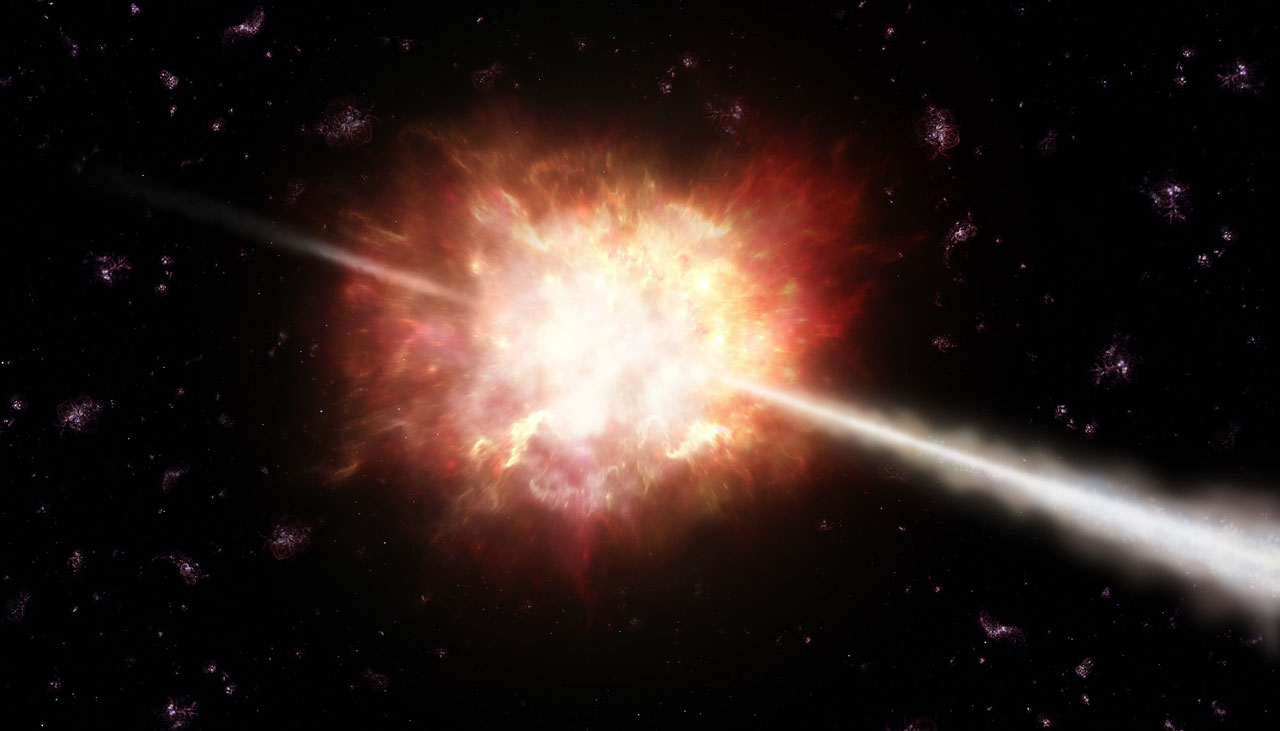
A gamma ray burst go along with a matter release in the form of two opposite cones. (credit ESO)
At high energies, the violent phenomena of the Universe are linked to the production of radiation and particles such as X-rays, gamma rays, subatomic particles of all types (charged particles, neutrinos, etc.) and to the extreme th gravitational radiation.
The aim of studying this radiation is to understand what mechanisms are capable of producing the acceleration of galactic and extragalactic particles within compact objects and their environment. Researchers are studying black holes (black holes in the centre of the Milky Way, in galactic binary systems or in active galaxies), supernova remnants, pulsars or gamma-ray bursts.
Concerning research on the existence and nature of dark matter particles, experiments can be carried out in the laboratory, directly for the search for WIMPs (dark matter called cold) or axions (dark matter called hot), but also indirectly by tracking gamma rays that would be produced during annihilation processes in dense regions. Axions can also be produced in the Sun or during the propagation of gamma rays.
With the help of space missions, telescopes on the ground, or detectors hidden under the rock sheltered from cosmic rays, Irfu teams develop instruments, exploit them and analyze data to discover the enigma of violent phenomena in the Universe and the mystery of dark matter.
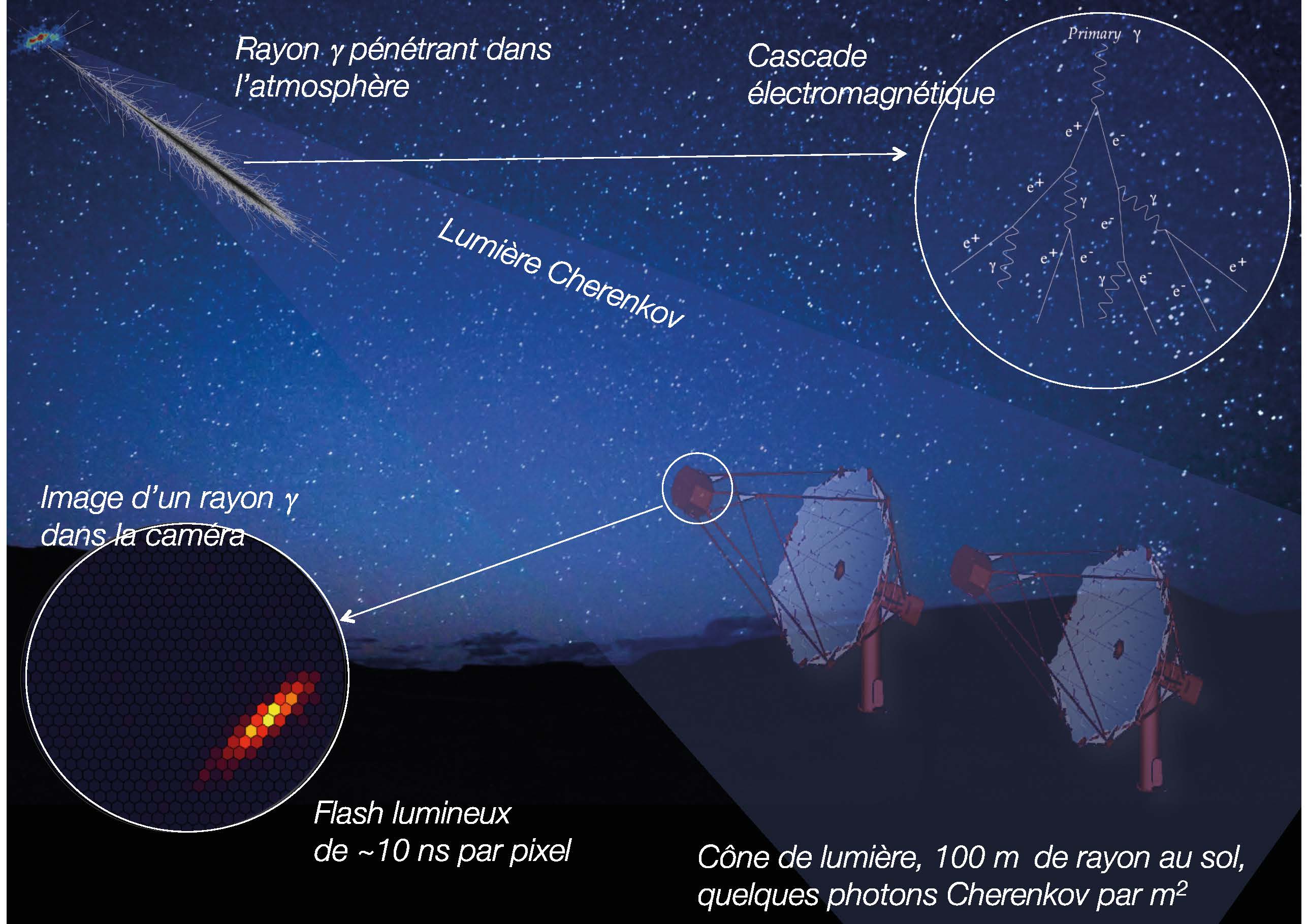
The H.E.S.S. Telescope Network indirectly detects gamma rays produced during the acceleration and/or propagation of cosmic rays within or near sources of galactic cosmic radiation. Very high energy gamma rays interact in the Earth's atmosphere creating a sheaf of particles.