CEA > iRFU >   

Service d'astrophysique
Laboratoire AIM

 
drapeau drapeau
« Experiments


SNLS : SuperNova Legacy Survey

News/Highlights

Gallery

SNLS : SuperNova Legacy Survey 

SNLS: Discovery of a supernova whith MEGACAM. On the photo on the left, one sees the supernova on top left of the central galaxy.

 Objectives:

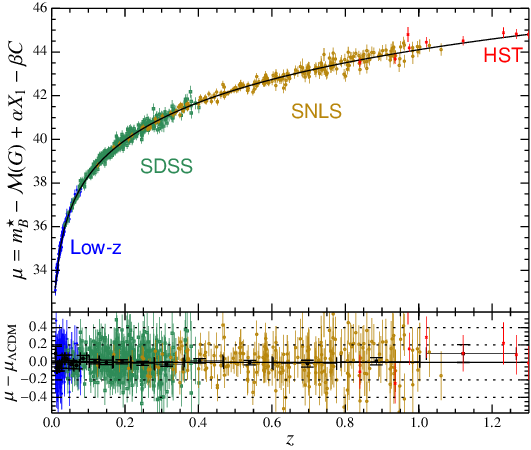
The objective of SNLS is to find and study high-redshift supernovae for cosmological applications. It follows in the steps of the original studies that made the surprising discovery of a non-vanishing cosmological constant or, equivalently, a vacuum energy. SNLS strives to refine these original results by measuring the cosmological parameter w, the ratio between the cosmological pressure and energy density, thereby studying the possible time variation of the vacuum energy. Measurements of supernovae at high redshift (of order 1) are complementary to measurments of the Cosmic Microwave Background that correspond to redshifts of order 1000. The two give independent, nearly orthogonal, constraints on the cosmological matter and vacuum densities. Combining the two types of measurements gives a precise determination of the densities.

Collaboration:

Dapnia/SPP, LPNHE-Jussieu (Univ Paris6-Paris7), LAM-Marseilles, University of Toronto, University of Victoria


Observational means:

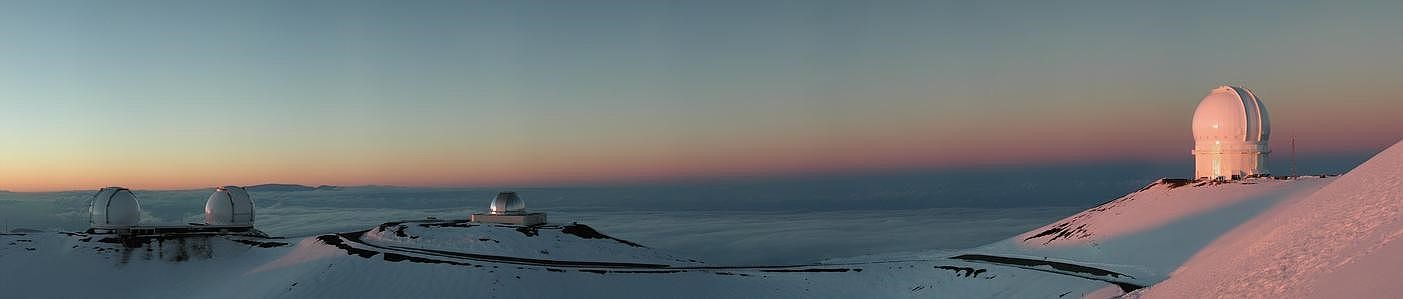
Search for supernovae in deep images (exposure time near one hour) taken with the CFHT (Hawaii) in four fields of 1 deg2. The exposures are taken each month within 10 days of the new Moon.

The redshifts are determined from spectra taken with 8-meter class telescopes (exposure times of order 1 hour).

Technical details:

Photometry: Megacam is set up at CFHT. When first installed, Megacam was the largest CCD camera in the world (40 CCD, 2kx4k= 300 million pixels).

Spectroscopy: done usito 3 8-meter class telescopes: VLT (Chili), Gemini (Chili and Hawaii), Keck (Hawaii) 

Specificic points:

SNLS is presently the most productive high-redshift supernova program.


Contribution  of the  Dapnia:

Construction of the Megacam camera and data analysis at the SPP.


Life of the experiment:

Milestones:

  • May 2003, installation of Megacam, first photos;
  • First supernovae observed in June 2003.
  • October 2005, publication of first year results with constraints on cosmological parameters;
  • data taking to continue through 2008;
  • Status October 2007: taking data

 Perspectives:

  • Continue to take data through 2008;
  • Refine measurements of cosmological parameters with several hundred supernovae.

Scientific production:

The first-year data yielded in 2005 a measurement of w to within 10% of the value expected for a cosmological constant. The paper was the third most cited astrophysical paper for that year.

Contact:

Nathalie PALANQUE-DELABROUILLE


last update : 03-17 00:00:00-2010 (2289)