By research themesBy division(s)By experiments
![]() |
15-12-2008
In collaboration with IRFU teams, CMS teams are currently making preparations for the first LHC data acquisition campaign.
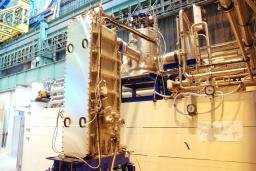
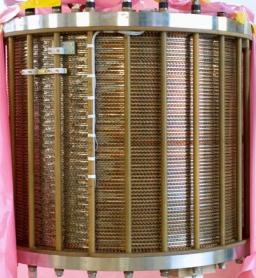
On November 14, 2008, the Compact Muon Solenoid (CMS) successfully generated a nominal magnetic field of 4 tesla. This success rewards IRFU efforts for the design and construction of what constitutes the largest superconducting solenoid magnet in the world. Over a period of approximately one month, ... More » |
![]() |
10-12-2008
The high energy part of the SPIRAL2 linear accelerator (new GANIL1 accelerator scheduled for implementation in 2012) uses two types of superconducting cavities. IRFU's Accelerator, Cryogenics and Magnetism Department is responsible for the design and development of ... More » |
![]() |
20-11-2008
Jean-Luc Starck, an experienced research scientist at IRFU (the CEA Institute for Research on the Fundamental Laws of the Universe) was awarded a 2.2 million euro grant spread over five years under the 7th European research and development framework programme (FP7). The grant comes in recognition ... More » |
![]() |
15-11-2008
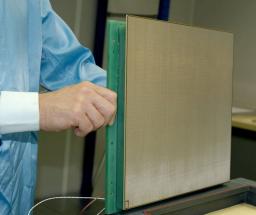
The Micromesh Gaseous Structure (Micromegas) detectors designed and developed by IRFU researchers have been used increasingly over the past few years in the field of particle and radiation detection for physics research, and show strong potential for nuclear, biomedical and industrial ... More » |
![]() |
12-11-2008
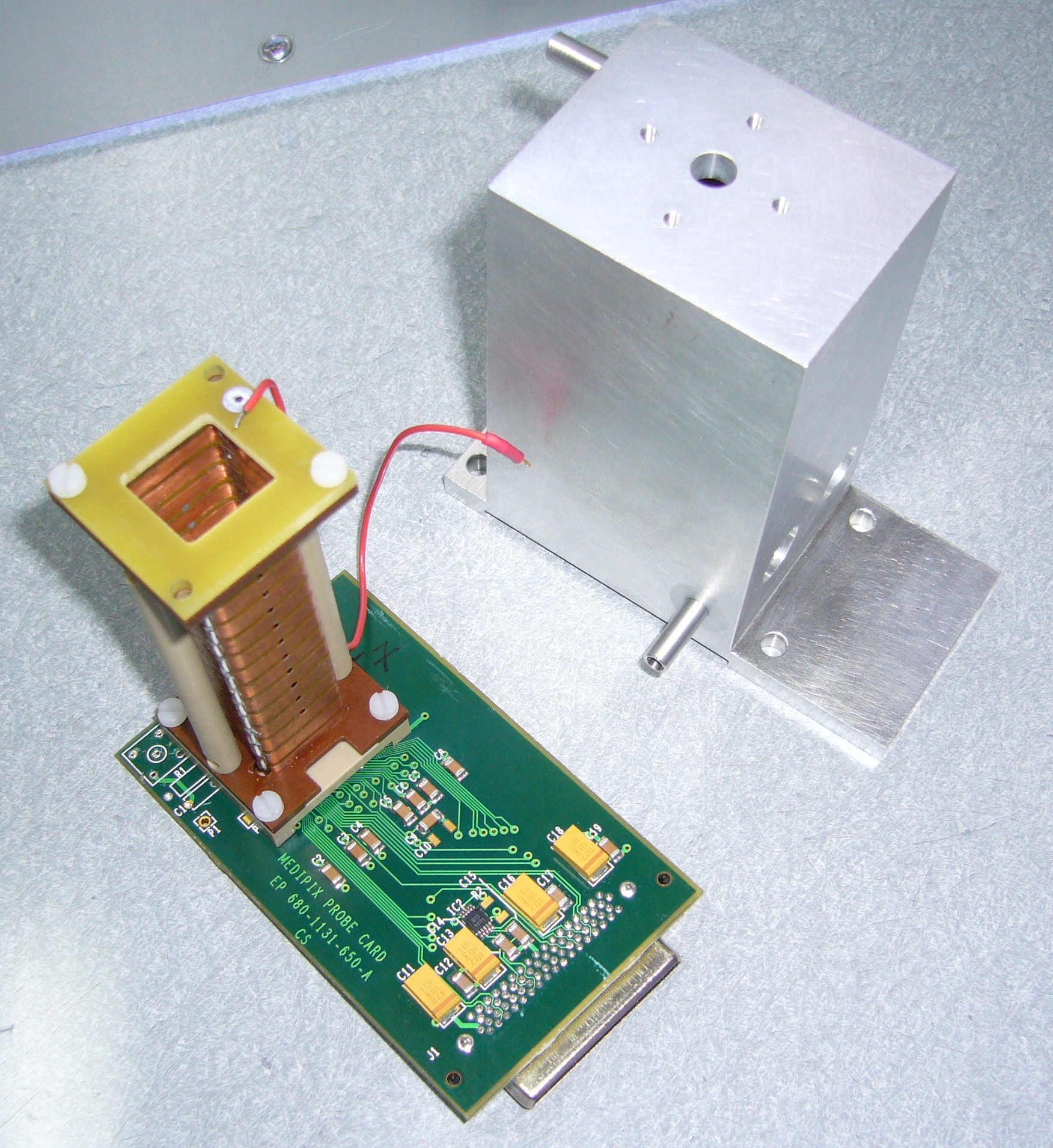
A prototype of a novel charged particle detector has just been put to successful use by an IRFU-CERN-NIKHEF team working as part of the European EUDET project. 3D digital images of charged particle tracks have been obtained using the TimePix chip in conjunction with a Micromegas detector. ... More » |
![]() |
03-11-2008
The 11.75 tonne whole body Iseult magnet to be installed in the Neurospin centre in 2012 will push back the boundaries of cerebral imaging. A key step in the success of this Franco-German project is the development of the SEHT test station in which a nominal field strength of 8 teslas was ... More » |
![]() |
03-11-2008
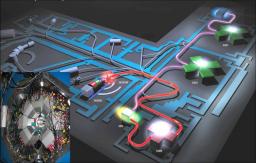
Shortly after the LHC started up on the 10th September 2008 at 9:30 am, the detectors recorded the first events resulting from proton collisions in the beam detectors. The data processing scheme that had been planned for such a long time immediately came into action with the distribution of data ... More » |
![]() |
03-11-2008
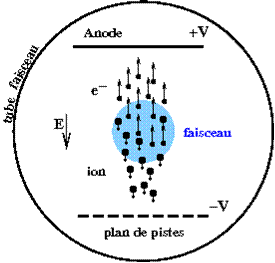
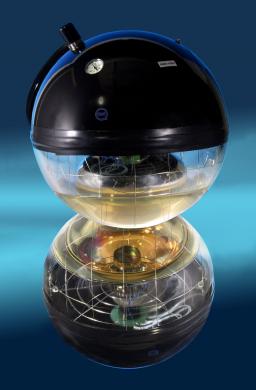
This large gas detector is based on a simple, strong and low-cost spherical geometry. The detector combines a large drift volume and proportional amplification in order to detect ionising particles. A metal ball at the centre of the sphere is held at a high voltage causing an ... More » |
![]() |
24-10-2008
Part of the IFMIF-EVEDA1) project consists of the construction of a prototype deuton2) accelerator at Rokkasho-Mura in Japan. The accelerator is due to enter service in 2013. The purpose of the EVEDA phase is to validate the IFMIF project which aims to investigate the strength of materials ... More » |
![]() |
28-08-2008
The ground state of bottomonium.
η b is the name of the particle recently discovered by the physicists working on the BaBar experiment.This ground state of ‘bottomonium’, a collection of particles formed from a bottom quark and an anti-bottom quark, has been sought for over thirty years. It has now been ... More » |
![]() |
04-08-2008
Scientists from the CDF and DZero collaborations at the U.S. Department of Energy's Fermilab have combined Tevatron data from the two experiments to advance the quest for the long-sought Higgs boson. They have presented their results on August 3rd at the International Conference on High Energy ... More » |
![]() |
18-06-2008
The shape of an atomic nucleus reflects the shell structure of the protons and neutrons of which it is formed. If the shells are completely filled, we speak of a "magic" nucleus, which is spherical in shape. Most nuclei, however, tend to be deformed because their shells are only ... More » |
![]() |
09-06-2008
Searching cosmic neutrinos
The last two lines of the ANTARES detector were connected and powered at a depth of 2500 m on the Mediterranean seabed during the night of May 30, 2008. This brings the number of lines to twelve and completes the construction phase of the largest underwater neutrino telescope ever built. The lines ... More » |
![]() |
18-04-2008
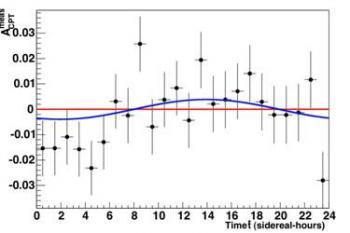
Lorentz symmetry probed in the BaBar experiment
The BaBar experiment running on the PEP-II accelerator at SLAC (California) has been collecting data for ten years and has recorded sufficient events to probe the most subtle aspects of the Standard Model of particle physics and quantum field theory. By analysing the behaviour over time of the ... More » |
![]() |
23-01-2008
A new look at early star births (23 January 2008)
An international team of astronomers lead by scientists of the Astrophysics Division of CEA-IRFU has discovered large molecular gas reservoirs - the combustible for forming new stars - hosted in ordinary massive galaxies in the young, distant Universe. The discovery has been made with the IRAM ... More » |