


Logo of the experiment.
Goal
The main goal of the experiment was to perform a complete study of CP violation (CP is the symmetry linking particules and antiparticules) in the system of B mesons.
More generally the experiment studied the physics of heavy flavors: mesons and baryons with a b or a c quark and tau leptons.
Context
The ARGUS experiment at Hambourg and the CLEO experiment at Cornell in the eighties and nineties were the first "B factories" built to study the physics of B mesons. BABAR and the BELLE experiment at KEK in Japan during the 2000's were "B factories" from the second generation. They were able to study CP violation.
Themes/programms
The energy content of the Universe/Antimatter and CP violation.
Localisation
The experiment was located at Stanford Linear Accelerator Center (SLAC) at Stanford University in the United States, using the PEP-II electron-positron collider.
Initiated in November 1993, the experiment took daata between May 1999 and April 2008.
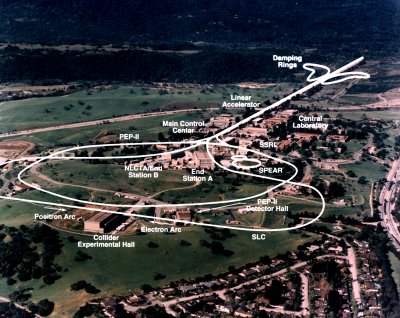
Site of the experiment.
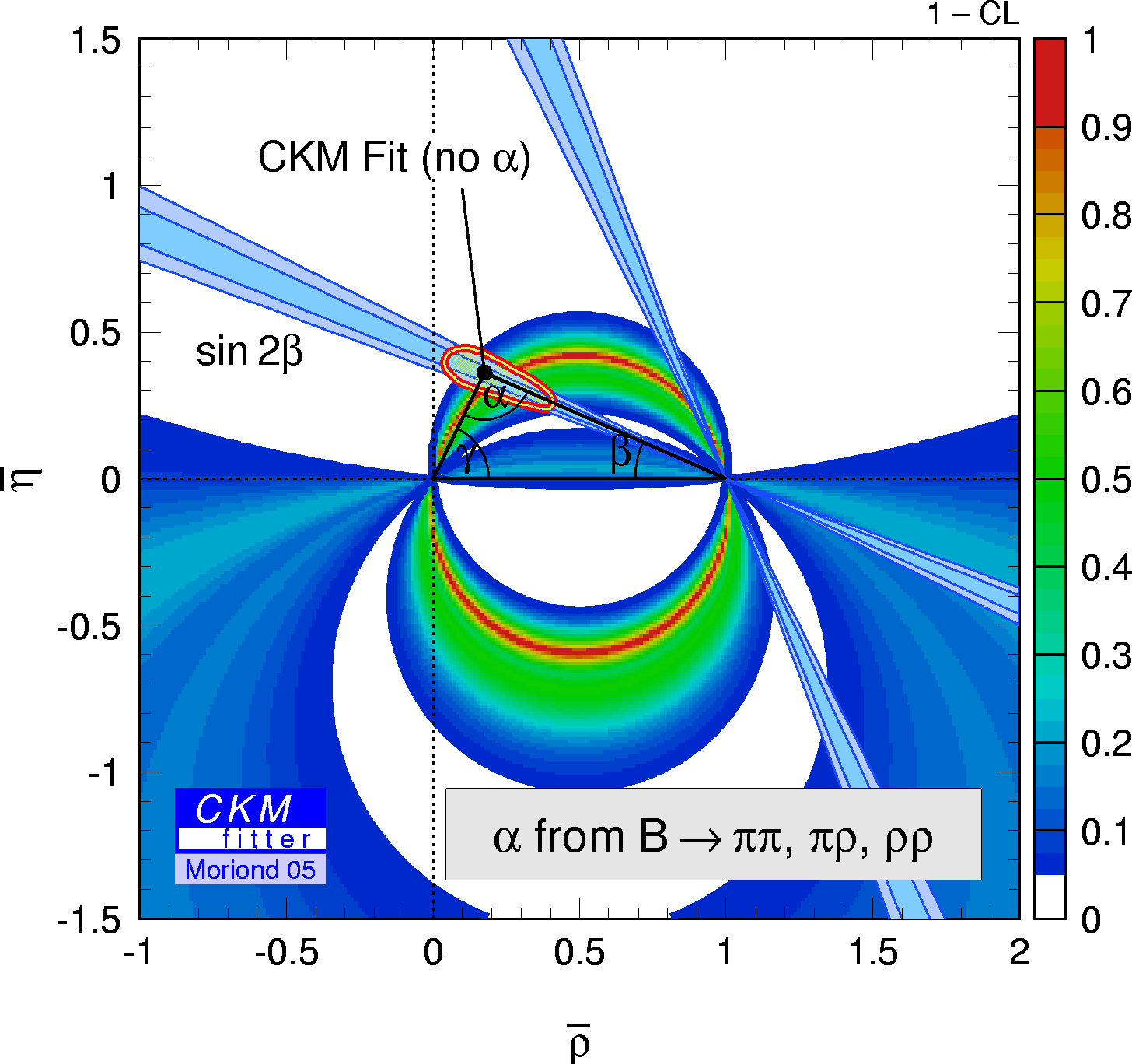
Mesurement of the alpha angle of the unitarity triangle.
Contribution from Irfu (ex-Dapnia)
The contributions
Dapnia played a major role in the construction and running of the DIRC detector (1995-1998). The DIRC was the main detector for particle identification in BABAR. This novel device prooved to be robust and performant.
In particular, Dapnia was responsible for:
- the mechanical structure of the Cerenkov light detector;
- the 11000 photomultiplicator tubes;
- the magnetic shielding;
- the calibration system;
- the reconstruction code;
- the alignement procedure.
Dapnia also played a very active role in data analysis:
- measure of the alpha angle of the unitarity triangle (with the B decays to rho pi and rho rho);
- measure of sin(2beta+gamma) (B→D* pi mode);
- study of the B→K* rho modes;
- study of the eta_c meson, measure of the beta angle;
- measure of the Vub parameter;
- study of CP, T, and CPT violation in dilepton events.
Scientific responsabilities
Physicists from Dapnia have had important positions in the collaboration:
- physics analysis coordinator (2000-2001) ;
- chair of the speakers bureau (1997-1998) ;
- conveners of several physics analysis groups (dileptons, inclusive hadronic B meson decays, time dependent analyses of B meson decays to charm);
- co-system manager of the DIRC detector (1995-1998 and 2003-2007)
- data quality manager (2001-2002);
- member of the executive board (2006-2009);
- president of the membership committee (2010-2014).
Scope of the experiment
The BABAR experiment has been one of the major experiment in High Energy Physics from 1999 to 2008. Dapnia and SPP have been heavily involved with a maximum of 14 physicists at the same time.

