


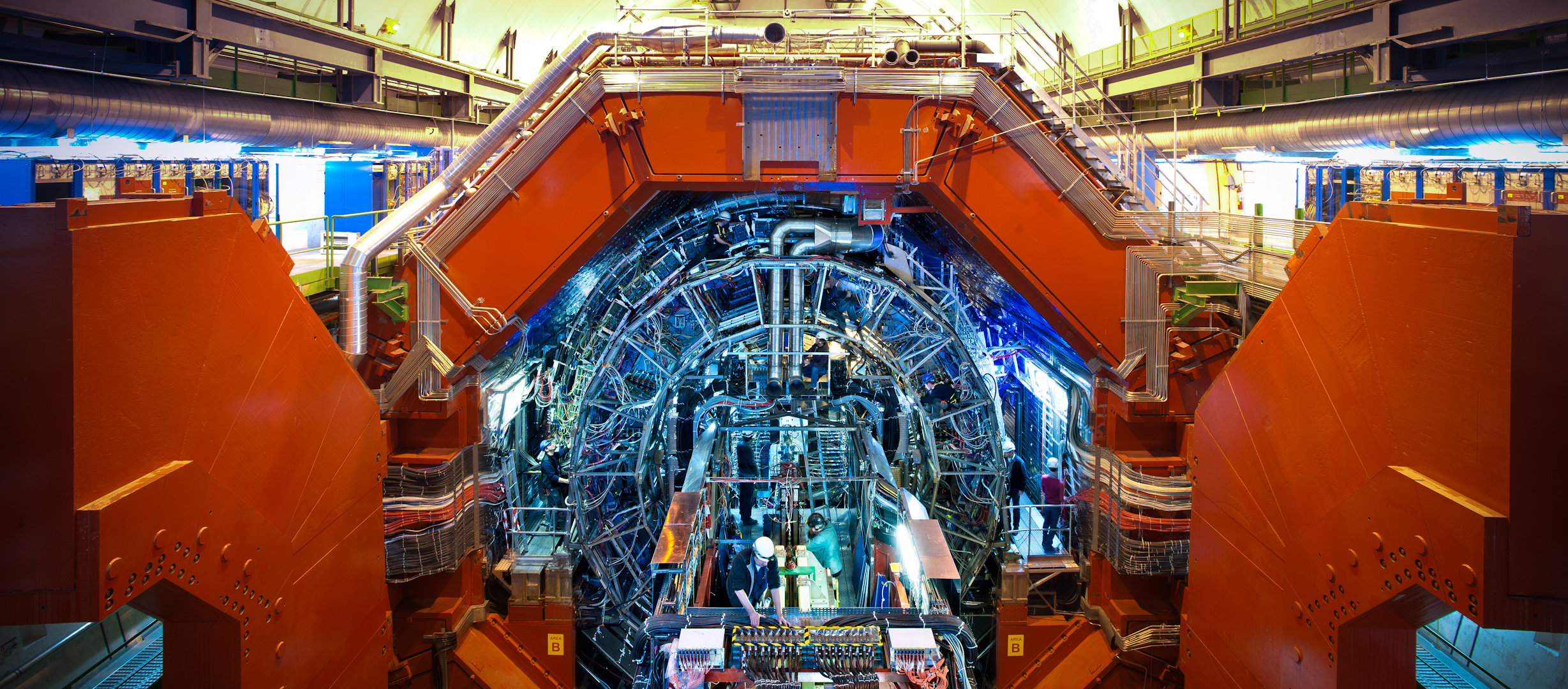
View of ALICE with the L3 magnet open.
Photo by A. Saba © 2012 CERN
The ALICE experiment is devoted to the study of nuclear matter under extreme conditions of temperature and density. It is specially designed to test the fundamental theory of the strong interaction, Quantum Chromodynamics (QCD), which predicts the existence of this new state of matter, the quark-gluon plasma (QGP).
Objectives
There are still some open question concerning the formation of our Universe. The ordinary matte of our Universe is composed of atoms formed by a nucleus, itself made of protons and neutrons, surrounded by a cloud of electrons. Protons and neutrons are themselves composed of quarks, which are to our current knowledge the elementary constituents of matter. Just after the Big Bang, during the first micro seconds of the creation of the Universe, its temperature was higher than 2000 billion degrees (about 100 000 times hotter than the centre of the Sun), the Universe was in a state of deconfined quarks and gluons: the quark-gluon plasma (QGP).
Why and how did hadrons (compounds of elementary particles) form? What are the properties of the QGP? Can we reproduce the early Universe? Those are questions ALICE tries to answer.
Ultra-relativistic heavy-ion collisions at the LHC
To recreate the conditions for the formation of the QGP, heavy ions are accelerated by the LHC at CERN near Geneva close to the speed of Light before making them to collide. ALICE is one of the four big experiments of the LHC placed at one of the crossing points of the LHC beams. ALICE was designed to reconstruct the thousands of particles created by the collision with to study the QGP created therein.
The ALICE detector
ALICE counts more than a thousand physicists and engineers, from 132 institutes in 36 different counties. ALICE is composed of 18 sub-detectors extending over a length of about 26 m and a height of 16 m, weighting over 10 000 tonnes. They are regrouped in a central part and a forward one called the muon spectrometer.
IRFU contributions
Among the different observables of the QGP, heavy resonances or quarkonia are particularly interesting. Quarkonia are rare and heavy particles composed of a pair quark and anti-quark, charm or beauty for the J/psi and Upsilon family, respectively. Quarkonia are produced at the early stage of the collision, even before the creation of the QGP, and thus experience the full evolution of the QGP that they have traversed. IRFU is particularly interested in the study of the production of quarkonia, which can be measured by its decay into a µ+µ- pair reconstructed by the ALICE muons spectrometer.
The muon spectrometer
The IRFU is thus involved in the realization of the ALICE muon spectrometer. The IRFU contributed to the design and the realization of the 5 tracking stations.
The IRFU was in charge of:
- the construction of 39 slats of detection (out of 160),
- the support pannels,
- the systems of translation of the 3 large stations and the handling and integration equipments in the cavern,
- the integration of the 3 big stations (3, 4 and 5),
- the study of the air cooling system.
Upgrade of the muon spectrometer
The make the most of the luminosity upgrade of the LHC foreseen for 2018 the electronics and read-out system of the muon spectrometer must be upgraded.

One of the muon tracking chambers.
Photo by A. Saba © 2007 CERN
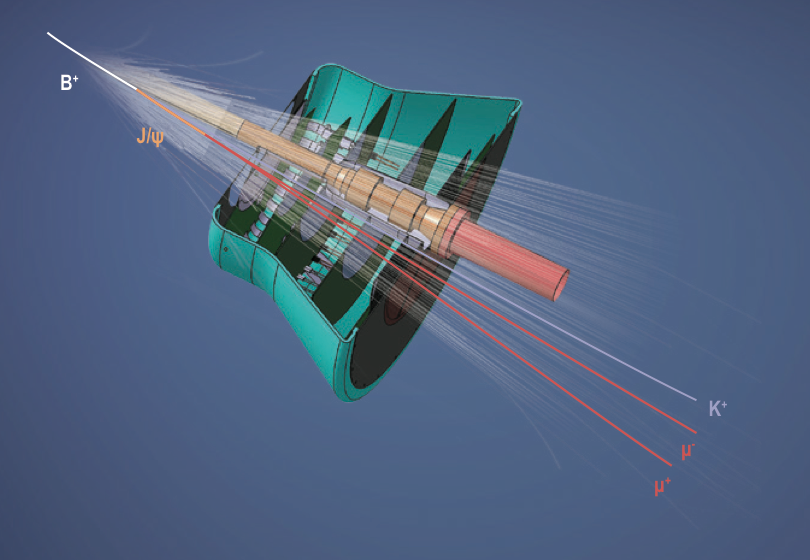
Schematic view of the MFT.
The Muon Forward Tracker (MFT)
To extend the physics program of the ALICE muon spectrometer a silicon pixel tracker will be placed between the crossing point of the LHC beams and the muon spectrometer.
Timeline
- 2003-2005: production of 39 slats
- July 2006: first half-chamber installed in the cavern
- June 2008: cavern closes
- August 2008: first particles in the ALICE V0 detector
- November 2009: first p-p collisions at 900 GeV
- March 2010: first p-p collisions at 7 TeV
- November 2010: first Pb-Pb collisions at 2.76 TeV
- March 2013: p-Pb collisions at 5.02 TeV
- April 2013: beginning of the first long shutdown of the LHC (LS1)
- 2013-2015: repairs of different components of the muon spectrometer
- Early 2015: Restart of the LHC (Run2)
- 2018: LS2
- Upgrade of the muon spectrometer
- Installation of the MFT
- ...
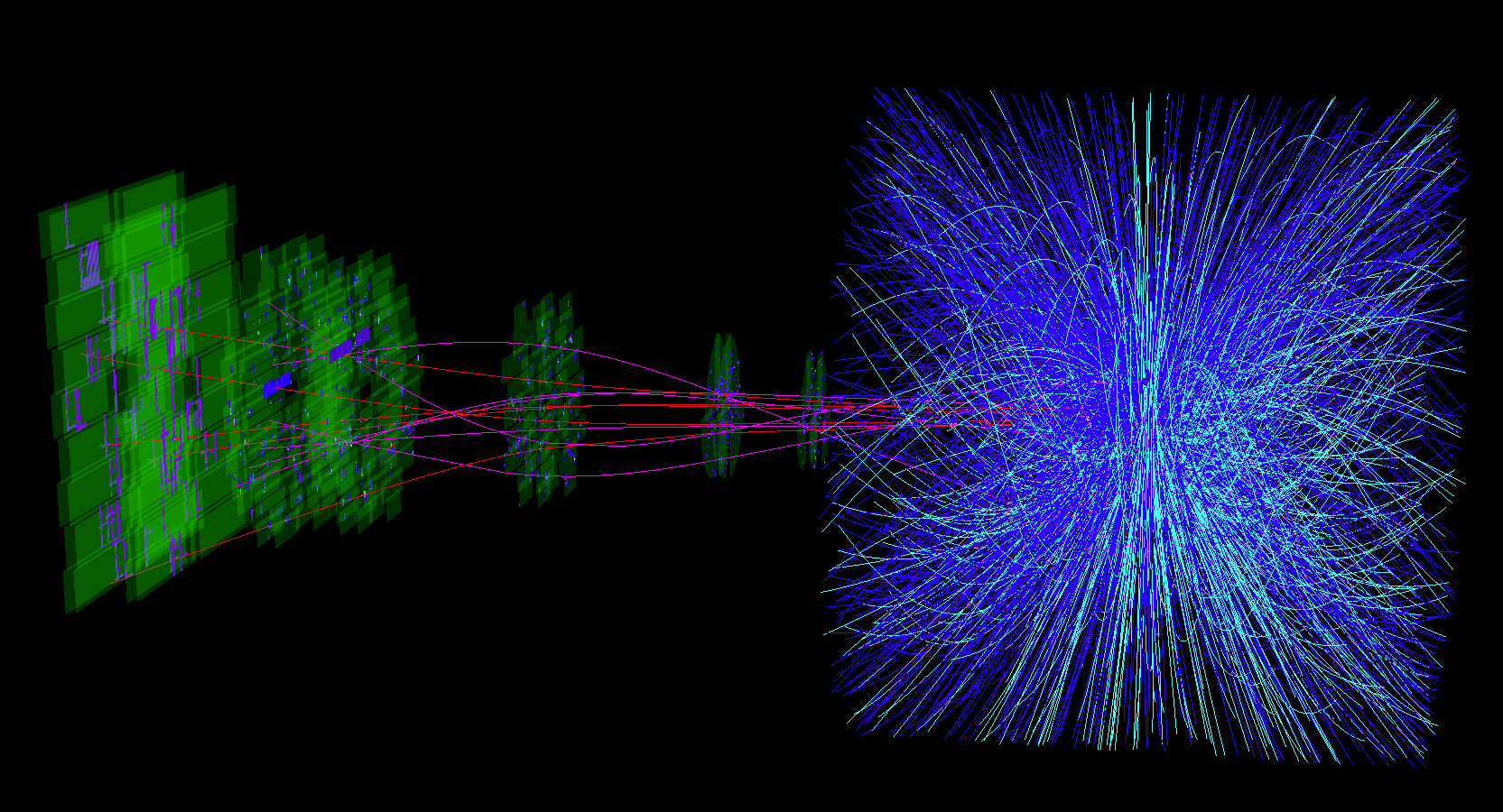
Event display of a Pb-Pb collision.
Contacts
Alberto BALDISSERI: Coordinator of the ALICE muon spectrometer
Hervé BOREL: Coordinator of the muon spectrometer upgrade
Fabienne ORSINI: Technical coordinator of the MFT

