
More than 280 members of the French physics community gathered at Jussieu on 20 and 21 January 2025 to complete and validate the French community’s contribution to the update of the European particle physics strategy. IRFU and IN2P3 opted for a joint approach, reflecting the strong links between the two institutes, which are essential to a coherent and solid strategy for France.
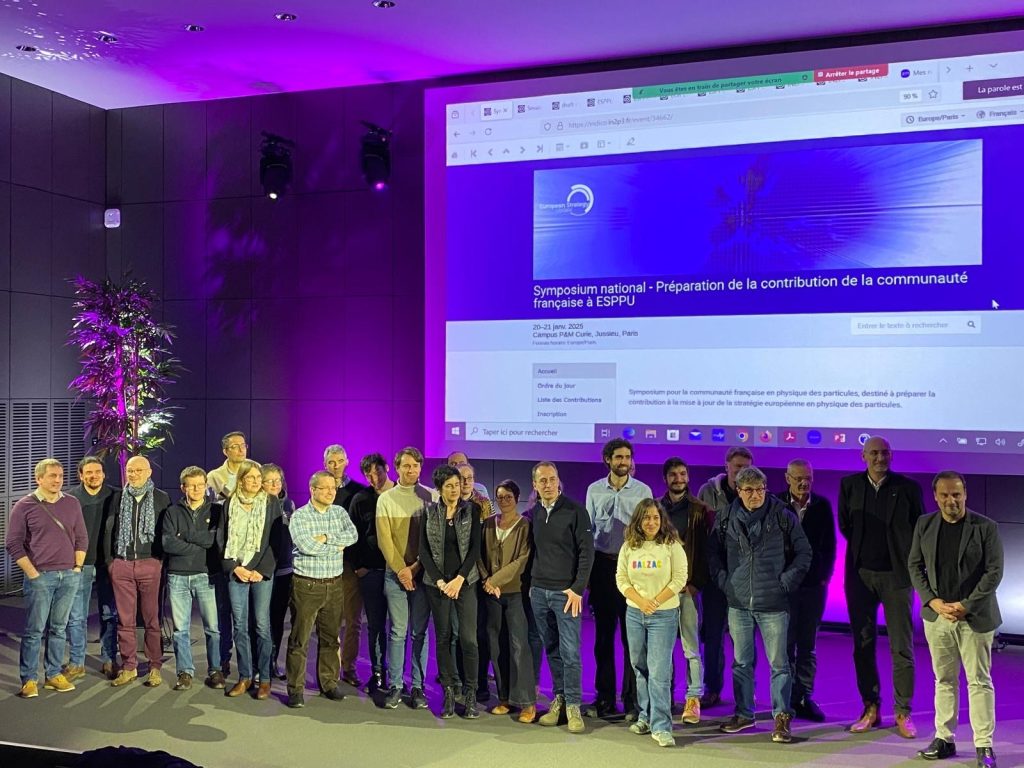
The five working groups have been hard at work, collecting contributions (62 documents have been submitted to the https://esppu.in2p3.fr portal, covering a wide range of topics: accelerator physics, new physics beyond SM, theory and phenomenology, R&D detectors, Higgs, electroweak physics, QCD, flavours, computing and data, non-accelerator physics, new experiments, accelerator R&D, sustainability, other societal issues, etc.), , organising discussions and workshops both within the laboratories and at national level, so that the symposium could provide a feedback of the community’s opinion and a basis for discussion. The community rallied round to prepare a dense and relevant symposium in a short space of time, in the presence of the institute directors.
The program for the session on 01/20/2025 (See https://indico.in2p3.fr/event/34662/timetable/#20250120.detailed) began with a presentation by the institute directors, then each of the thematic groups 1 to 4 (Standard Model and Beyond, Flavour Physics and Tests of Fundamental Interactions, Neutrinos, QCD and Heavy Ion Collisions) presented a summary of their work, then led a discussion with the audience before giving a brief report, the aim being to provide a summary that was truly representative of the community’s opinion. During their preparatory work, the working groups identified cross-cutting aspects (Theory, Instrumentation and R&D, Computing and data, Particle physics outside colliders and at interfaces, Careers of young scientists and training, Sustainability) which were the subject of specific lively discussions during the session on 01/21/2025. The transverse working group on the study of future colliders then led the discussion on the various scenarios for future colliders. All the pilots met over lunch to propose an initial draft summary, which was presented after lunch before the conclusion by the institute directors. The discussions were calm and rewarding, resulting in an overall summary that was presented for the first time.
The next steps will be for the working group leaders to draw up a summary of no more than 10 pages, for submission to the ESPP, and for the institute directors, by the end of January. The institute heads will then draw up a single IN2P3-IRFU institutional positioning document, which they will submit to the heads of CNRS and CEA, prior to submission on the ESPP portal.
Many thanks to : Fabrice Couderc, Sara Bolognesi, Michael Winn, Maarten Boonekamp, Philippe Schwemling, Louis Portales, Federico Ferri, Emilien Chapon and all the contributors to the lively discussions and documents.