
At the beginning of 2026, IRFU submitted the final version of Book #4, describing the linear accelerator of the ICONE project, to the Ministry of Higher Education and Research (MESR), the Deputy Scientific Directors of CNRS Physics, CNRS Nuclear and Particle Physics, and CNRS Chemistry, as well as the directors of the CEA’s Fundamental Research Division (DRF), its Rayonnement-Matière Institute (IRAMIS), and its Institute for Research on the Fundamental Laws of the Universe (IRFU).
This document marks the culmination of two years of Technical Design Report (TDR), carried out in collaboration with the teams from DACM and DIS, as well as partners from CNRS/LPSC Grenoble and INFN Legnaro. This structuring step consolidates the technical choices, expected performance, and cost and risk management for the future accelerator.
ICONE: A compact neutron source for France
The ICONE project (Compact Neutron Installation) is part of an innovative technology concept: a new generation of neutron sources based on high-intensity proton accelerators, known as HiCANS (High Current Accelerator-driven Neutron Sources).
ICONE thus aims to provide France with a national, accessible neutron source, complementary to research reactors such as the Laue-Langevin Institute (ILL) and major European infrastructures like the European Spallation Source (ESS).
Supported by CEA and CNRS with the backing of the Ministry of Research, ICONE fits into this evolution by providing a national neutronics facility open to scientific and industrial communities wishing to advance their research and development. More compact and flexible, this facility will enable the non-destructive exploration of the intimate structure of materials, a crucial issue for fundamental physics, chemistry, and industries such as energy and new materials.
The ICONE facility
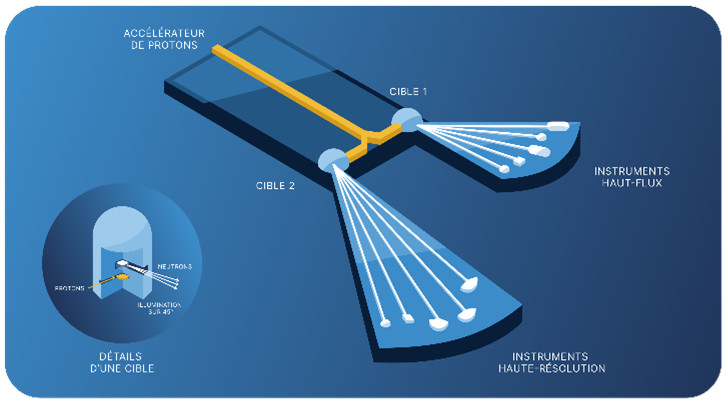
ICONE will provide researchers and engineers with the ability to explore materials using neutron scattering. It will rely on:
- A high-intensity linear proton accelerator with an output energy of 25 MeV (with a possible upgrade to 40 MeV) and a peak current of 80 mA.
- Two neutron production targets: a “High Flux” target and a “High Resolution” target, allowing multiple experiments to be conducted simultaneously in different physics fields.
- A set of 12 instruments exploiting neutron-material interactions, distributed across two experimental halls.
- Two personnel buildings with a technical area and an office area.
The Technical Design Report (TDR)
Submitted at the beginning of the year, the Technical Design Report (TDR) defines the project’s main lines, including the technology used, the targeted scientific applications, and clarifies all technical, financial, and organizational aspects to validate its feasibility and prepare for the construction phase.
The ICONE TDR documents consist of 6 books detailing the technological and managerial choices for the construction of the ICONE research instrument:
- Book 1: The science conducted at ICONE,
- Book 2: ICONE’s neutron instruments,
- Book 3: ICONE’s target-moderator-reflector assemblies,
- Book 4: ICONE’s linear accelerator,
- Book 5: ICONE’s infrastructure,
- Book 6: The management of ICONE’s construction.
The IRFU teams were particularly active on Book 4 (the linear accelerator), but were also involved in Book 3.
The linear accelerator (Linac) designed by IRFU
Building on the experience gained from major international projects (ESS, SPIRAL2, LINAC4), the Irfu teams (DACM and DIS departments) designed a custom machine that meets ICONE’s requirements while optimizing development costs, significantly reducing technological risks, and ensuring the performance necessary for scientific operation.
The accelerator includes the following subsystems:
- Proton source: produces a continuous 80 mA beam at 75 keV.
- LEBT (Low Energy Beam Transfer Line): a line that measures, chops, and adapts the beam for the RFQ.
- RFQ (Radio Frequency Quadrupole): bunches the beam and accelerates it to 3.6 MeV.
- MEBT (Medium Energy Beam Transfer Line): adapts the beam for the DTL.
- X-DTL: accelerates the beam to the final energy of 25 MeV. Two technologies were studied: one based on a classical Alvarez-type DTL (Drift-Tube Linac), and the other on a series of IH-DTL (Inter-digital H-mode DTL) cavities.
- HEBT (High Energy Beam Transfer Line): guides, separates, and shapes the beams toward the two targets.
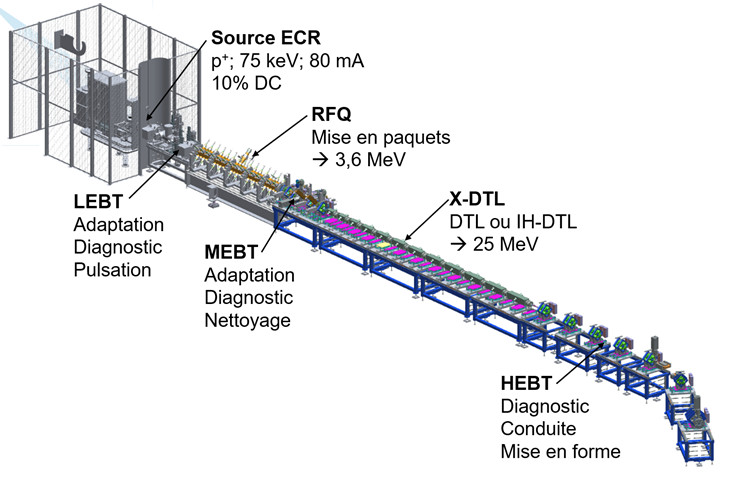
3D view of the linear accelerator including one of the two beam distribution lines to the high-resolution target (credit : CEA)
The ICONE-Linac project at IRFU
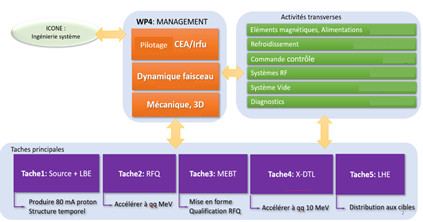
The Technical Design Report (TDR) of the ICONE linac mobilized a team of about thirty people for two years, organized in work packages (WP), typical of large accelerator projects. This organization, illustrated in the figure above, relies on central coordination and cross-cutting expert groups to cover all the scientific, technical, and industrial aspects necessary for the machine’s design.
The management of Work Package 4 ensured the global coordination of the project, systems engineering, and the integration of various contributions. Three main poles formed the core of this WP:
- Management and systems engineering, ensuring the overall coherence of the linac, the interface between subsystems, and the consolidation of the design.
- Beam dynamics, responsible for the design and optimization of the accelerator’s beam performance.
- Mechanical design and 3D modeling for defining mechanical structures, equipment integration, and layout studies.
In parallel, several cross-cutting activities involved experts from Irfu’s LEDA, LDISC, LISAH, LCAP, LRI, and LEIGE to provide their specific expertise on the accelerator’s critical subsystems. These contributions concerned:
- Magnetic elements and power supplies,
- Cooling systems,
- Control-command systems,
- Radiofrequency (RF) systems,
- Vacuum systems,
- Beam diagnostics.
These cross-cutting expertises supported all the technical tasks of the project to ensure the coherence and industrial feasibility of the machine.
The studies were structured around five main tasks, corresponding to the different sections of the linac:
- Task 1 – Source and LEBT: aimed at producing a proton beam of 80 mA with the required temporal structure.
- Task 2 – RFQ: dedicated to the design of the Radio-Frequency Quadrupole, enabling the initial acceleration of the beam to a few MeV.
- Task 3 – MEBT: focused on beam shaping and conditioning, as well as RFQ qualification.
- Task 4 – X-DTL: aimed at accelerating the beam to ~25 MeV.
- Task 5 – HEBT: concerning the distribution of the beam to the various experimental targets.
In total, about thirty IRFU experts, covering all the disciplines necessary for the realization of a particle accelerator (beam dynamics, RF, magnetism, mechanics, vacuum, diagnostics, control-command, cryo-cooling, etc.), contributed to this study phase.
Thanks to this mobilization and IRFU’s recognized experience in the design and construction of linear accelerators, the team was able to define the complete architecture of the ICONE linac, establish a detailed cost estimate and propose a realistic construction schedule.
Parallel to the design studies, several technological developments identified as critical were launched to verify their technical feasibility and validate the expected performance for the future linac. These R&D actions aimed to reduce risks associated with the technological choices made in the machine’s design. Three main developments were thus initiated:
- An IH-DTL (Interdigital H-mode Drift Tube Linac) accelerating cavity, currently undergoing experimental characterization,
- A new-generation ion source of the SHILI-3 type, designed to provide the required beam intensities,
- A permanent magnet quadrupole, developed to meet the integration and compactness constraints of the accelerator line.
These R&D programs allowed the validation of the selected concepts and the acquisition of the first experimental feedback. Measurement campaigns are still ongoing to confirm the achieved performance.
A strategic milestone
The delivery of the accelerator’s TDR represents a major step for ICONE. It validates the technological choices, achievable performance, budgetary coherence, and realization trajectory.
This validation starts the countdown for the construction of this infrastructure, which will be located on the CEA Paris-Saclay site. The schedule aims for an operational first phase by 2034, with the first instruments, and a full commissioning of the facility by 2037.
With its two targets (High Flux and High Resolution) and 12 instruments distributed across two experimental halls, ICONE is set to become an essential link in Europe’s neutronics ecosystem. Submitting this file to the ministry and scientific authorities is not just an administrative formality, it is the technological green light to provide France with a major scientific sovereignty tool for the decades to come.
Contact: Didier URIOT
Project website: https://www.icone-neutron.fr/