

The cosmic kaleidoscope
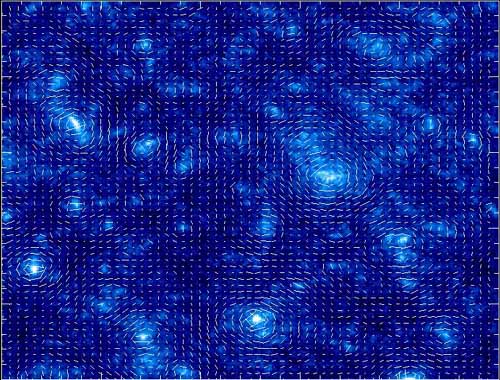
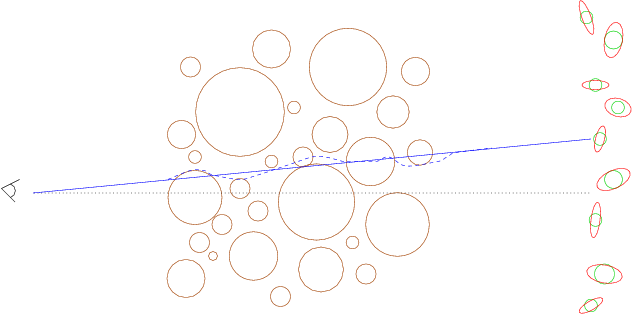
As it travels near matter concentrations, visible or dark, light does not travel in a straight line. It is instead deflected by gravity, as if it went through a lens. This effect, known as “gravitational lensing”, is predicted by the theory of General Relativity and is currently observed by large telescopes. It distorts the shape of galaxies like a cosmic kaleidoscope and allows scientists to map the distribution of mass in the Universe. This new technique is currently used by several international teams of astronomers who measure this “cosmic shear”, the very small distortions produced on the images of distant galaxies by large scale structures (groups and clusters of galaxies) on the line of sight.
An important review of this subject, written by Alexandre Refregier, astrophysicist at the Service d’Astrophysique at CEA-DAPNIA Saclay, will appear this fall in the series “Annual Reviews of Astonomy and Astrophysics”. It includes a history of this fast-evolving field, a summary of the most recent measurements, and a presentation of the perspectives offered by future instruments.
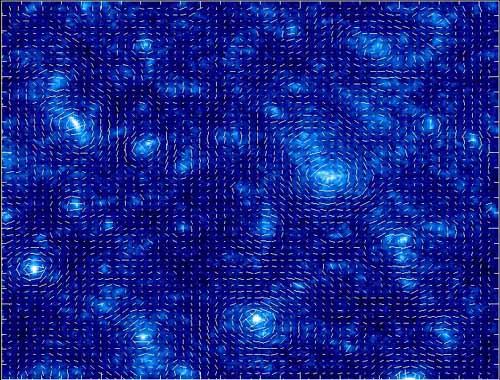
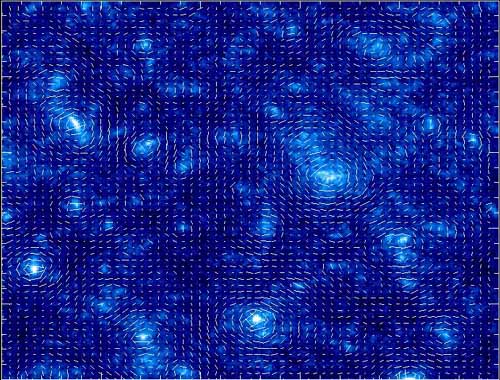
The measurements of cosmic shear already yield a determination of the amplitude of the inhomogeneities of Dark Matter on large scales. In the near future, upcoming instruments like the Megacam camera developed at the Service d’Astrophysique at CEA-DAPNIA Saclay and recently installed at the Canada-France-Hawaii Telescope, will yield measurements of this effect with unprecendented precisions. These new surveys will allow scientists to place strong constraints on dark energy, the second mysterious and dominant component of our universe.
Publication :
“Weak Gravitational Lensing by Large-Scale Structure“, A. Regfregier,
will be published in “Annual Review of Astronomy & Astrophysics”, 2004
for on-line version : see “astro-ph/0307212“