Star formation in the filamentary Aquila and Taurus molecular clouds
Based on observations of nearby molecular clouds with the Herschel space observatory, recently large samples of future stars were detected in the form of dense cores. The properties of these compact seeds and their connection with interstellar filaments reveal us the earliest key stages of stars and the way of low-mass star formation.
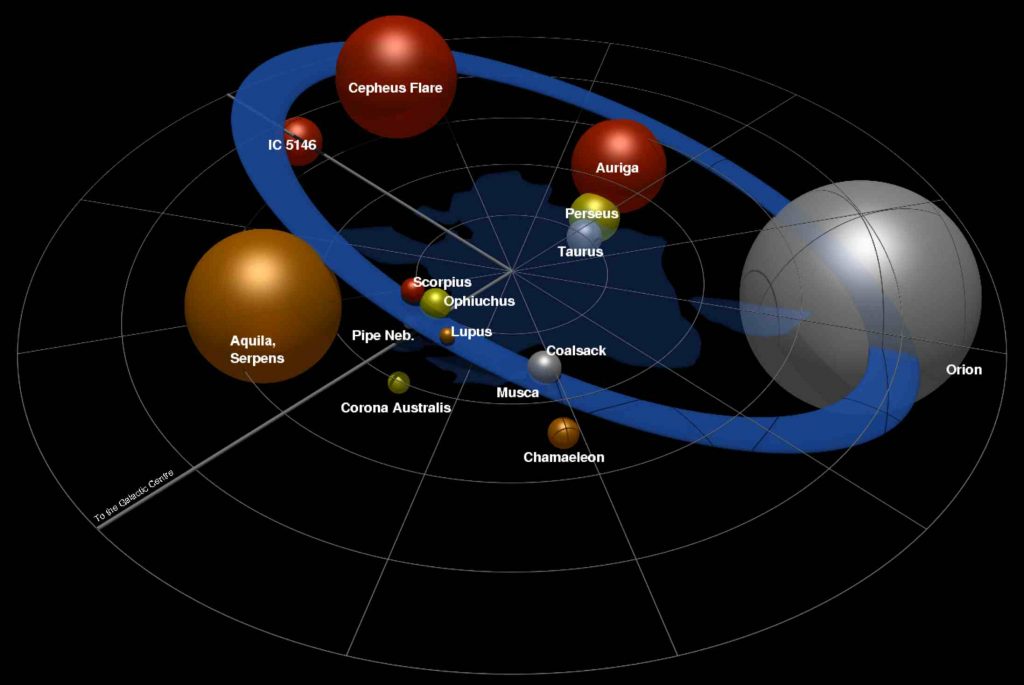
Among several cloud complexes along the Gould Belt (see image below) the Aquila and Taurus regions were targeted. While the star formation in Aquila was relatively unexplored until recently, the Taurus cloud with its main filaments is well known. The Aquila Rift lies above the Galactic plane at the distance of about 260 parsec (approximately 850 light-years from the Sun). The Taurus region is more nearby, it seems to sit in the wall of the Local Bubble – a cavity, surrounding the Solar System- at 140 parsec (or 450 light-years) from us.

In these two regions, a complete census of dense cores was obtained with Herschel and their properties and spatial distribution discussed. The large-number statistics of several hundreds of cores separately in Aquila and Taurus allowed us to obtain the most meaningful results on the formation of dense cores and their physical properties, such as their temperatures, masses, densities and lifetimes, which was not possible until now.
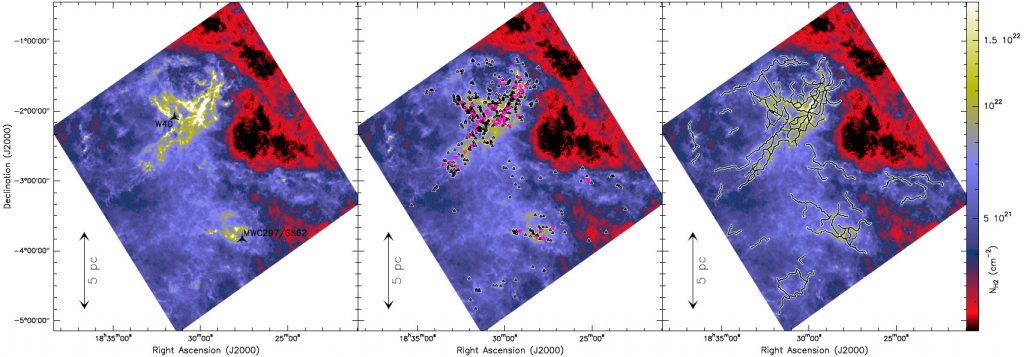
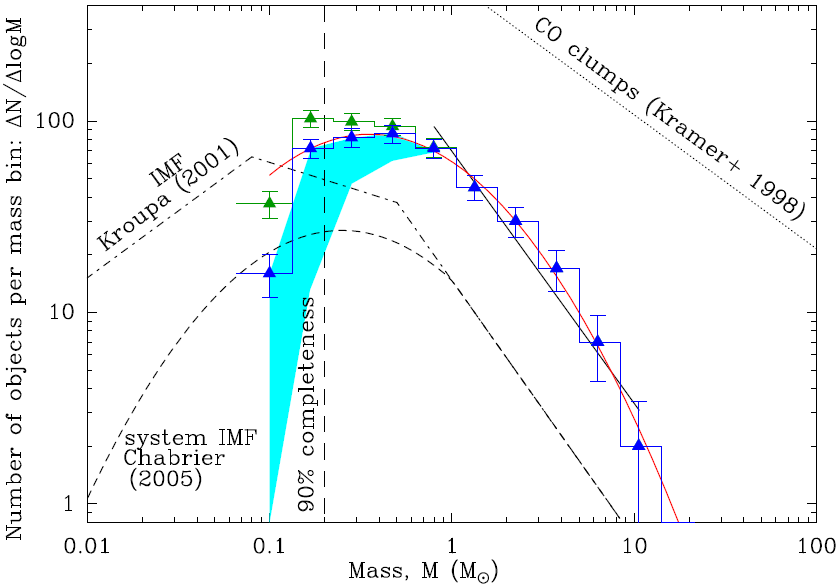
One of the primary objectives of the Herschel Gould Belt survey was the study of the distribution of prestellar core masses or “prestellar core mass function”. From its comparison to the mass distribution of stars (stellar initial mass function) it was possible to confirm that stellar masses are already determined at the early stages of filament/cloud fragmentation. The spatial distribution of compact prestellar cores is strongly correlated with that of the densest filaments, showing that interstellar filaments are the preferred environment for star formation.
These Herschel findings support a picture where ubiquitous filaments are believed to precede the onset of star formation. Then, under the influence of local gravitational forces the densest filaments contract and fragment to compact protostellar seeds which are ultimately forming stars in molecular clouds of the Galactic interstellar medium. This filaments-driven scenario provides some new insight into the origin of the quasi-universal star formation law observed on galactic scales.
Contacts: Vera Konyves, Philippe André
Publications :
“A census of dense cores in the Taurus L1495 cloud from the Herschel Gould Belt Survey“
Marsh et al. 2016, (MNRAS 459, 342) – astro-ph/1602.03143
“A census of dense cores in the Aquila cloud complex: SPIRE/PACS observations from the Herschel Gould Belt survey“,
V. Konyves et al. 2015 (A&A 584, A91) – astro-ph/1507.05926
“From Filamentary Networks to Dense Cores in Molecular Clouds: Toward a New Paradigm for Star Formation“,
Ph. André et al. 2014 (Protostars and Planets VI, 27) – astro-ph/1312.6232
“From filamentary clouds to prestellar cores to the stellar IMF: Initial highlights from the Herschel Gould Belt survey“,
Ph. André et al. 2010 (A&A 518, L102) – astro-ph/1005.2618
Links:
The Herschel Gould Belt survey website (http://gouldbelt-herschel.cea.fr)
Images :

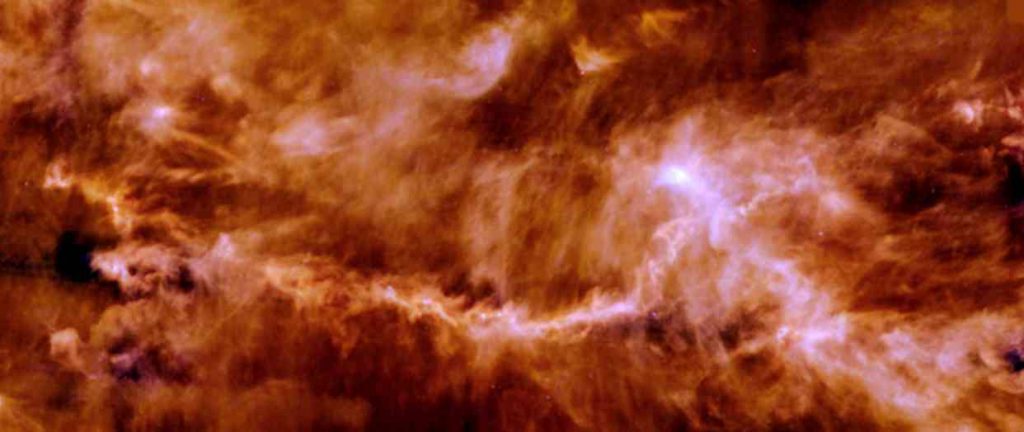
Colour-composite image of the Aquila Rift showing the extended filamentary structure of this star-forming cloud.
See : Herschel image of the l'Aquila Rift
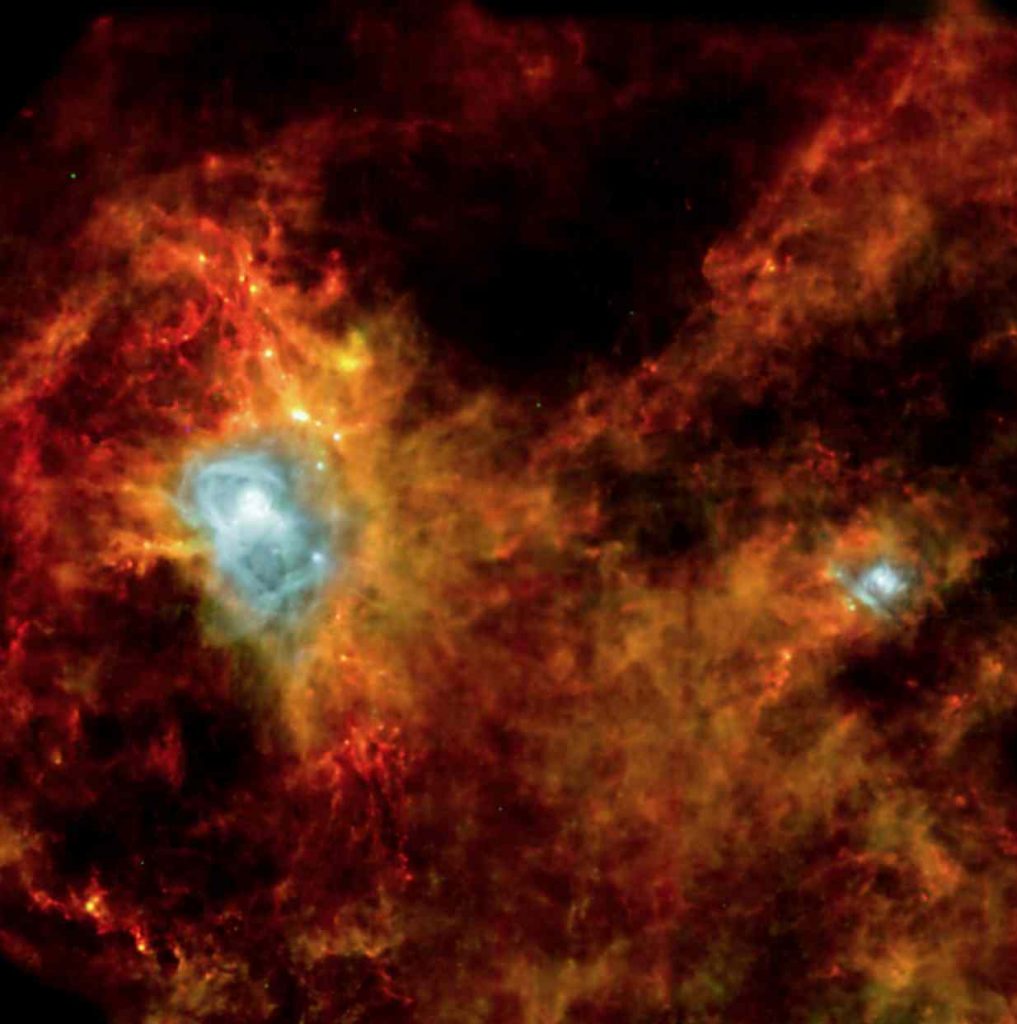
Three-colour image of the B211/B213 filament in the Taurus Molecular Cloud combining Herschel bands at 160 μm (blue), 250 μm (green) and 500 μm (red). The image spans about 2×5 degrees.
See : Herschel image of the Taurus cloud