

While the JWST was observing TRAPPIST-1, the system of seven exoplanets, an international team of researchers, including the Astrophysics Department at CEA Paris-Saclay, noticed that celestial passengers were regularly entering the field of view. They then developed a method for studying them, and identified 138 new asteroids in the main belt. These celestial bodies, ranging in size from a bus to several stadiums, represent the smallest asteroids ever detected in this region of space.
Thanks to this new approach, researchers can now spot asteroids as small as 10 metres in diameter, paving the way for in-depth exploration of the Solar System’s smallest objects. This breakthrough is crucial for better understanding the history of the Solar System and for improving the tracking of potentially dangerous asteroids, thereby enhancing planetary security.
The study was published in the prestigious journal Nature, under the title “JWST sighting of decameter main-belt asteroids and view on meteorite sources“.
Observing asteroids in the main belt, a difficult quest
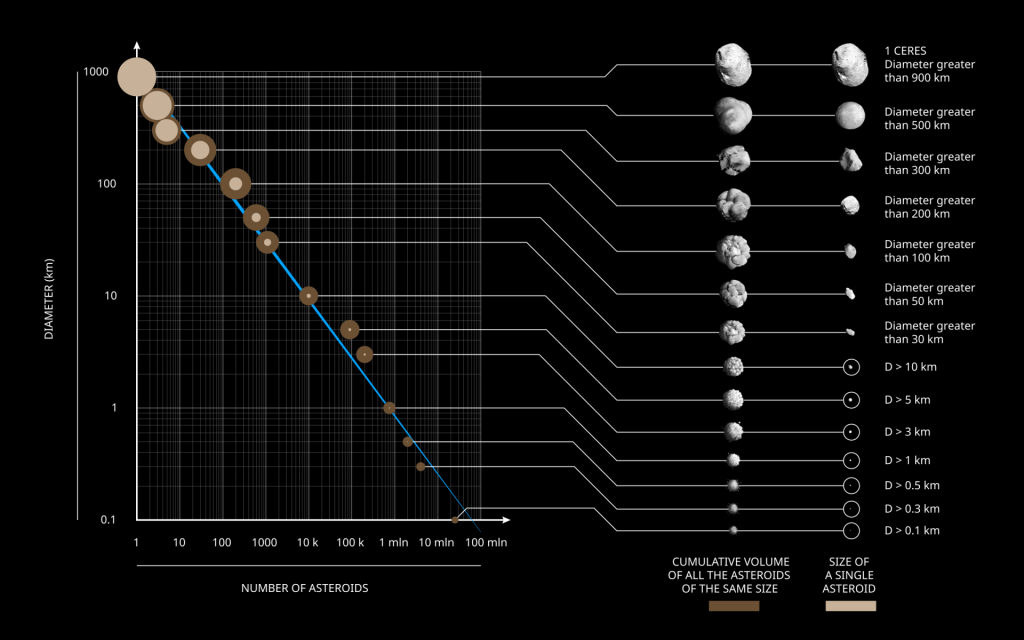
The asteroid that caused the extinction of the dinosaurs measured around 10 kilometres in diameter, equivalent to the width of Brooklyn. Such an impactor strikes the Earth very rarely, with a frequency estimated at between once every 100 and 500 million years. In contrast, much smaller asteroids, comparable to the size of a bus, can hit the Earth much more frequently, every few years, because there are so many of them (see Figure 1). These asteroids, described as “decametric” because of their diameter of around ten metres, are nevertheless capable of generating shockwaves that can cause damage on a regional scale, as in the 1908 explosion in Tunguska, Siberia, or the 2013 explosion in the sky over Chelyabinsk, in the Urals.
Most of these asteroids come from the main belt between Mars and Jupiter, where millions of celestial bodies orbit. Keeping track of these asteroids is vital, both for scientific research – to shed light on the origins and evolution of the solar system – and for global security – by identifying NEOs, asteroids whose orbit crosses that of the Earth and which could pose a threat.
However, until recently, the instruments available were only able to detect asteroids in the main belt measuring at least one kilometre in diameter. This limit is largely insufficient, given that the majority of asteroids in this region are much smaller. What’s more, these small asteroids are more likely to leave the main belt and become near-Earth objects, increasing the risk of causing significant damage to our planet. A better ability to spot these small bodies is therefore crucial to meeting these challenges.
From undesirable to desirable: when ‘parasites’ become a scientific opportunity
As part of the programme entitled “TRAPPIST-1 Planets: Atmospheres Or Not?“, co-directed by the Astrophysics Department (DAp) of the IRFU at CEA Paris-Saclay, the James Webb Space Telescope (JWST) observed the TRAPPIST-1 exoplanetary system using the MIRI instrument. The aim was to study the phase curve of the first two planets, TRAPPIST-1 b and c, in order to follow the evolution of their luminous flux over a complete orbit. This type of observation makes it possible to measure the thermal emission of the different faces of each planet and to study the distribution of heat on their surface, with the aim of confirming or ruling out the presence of an atmosphere.
To cover a complete orbital period for planets b and c (1.5 days and 2.42 days respectively), the observations lasted around 60 hours, making this the longest continuous observation programme of a star carried out by JWST for the study of exoplanets,” explains Elsa Ducrot, a researcher in the CEA’s Astrophysics Department, co-leader of this observation programme and co-author of this study.
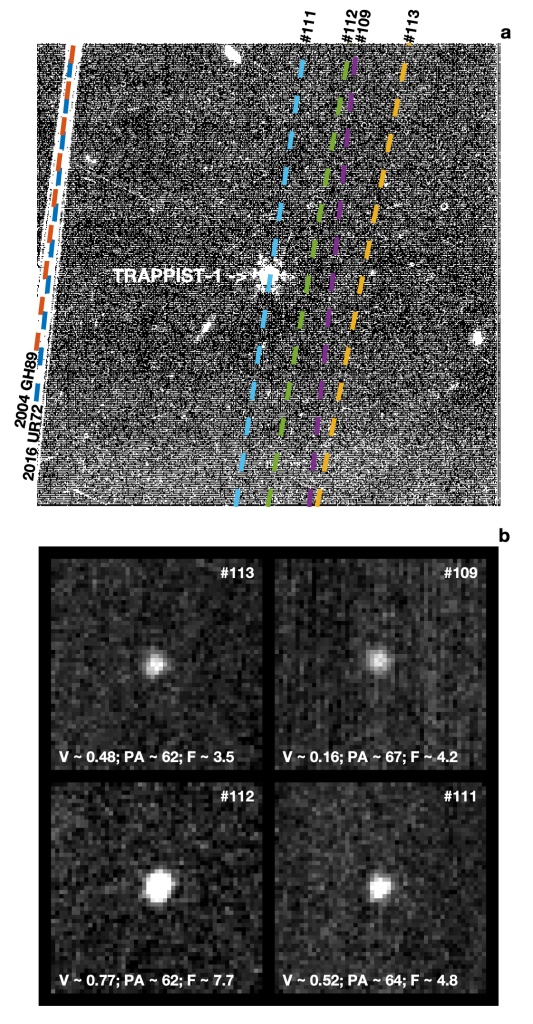
When these observations were analysed, an international research team led by the Massachusetts Institute of Technology (MIT, USA) and including the DAp, discovered that they were polluted by asteroids crossing the field of view (see figure 2a). Although the field is very small (56.3″ × 56.3″), many asteroids appear regularly, because TRAPPIST-1 is located in the plane of the ecliptic, where the objects of the solar system are located, particularly those in the main belt.
For most astronomers, asteroids are considered to be pests of the sky: they cross the field of vision and disrupt the data, notes Julien de Wit, co-lead author of this study and a researcher at MIT.
However, instead of simply cleaning the data of this “parasite”, as is usually done, the researchers wondered whether this information could be used to identify asteroids in our own solar system. To do this, they used a technique called “shift and stack”, developed in the 1990s. This method involves shifting and stacking several images from the same field of view in order to highlight a faint object that might be hiding in the noise.
A new window on space
The presence of TRAPPIST-1 in the field of view of the MIRI instrument represents a real opportunity, as its mid-infrared sensitivity makes it perfectly suited to observing asteroids. In visible light, only the sunlight reflected by the asteroid is perceptible. If the asteroid is small and distant, the luminous flux becomes extremely weak. In infrared light, on the other hand, the light emitted directly by the asteroid is captured, considerably increasing the observable flux. Thanks to its high collecting power and infrared vision, the JWST is an ideal instrument for detecting small bodies in our solar system.
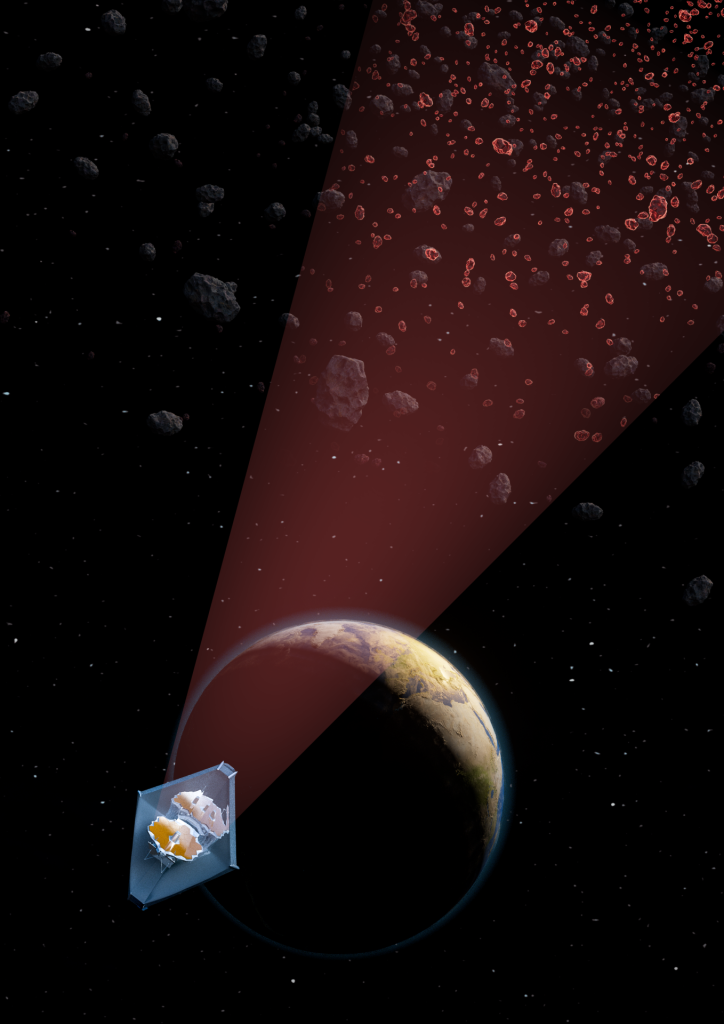
By processing more than 10,000 images of the TRAPPIST-1 system taken by JWST, the team identified eight asteroids already listed in the main belt. By analysing the data in greater depth, they were able to detect 138 new asteroids, all a few tens of metres in diameter (see Figure 2b). These objects are the smallest asteroids ever observed in this region, enabling a new population of asteroids to be explored (see Figure 3).
This is a whole new region of space that we are exploring using modern technologies, adds Artem Burdanov, lead author of the study and a researcher at MIT. It’s an excellent example of what we can achieve by analysing data differently. Sometimes the results exceed our expectations, and that’s the case here.
Researchers plan to use this method to identify and track new NEOs, asteroids whose orbits cross that of the Earth.
We have already been able to detect near-Earth objects measuring up to 10 metres when they were very close to us, explains Artem Burdanov. Now we have a way of spotting these small asteroids at a much greater distance, enabling us to carry out more precise orbital tracking, which is essential for planetary defence.
CEA/IRFU Contacts: Elsa Ducrot, Pierre-Olivier Lagage