

A superflare is an exceptionally powerful electromagnetic emission from a star, releasing energy equivalent to a trillion hydrogen bombs, well beyond the solar flares recorded to date. To determine whether the Sun is capable of producing such monsters, an international team, including the IRFU Astrophysics Department at CEA Paris-Saclay, analysed tens of thousands of stars similar to the Sun. The researchers discovered that not only can the Sun generate superflares, but that these occur on average once a century, a much higher frequency than previously estimated.
However, the traces left by past solar eruptions in the Earth’s archives show that these superflares are not always accompanied by massive ejections of matter, which is fortunate for our technological society, which is vulnerable to these events. To better understand and anticipate these solar tantrums, researchers are using complex numerical simulations to study the mechanisms behind magnetism and solar eruptions.
The study was published on 13 December 2024 in the journal Science.
Could the Sun be capable of generating superflares?

Flares are sudden, localised, high-intensity electromagnetic emissions from stars such as the Sun. These phenomena release a considerable amount of energy in a very short space of time (see Figure 1). They are frequently accompanied by massive plasma ejections, known as coronal mass ejections (CMEs). When the solar energetic particles (SEPs) from these eruptions reach the Earth, they pose a significant radiative hazard to satellites, aircraft and humans. The powerful solar storms observed this year, which generated auroras as far away as low latitude regions, bear witness to the Sun’s impetuous nature. But could it produce even more intense eruptions, superflares, with catastrophic consequences for the Earth? And if so, how often might they occur?
Evidence of the worst solar ‘storms’ can be found in prehistoric tree rings and ice cores dating back thousands of years. Analysis of these terrestrial archives, covering the last 12,000 years, suggests that an extreme solar storm occurs on average every 1,500 years. However, this estimate could be underestimated, as the relationship between superflares and extreme solar particle ejections is still uncertain. As for direct measurements of solar radiation, they date back only to the space age, a period too short to provide definitive conclusions.
An alternative is to study superflares statistically on stars similar to the Sun. If the properties of these stars match those of our star sufficiently, the frequency of observed superflares can provide an indirect but valuable estimate of the frequency of solar superflares.
Surprisingly frequent superflares
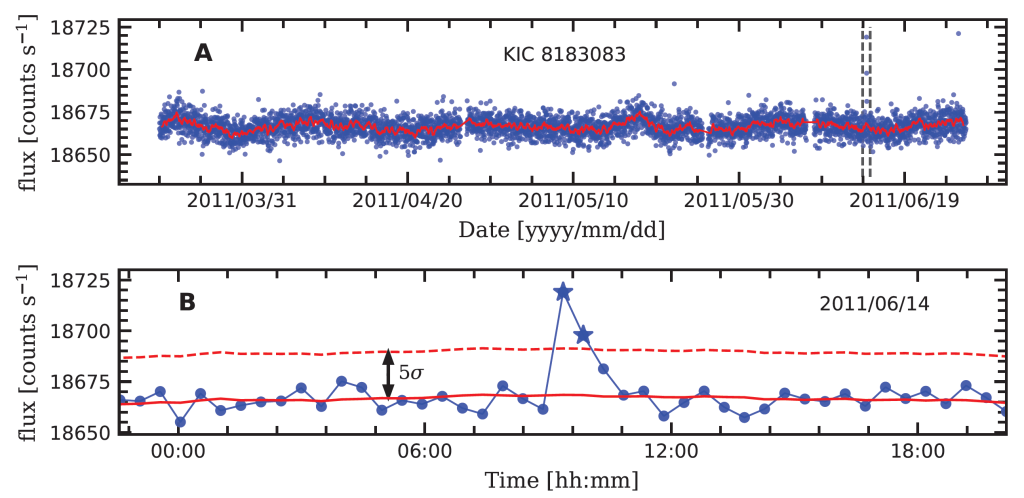
For this study, the researchers used data from the Kepler telescope (NASA), which continuously observed variations in the luminosity of thousands of stars over 4 years, from 2009 to 2013. They then selected the stars whose temperature and luminosity were comparable to those of the Sun, with a precise location determined using the Gaia satellite. The resulting sample includes 56,450 stars, representing the equivalent of 220,000 years of stellar activity, or around 18 times more than the Earth’s archives.
Superflares, which release more than an octillion joules in just a few moments, show up as pronounced peaks in the luminosity curve of stars (see Figure 2). After eliminating potential biases, such as cosmic radiation or nearby asteroids, the researchers identified 2,889 superflares in 2,527 stars, an average of one superflare per star every 100 years. Even if we restrict the sample to only those stars with characteristics closest to those of the Sun, we find the same frequency of eruptions.
We were very surprised by the frequency of these super-belapses, said Dr Valeriy Vasilyev, lead author of the study and a researcher at the Max Planck Institute.
Indeed, previous studies have reported frequencies around two orders of magnitude lower than those observed in this study, between 1,000 and 10,000 years ago. However, these estimates are incompatible with observed solar flares, probably because of biases in the analyses, linked to uncertain identification of the sources of the flares.
Superflares dictated by a law of power

From the energy distribution of the number of stellar flares per year and per unit of energy (see Figure 3), the researchers observed that the frequency of flares decreases with the energy released according to a power law of the type E-α, where the exponent α determines the speed of this decrease. The value of α for the Sun, obtained from measurements taken from space between 1986 and 2020, is in very good agreement with stellar measurements, validating estimates of the frequency of superflares (E>1034 erg) at around one per century.
However, the question remains: can the Sun, with its slow rotation (28 days), accumulate enough energy to generate such eruptions? In addition to their contribution to the interpretation and analysis of the data, dynamo simulations carried out by researchers in CEA’s Astrophysics Department have demonstrated that such a phenomenon is energetically possible.
High-performance dynamo calculations of solar-type stars easily explain the magnetic origins of the intense energy release during these superflares, explained by Dr. Allan-Sacha Brun
How to protect yourself from dangerous space storms
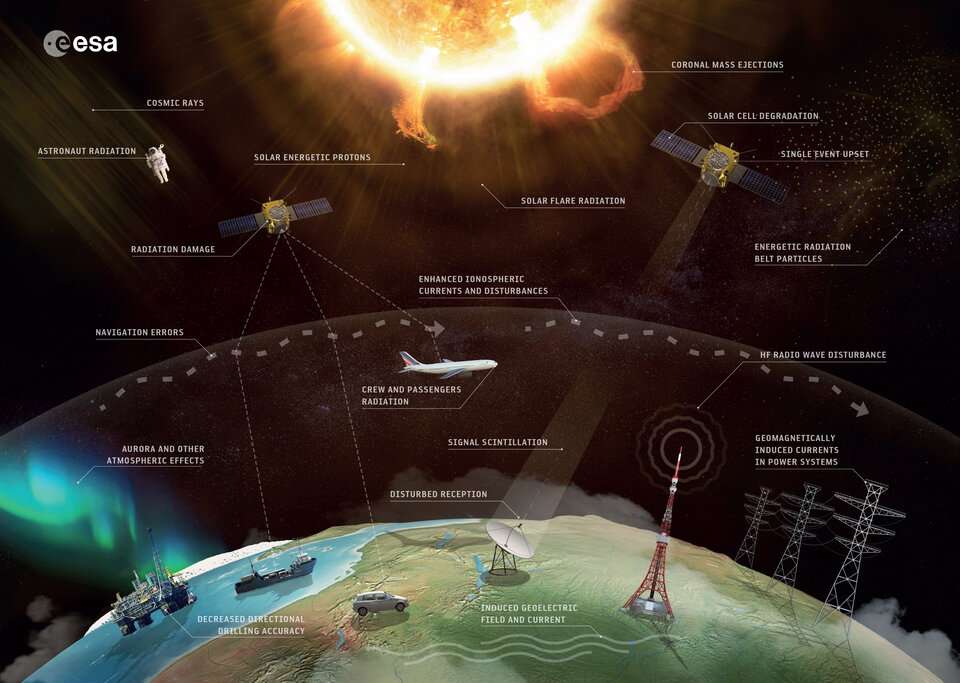
This study reveals that the Sun could generate superflares at a higher frequency than previously estimated: around once a century. These phenomena can release energies up to 100 times greater than those of the most powerful solar flare ever recorded, which occurred on 28 October 2003. Fortunately, terrestrial archives show that these superflares are not systematically accompanied by massive ejections of energetic charged particles, which is a blessing for our techno-dependent civilisation. Indeed, such ejections could have catastrophic consequences (see Figure 4), causing, for example, the loss of satellites, power cuts, flight diversions or even stoppages, radio blackouts and so on.
This study therefore highlights the importance of better understanding our Sun in order to anticipate these extreme events and limit their effects. But this task is far from easy. Real-time monitoring of solar flares allows only a limited response, as the dangerous particles and radiation reach the Earth in just 8 minutes, too short a time to implement effective countermeasures. It is therefore essential to develop ways of anticipating the Sun’s future states. To do this, CEA researchers use complex numerical simulations and assimilate into these models real data capable of reproducing these phenomena, a discipline known as space meteorology. It aims to study the effects of solar flares on the Earth and develop strategies to protect against them.
The IRFU Astrophysics Department at CEA Paris-Saclay has made this its speciality. Using supercomputers, researchers numerically simulate the Sun and the complex environment between the Sun and the Earth, where the solar wind and magnetosphere interact (e.g. Whole Sun, Stormgenesis and WindTRUST projects). This work is based on a vast network of continuous observations of the Sun, thanks in particular to the STIX instrument, designed in part at CEA Paris-Saclay and carried on board the Solar Orbiter satellite. This instrument provides invaluable X-ray spectro-imaging data for studying the physical processes behind solar flares.
From 2031, researchers will also be able to count on the ESA’s Vigil probe (in particular the JEDI instrument, for which the CEA is scientific co-installer), which, from an observation post on the side of the Sun, will monitor in near-real time the early signs of dangerous phenomena before they become visible from Earth. Finally, from the end of 2026, the Plato satellite (ESA), a worthy successor to Kepler, for which the CEA has a hardware and scientific contribution, will enhance the study of the Sun by enabling statistical comparisons with similar stars.
CEA/IRFU Contacts: Allan-Sacha BRUN