

Magnetars are neutron stars characterised by their magnetic fields, which are among the strongest in the Universe, and by their intense X-ray and gamma-ray emissions and eruptions. An international team of scientists, including researchers from the Astrophysics Department at CEA-Paris Saclay, has modelled the formation of their magnetic field, induced by the Tayler-Spruit dynamo, and its evolution over periods of several hundred thousand years. This dynamo is generated by the fall of matter on the neutron star just after its formation, following the explosion of the parent star into a supernova. The results of the simulations are in agreement with observations of low-field (‘low-B’) magnetars, neutron stars with dipolar magnetic fields 10 to 100 times weaker than those of classical magnetars.
These results offer a major breakthrough by resolving a scientific enigma that has persisted since the discovery of these magnetars in 2010. They also indicate that low-field magnetars form by a different process to classical magnetars, probably due to variations in the dynamos of neutron stars during their formation.
The study was published in the prestigious journal Nature Astronomy.
The Tayler-Spruit dynamo mechanism…

Neutron stars are the remnants of massive stars that have run out of fuel and then exploded in a supernova, ejecting most of their outer layers. Among these stars, magnetars are distinguished by their intense magnetic fields, which can reach 10^15 Gauss, ten billion times more powerful than the fields generated by humans. These extreme fields make magnetars brilliant transient sources that emit X-rays and gamma rays. One key question remains: understanding the precise origin of these fields and how they have evolved over millions of years.
In 2022, a team from the Department of Astrophysics (DAp) at CEA Saclay proposed an innovative scenario to explain the formation of these extreme magnetic fields, based on the Tayler-Spruit dynamo, a process that converts the motion of plasma into a magnetic field. The Tayler-Spruit dynamo is activated in particular when the matter expelled during the supernova explosion falls back onto the young neutron star. In 2023, an in-depth study using three-dimensional numerical simulations was able to reproduce the observed intensities of the magnetic fields of magnetars (see Figure 1). However, these simulations were limited to the first ten seconds following the formation of the protoneutron star. We still needed to understand how these fields evolve over long periods.
… would give rise to weak-field magnetars
In order to study the long-term evolution of magnetars whose magnetic field is generated by the Tayler-Spruit dynamo, the team from the Department of Astrophysics (DAp) at CEA Saclay collaborated with researchers from the universities of Newcastle and Leeds, who specialise in the evolution of neutron stars on timescales of up to several hundred thousand years.
Dr Andrei Igoshev, lead author of the study and a researcher in the School of Mathematics, Statistics and Physics at Newcastle University, said: “This study shows that this process plays a crucial role in the formation of the magnetic fields of weak-field magnetars through the Tayler-Spruit dynamo”.
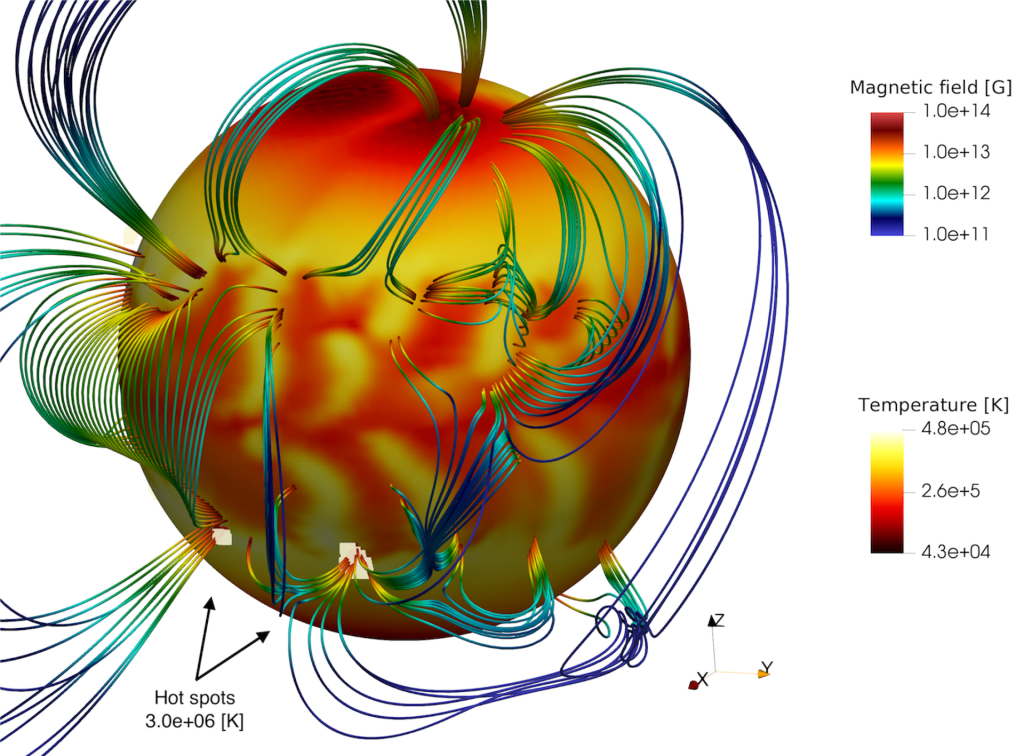
The numerical simulations carried out in this study (see Figure 2) reproduce the main observed characteristics of low-field magnetars, in particular :
- Weak dipolar magnetic fields: These magnetars have magnetic fields 10 to 100 times weaker than conventional magnetars, with values below 10^13 Gauss.
- X-ray light curves: Because of their extremely high temperatures, magnetars emit mainly in the X-ray range. Simulations faithfully reproduce this thermal emission, which is modulated by hot spots on the star’s surface.
- X-ray bursts and eruptions: The powerful magnetic field deforms the crust of the neutron star, sporadically causing small ruptures. These deformations trigger flashes of X-ray and gamma-ray light. Simulations show that the conditions required for these events are well reproduced.
- Slow rotation periods: Like classical magnetars, weak-field magnetars have long rotation periods compared with other neutron stars. One hypothesis put forward is that these magnetars could be ageing versions of classical magnetars, whose initially strong dipolar magnetic field has extracted their angular momentum before being gradually dissipated. This study proposes another explanation: their slow rotation period could be the result of interaction with the surrounding matter from the return of matter after the supernova, which slows down the star’s rotation after generating the magnetic field.
A scientific enigma solved!
In this study, the researchers have shown that the Tayler-Spruit dynamo, activated by the fallout of matter from supernova explosions, is a key mechanism behind the formation of weak-field magnetars. This work shows that these objects are not necessarily evolved remnants of classical magnetars, but may be the result of a dynamic process right from their birth. This scenario thus offers a complete and coherent explanation of the phenomena observed, while resolving a scientific enigma that has persisted since their identification in 2010.
By directly connecting the dynamo process to the observable properties of magnetars, these simulations – the first to describe the long-term evolution of the magnetic field from a field generated coherently by such a process – open up a new way of constraining the formation of these mysterious objects,” enthuses Jérôme Guilet, a researcher at the DAp and one of the authors of the study.
IRFU/DAp Contacts: Jérôme Guilet and Raphaël Raynaud