

As we explore the farthest reaches of the universe, some ten billion light-years from Earth, the Solar neighbourhood is still full of surprises. In archival data, an international team, including researchers from the Department of Astrophysics (DAp), has found a dark molecular hydrogen cloud located 300 light-years from the Sun, at the edge of the Local Bubble. This is the first molecular cloud discovered by H2 fluorescence, and a fine example to study the interaction of a cloud with a superbubble.
This study has been published in the prestigious review Nature Astronomy.
The space between stars is filled with gas and dust. This medium is stirred by currents, shaken by shock waves from stellar explosions, irradiated by the ultraviolet (UV) light from stars, and sculpted by gravitation. It is constantly in motion, with gas flowing between vast, tenuous, hot bubbles caused by stellar activity and more compact, cold, and dense clouds where new stars are born. The gas in these dense clouds is mainly made up of molecules, but the most abundant ones, H2, radiate so little in these cold environments that we must use the radio emission from the much rarer CO molecules to map the molecular clouds. We know that large quantities of molecular gas escape CO observations.
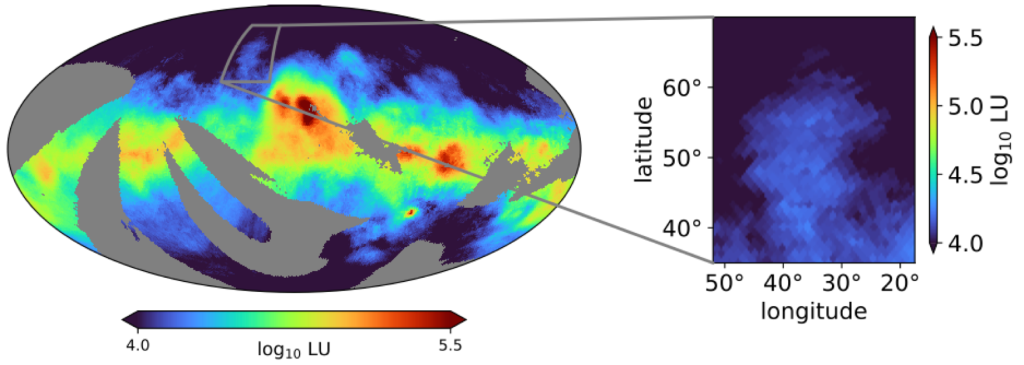
However, in the presence of UV light, H2 molecules can become excited and fluoresce, in the same way as stones or animals that take on magnificent colours when illuminated by black (UV) light. The team used the H2 fluorescence maps obtained between 2003 and 2005 by the FIMS/SPEAR instrument aboard the STSAT-1 Korean satellite. Combined with a set of maps of CO emission, radio emission from hydrogen atoms, infrared emission from dust, and X-ray absorption by the gas, the authors found a hitherto unknown molecular cloud, with a mass 3400 times that of the Sun, close to us, but not yet recorded because of its lack of emission apart from this faint fluorescent glow. This cloud, named Eos after the goddess of dawn, is the first molecular cloud discovered using H2 fluorescence. It does contain a small clump visible in CO, but which reveals only the tiny tip (less than 1%) of the iceberg. The figure on the left represents the all-sky far-ultraviolet H2 fluorescence emission map, in log line units (LU: photons cm−2 sr−1 s−1), The map was obtained with the FIMS/SPEAR instrument by Jo, Y.-S. et al. (2017). The inset shows an enlargement of the Eos cloud region.
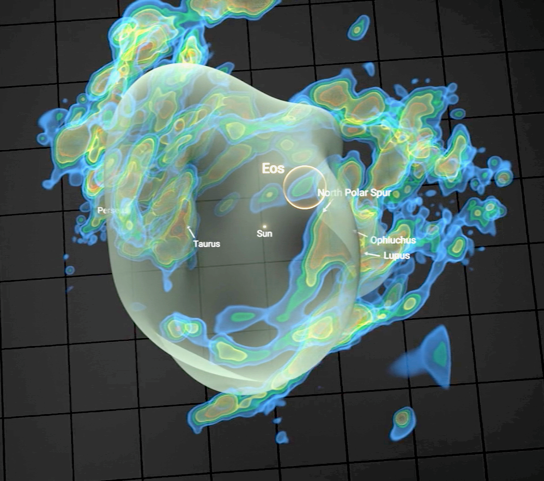
The cloud extends between 300 and 400 light-years from the Sun. It is most likely associated with the edge of the Local Bubble (image on the right; an animated version is available, and a 3D interactive map are accessible using Google Chrome or Firefox). The Local Bubble is a large cavity of hot (million-degree) gas, inflated by multiple stellar explosions to a size of 2,000 to 3,000 light-years, through which the Sun has been passing for 5 to 7 million years. In its expansion, the Bubble has swept away and compressed a shell of dense gas around its perimeter, of which the Eos cloud is likely a part. Measurements indeed indicate that Eos‘ days are numbered. The UV light that allows it to fluoresce also dissociates the H2 molecules, which will be destroyed in 5 or 6 million years’ time. In the meantime, Eos provides a nearby laboratory for studying how a cloud evolves in contact with the hot gas and the UV and X-rays from a superbubble, which is a common situation in the cycle of interstellar gas in galaxies.
Contact Irfu/DAp: Isabelle GRENIER.