Natalia Porqueres, an astrophysicist in the Department of Astrophysics at IRFU, has just been awarded a European ERC Starting Grant for her project OCAPi — an innovative analysis technique that could revolutionize our understanding of the dark Universe, capable of detecting deviations from the standard cosmological model based on Einstein’s general theory of relativity.
To this day, the formation of cosmic structures and the nature of dark energy and dark matter — two essential components of the standard cosmological model — remain poorly understood. Natalia is developing new data analysis techniques to extract information from the cosmological observations of the Euclid mission (a space observatory launched in July 2023 for a six-year mission), whose main objective is to understand the “dark sector” of the Universe.

However, to fully exploit the potential of these datasets, very precise analysis techniques will be required.
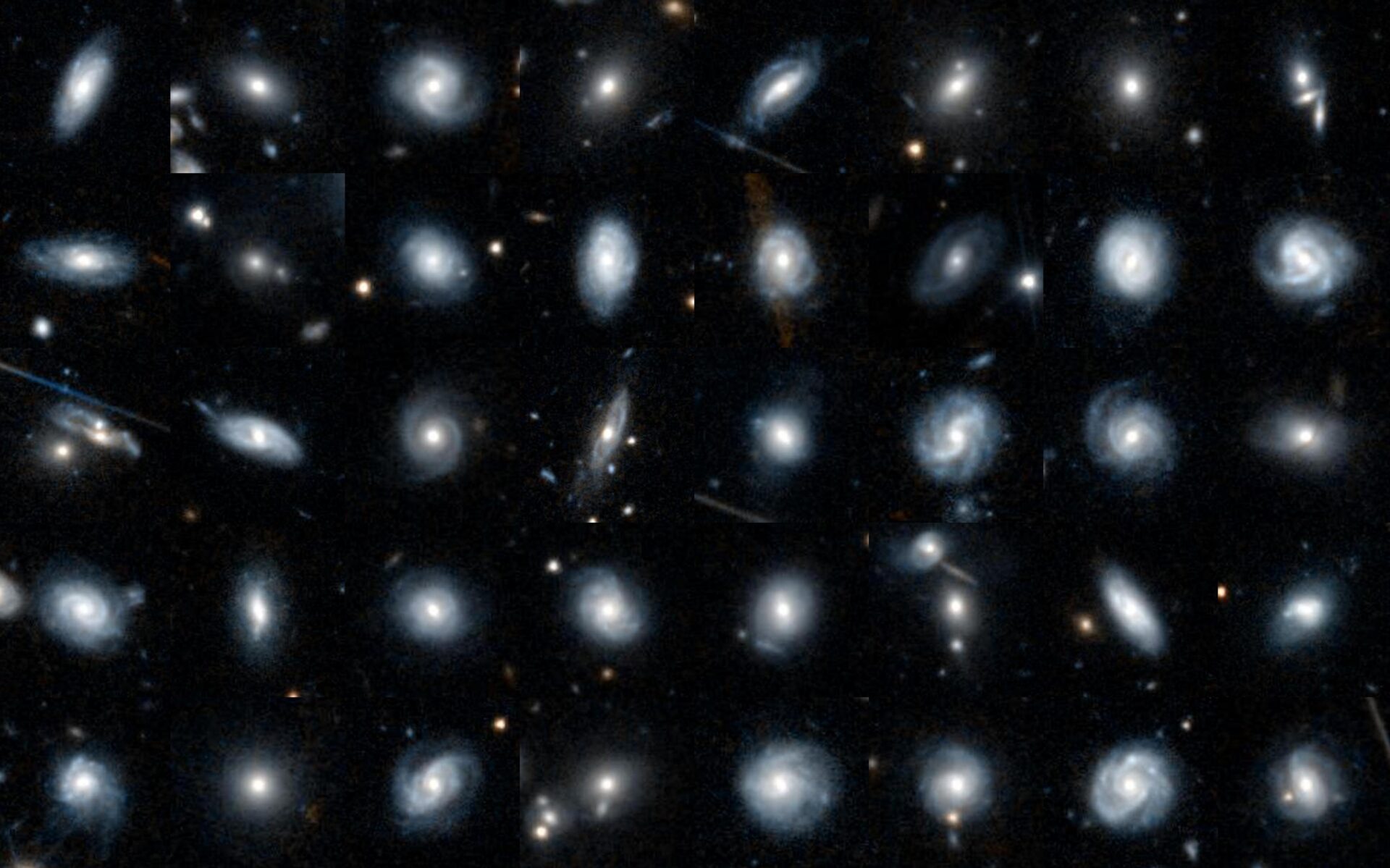
Euclid will measure the distorted shapes of
billions of galaxies to study the composition
of the Universe and the formation of cosmic
structures.
CREDIT: ESA/Euclid/Euclid Consortium/NASA
The OCAPi project will develop cutting-edge methods to optimally exploit weak gravitational lensing data from the billions of galaxies observed by the Euclid space telescope. This innovative technique performs gravitational simulations within a statistical framework and compares them to the observed weak lensing maps, pixel by pixel.
“Unlike standard analyses, which compress the data and inevitably lead to information loss, OCAPi will analyze the lensing maps pixel by pixel, without any data compression. This ensures that we capture all the information contained in the data, maximizing accuracy and strengthening our ability to distinguish cosmological signals from systematic effects”, explains Natalia.
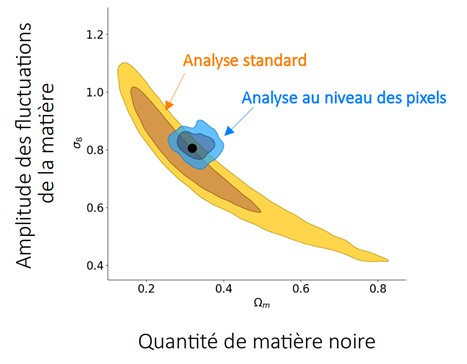
By capturing all the information contained in the data, this method provides the most precise possible constraints on cosmological parameters. Proof of concept has shown that pixel-level analysis reduces marginal errors on cosmological parameters by up to a factor of 5 compared to standard techniques.
This approach also produces probabilistic maps of matter distribution at different cosmic times, making dark matter visible and opening a new path for testing physics using the large-scale structure of the Universe.
By maximizing the scientific return from one of the most powerful datasets cosmology will have for decades, OCAPi will advance our understanding of dark energy and provide a digital twin of the Universe to study the formation and evolution of cosmic structures.