

A collaboration led by solar physicists from the LDE3 laboratory (Dynamics of Stars, (Exo)planets, and their Environment – DAp/CEA-IRFU), in partnership with the Universities of Montreal and Oslo, has demonstrated that the energy dissipation responsible for solar flares propagates in cascades, akin to avalanches. These findings, published in Physical Review E (2025), are based on high-resolution magneto-hydrodynamic (MHD) simulations, which reveal that the dissipation of magnetic energy follows universal laws, independent of the simulation details. The same rules apply across all scales. While the simulation cannot predict a specific flare, the avalanche-like behavior leading to these events allows us to estimate the probability that a flare of a given size will occur.
Revolutionary Observations by Solar Orbiter
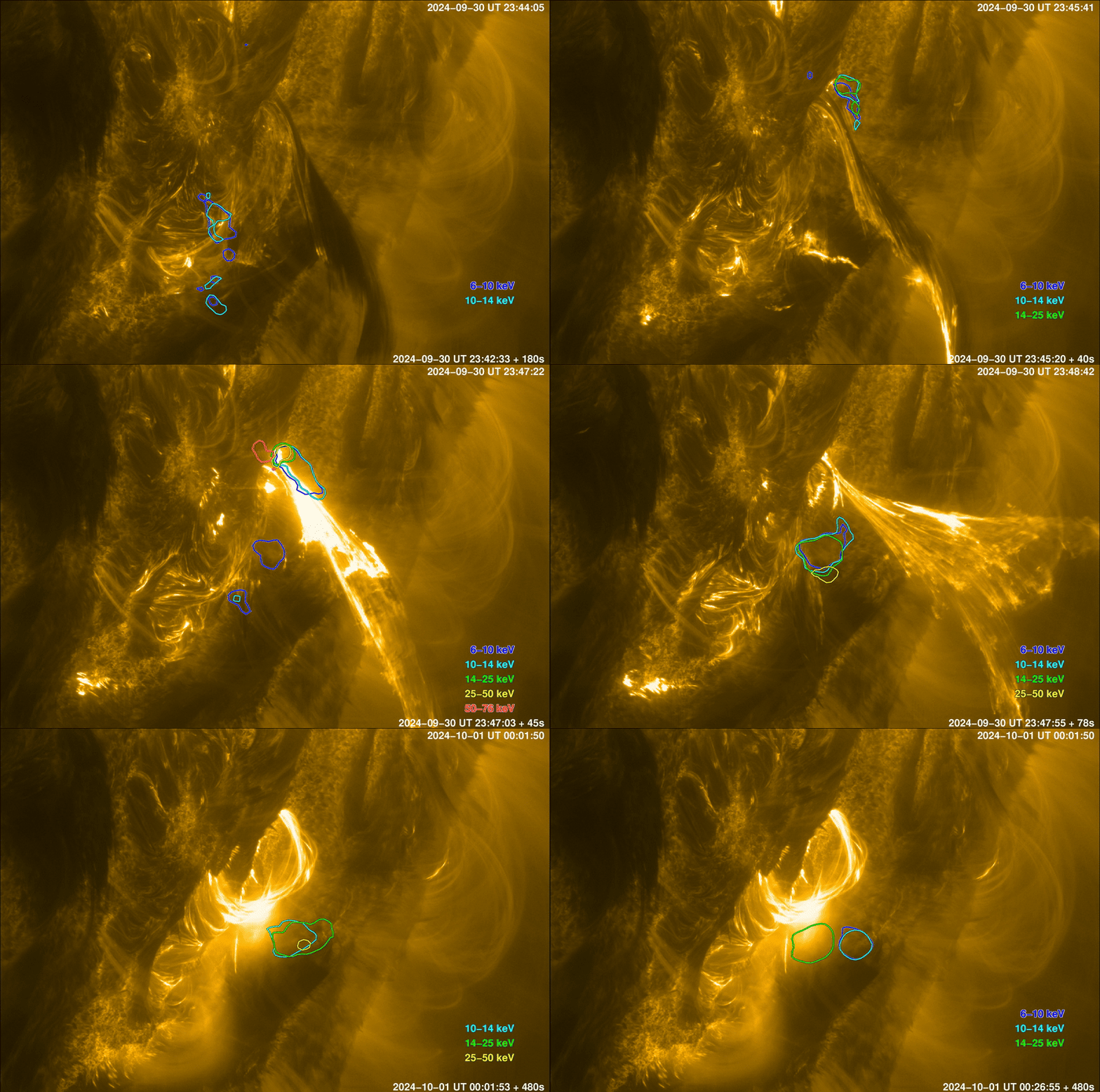
On September 30, 2024, the Solar Orbiter probe (ESA) recorded a major solar flare with unprecedented detail. For 40 minutes, its four instruments (EUI, SPICE, STIX, PHI) captured the entire process, from the solar corona to the photosphere.
Solar flares are colossal explosions on the Sun’s surface. They occur when the energy stored in tangled magnetic fields is suddenly released through a process called “magnetic reconnection.”
The data reveal a cascade mechanism: magnetic reconnections chain together, destabilize large-scale magnetic structures, and release colossal energy—a phenomenon comparable to avalanche models (like a sandpile collapsing grain by grain).
These observations, detailed in the ESA press release (“Magnetic avalanches power solar flares,” January 2026), confirm that solar flares are not isolated explosions but rather the result of self-similar dynamics—where the same rules apply at all scales.
MHD Simulations and Observations: A Decisive Convergence
The MHD simulations (“Avalanches in magnetohydrodynamical simulations”, PHYSICAL REVIEW E 112, L063202 (2025) show that current sheets and their energy dissipation follow power-law distributions, faithfully reproducing the behaviors observed by Solar Orbiter.
Together, these approaches indicate that:
- Solar flares result from cascades of micro-events.
- Their energy and duration follow identical mathematical laws.
The image (on the left), extracted from the simulation, shows a magnetic energy dissipation zone (green bubbles) in the lower solar corona, modeled with the Bifrost code. The magnetic field (transparent gray tubes) is disturbed by convective movements (visible in red/blue) at the photosphere, leading to rich dynamics and the creation of these active zones, which develop similarly to avalanches.

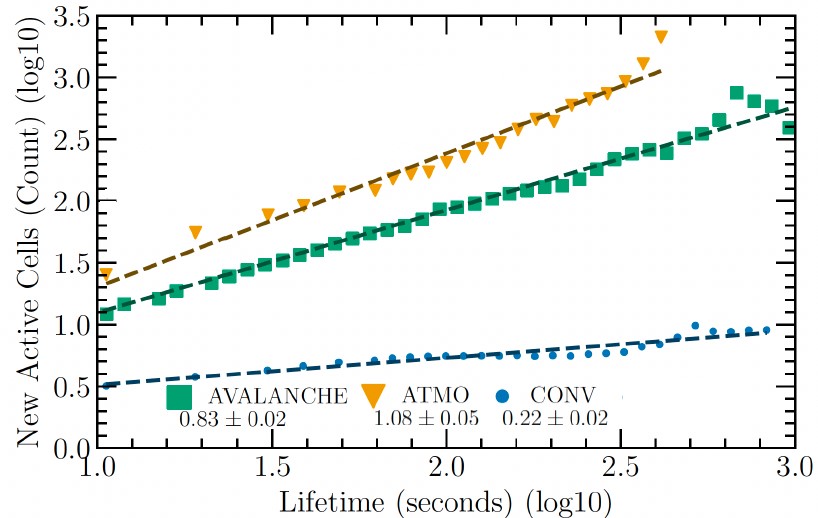
To emphasize the avalanche-like behavior of the 3-D simulation of the solar atmosphere, we present (in the figure on the right) a power law of the simulation:
- The green curve represents a typical avalanche behavior, such as that observed in snow avalanches (there are many small slides and a few large ones, but all follow a similar distribution).
- The orange curve represents the dynamics of the solar atmosphere. Its behavior follows a power law similar to that of avalanches, suggesting that phenomena in the solar atmosphere (such as flares or magnetic reconnections) propagate in a manner similar to an avalanche.
- The blue curve represents the internal dynamics of the Sun, linked to convection (movements of hot plasma inside the Sun). Here, the behavior is different, with a much shallower slope, indicating that the Sun’s convective dynamics do not follow a typical avalanche power law.
The simulation effectively reproduces a different dynamic between the Sun’s internal convective dynamics (High-Reynolds-number turbulent dynamics) and the Sun’s atmospheric dynamics (chaotic and cascading propagation), confirming that the latter behaves like an avalanche.
Toward Better Prediction of Solar Storms
These experimental and high-performance numerical simulation discoveries pave the way for a detailed understanding of the triggering mechanisms of flares and could help identify precursor signals to anticipate solar storms—a major challenge for protecting satellites and electrical grids.
Contacts: Allan-Sacha BRUN, Antoine STRUGAREK