

The UNIONS collaboration (The Ultraviolet Near Infrared Optical Northern Survey), an international team of astronomers, has published new results in cosmology using the weak gravitational lensing method. Published this month in a series of papers, this work probes the distribution of matter in the cosmic web by analyzing the shapes of 61 million galaxies undergoing subtle distortions due to gravitational lensing. This research aligns with the standard model of cosmology.
The map opposite shows the distribution of dark matter analyzed by the UNIONS collaboration. The Milky Way, as observed by the Gaia mission, is projected in the background. Dark blue areas indicate regions denser than average, while white areas correspond to the least dense regions. The gaps in the survey represent areas whose observations have not yet been processed. In the future, these missing regions of the dark matter map will be filled in.

Seeing the Invisible
The ordinary matter we observe—stars, gas, planets—accounts for only 5% of the universe’s composition. The rest is dark:
- Dark matter, invisible but whose gravity shapes the cosmic web and influences galaxy formation,
- Dark energy, responsible for the accelerated expansion of the universe.
Each of these components represents profound unsolved mysteries in physics. Although dark matter does not emit light, it can distort light’s path. As light from distant galaxies travels through the cosmos, the gravity of the matter it encounters, including dark matter, slightly bends its trajectory. As a result, galaxies appear slightly stretched. This effect, known as weak gravitational lensing, is imperceptible when considering galaxies individually. However, statistically measuring this effect using tens of millions of galaxies reveals the distribution of matter in our universe. This technique is called cosmic shear.
“Cosmic shear is a scientifically rich technique to study, at the intersection of many research fields, and the UNIONS collaboration is an excellent environment for testing and developing new ideas to better understand this effect.” – Sacha Guerrini, PhD student at CEA Paris-Saclay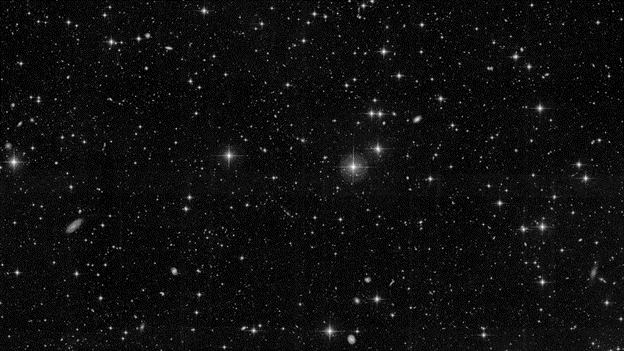

Data is collected using the Canada-France-Hawaii Telescope (CFHT) at the summit of Mauna Kea in Hawai’i. Equipped with the wide-field MegaCam camera, CFHT observes the sky in red visible light with exceptional clarity. This clarity is sufficient to discern a one-euro coin at seven kilometers away or the shape of millions of small galaxies located light-years away. The resulting catalog from these observations, obtained with MegaCam over nearly ten years and covering 3,500 square degrees of the sky, contains precise measurements of the shapes of over 61 million galaxies.
“ It is a pleasure to see these results, the fruit of several years of work, taking shape. In particular, thanks to the contribution of young researchers in our group.” ” – Martin Kilbinger, researcher at CEA Paris-Saclay and head of the UNIONS cosmology group at CEA.Strengthening the Standard Model – and Looking Ahead
UNIONS’ results are consistent with the standard model of cosmology, describing a universe composed primarily of dark matter and dark energy. This is an important independent confirmation in the northern hemisphere sky, where no survey of this scale and quality had been conducted before.
“Previous work by other groups focused on the southern hemisphere sky. What makes this data so valuable is that we used it to create the largest dark matter map of the northern hemisphere,” explains Dr. Mike Hudson, leader of UNIONS’ weak gravitational lensing team and professor of astrophysics and cosmology at the University of Waterloo. “These results deepen our understanding of dark matter and the formation of structures in the Universe.”Cosmic shear is one of the most powerful tools cosmologists have to study dark energy, particularly when combined with complementary methods such as Type Ia supernovae and baryon acoustic oscillations. Weak gravitational lensing and surveys like DESI measure different things—cosmic structure growth on one hand, and the history of expansion on the other—so UNIONS’ results do not contradict recent evidence from DESI suggesting a possible evolution of dark energy. On the contrary, these clues only appear when these probes are combined. UNIONS does not operate in isolation but provides an essential and independent piece to this overall picture.
This Is Only the Beginning for the Cosmological Exploitation of UNIONS Data
The collaboration is currently working on exploiting galaxy observations by taking their colors into account. By combining data from CFHT-MegaCam, Subaru, and Pan-STARRS, researchers will be able to determine the distance of each galaxy and thus map the universe more precisely. In turn, this will significantly improve what they can learn about the nature of dark matter and dark energy through UNIONS.
UNIONS also plays an important role in the Euclid space mission of the European Space Agency. From space, Euclid measures the shapes of billions of galaxies with extremely high precision, but these observations must be supplemented with ground-based images in multiple colors. In the northern hemisphere, UNIONS provides essential optical data for this purpose. This data helps to more accurately estimate the distances of galaxies observed by Euclid and improves the calibration of gravitational lensing measurements, transforming Euclid’s exceptionally sharp images into a three-dimensional map of the dark universe.

Contacts
– DAp: Calum MURRAY , Sacha Guerrini, Martin Kilbinger, Jean-Charles Cuillandre
– University of Waterloo: Mike Hudson
References:
F. Hervas-Peters et al., “UNIONS-3500 Weak Lensing: I. A Galaxy Shape Catalogue in the Northern Sky,” arxiv:2605.13549
C. Daley et al., “UNIONS-3500 Weak Lensing: II. B-mode validation for cosmic shear,” arXiv:2604.03227
L.W.K. Goh et al., “UNIONS-3500 Weak Lensing: III. 2D Cosmological Constraints in Configuration Space,” arxiv:2605.13547
S. Guerrini et al., “UNIONS-3500 Weak Lensing: IV. 2D Cosmological Constraints in Harmonic Space,” arxiv:2605.13543