




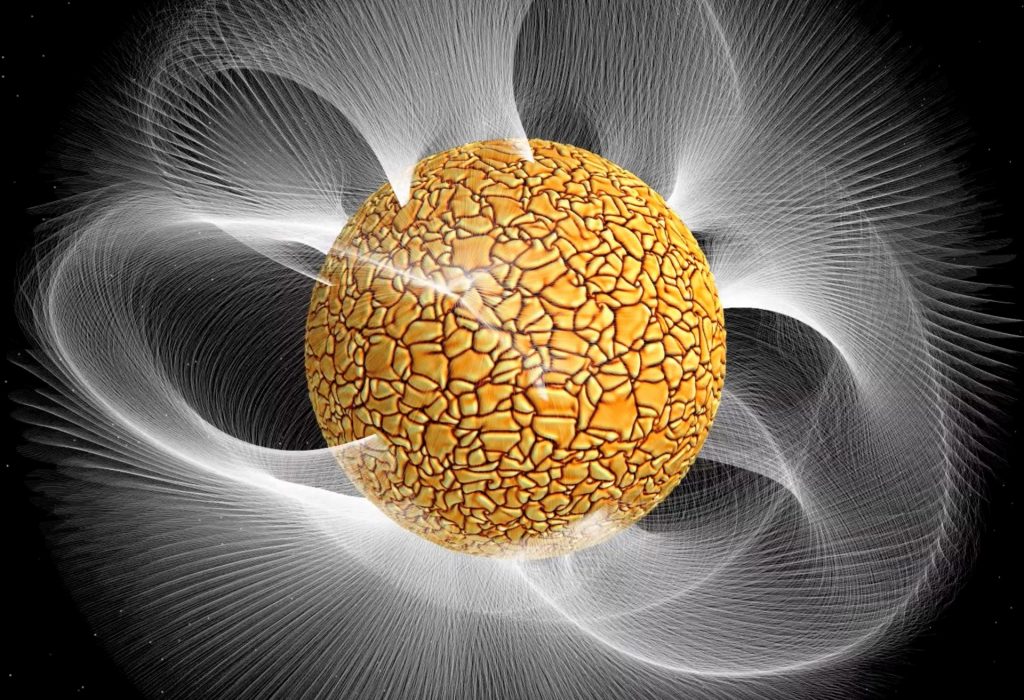
The Sun is a magnetic star, whose intense activity has a direct impact on our modern, technological society. Currently modulated by an 11-year cycle, has this always been the case, and will this cyclical state of the Sun’s magnetism persist over the course of its evolution?
It turns out that the braking of the stars would stop instead of continuing to slow down as we would expect. What changes in a star to explain why this deceleration has stopped?
To answer this key question about our star, an international team, including researchers from DAp-AIM, has carried out three studies, based on observations and multidimensional magnetohydrodynamic HPC numerical simulations on the GENCI supercomputers at TGCC and Idris, on the origin of the magnetism and rotation of the Sun and solar-type stars (via the physical mechanism known as fluid dynamo) in a “Sun over time” approach. These studies, after more than 5 years of code development and millions of hours of calculations, have highlighted the essential role of a parameter, called the Rossby number, in characterising not only the internal rotation properties of stars but above all the nature of their magnetism over secular time.
Credit: CEA/A. Strugarek, Q. Noraz, A.S. Brun
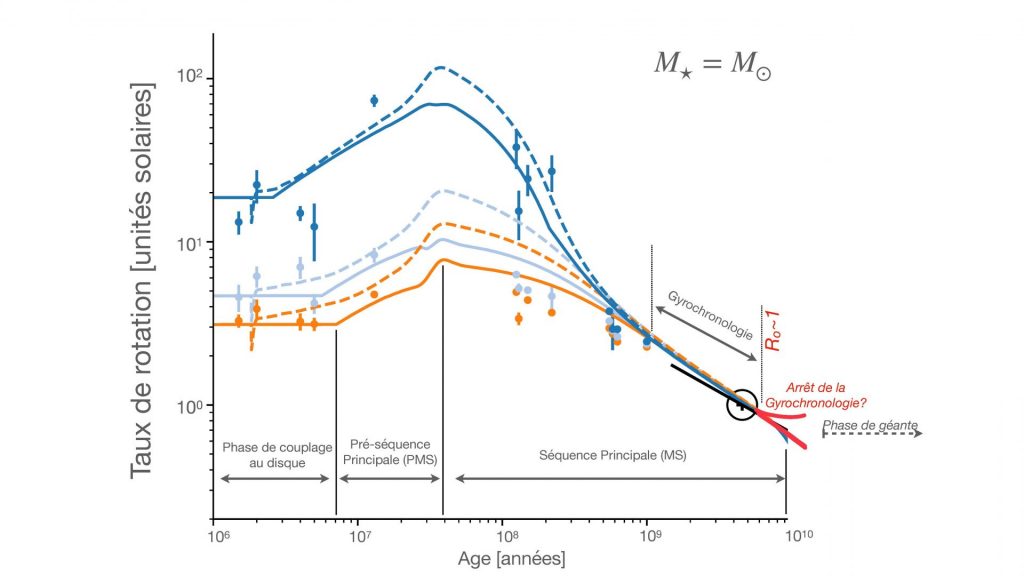
The Sun has gone through several phases in its evolution. Figure 1 shows the evolution of its rotation.
- In its young phase, the star first passes through a plateau, with rotation remaining constant for several million years until the star has decoupled from its primordial disc of matter (or accretion disc).
- Once this disc has dissipated (by forming planets, for example), the star contracts and accelerates (pre-main-sequence phase or PMS) to reach the highest rotational speeds, until conditions in its nuclear core are sufficient to trigger the burning of hydrogen by nuclear reactions. This critical point in the evolution of our star is called the ZAMS (zero age main sequence).
- The Sun then enters its main sequence and its rotation slows down as it loses angular momentum via its magnetised particle wind.
This scenario of the rotational history of our star is confirmed by the observation of star clusters of different ages, which we represent in Figure 1 by the small coloured discs with error bars.
It was proposed by Skumanich in 1972, then Barnes in 2003, that the slowing down of solar-type stars follows a law of the type Ω(t)~t-0.5, i.e. they all converge towards the same rotation from the age of the Hyades (around 650 to 800 million years ago). This direct relationship between the age and rotation rate of solar-type stars is known as gyrochronology.
The phase where all the curves (whatever their initial velocity) converge is the evolutionary period where gyrochronology is a priori possible, unless it stops for older stars with a Rossby number greater than 1 as recently proposed by some authors (Van Saders et al. 2016).
Alongside this change in the star’s rotation rate over secular time, there is also a change in the level of magnetic activity and the relative size of the star’s convective envelope. Young stars rotate rapidly and are very magnetically active, while older stars are slow and less active.
However, gyrochronology has recently been called into question by data from the Kepler satellite. The braking of solar-type stars would stop (red dot in Fig. 1) around the age of the Sun (around 4.5 Gans), which means that the wind would no longer be as effective at extracting the angular momentum of stars after this age.
We therefore need to better characterise the complex feedback loop between dynamo -> magnetism -> wind -> braking -> rotation -> dynamo in order to understand the secular evolution of the magnetism of solar-type stars and the possible existence of a magneto-rotational regime shift.
It turns out that these regime changes can be delimited by a quantity called the Rossby number, named after the famous Swedish physicist, which characterises how a star’s rotation influences its internal dynamics.
Thanks to multidimensional 3D MHD numerical simulations carried out with the ASH code on the GENCI supercomputers at the TGCC and Idris, a team of researchers from Irfu and international colleagues have developed simulations of the dynamo of solar-type stars with this precise aim (results published in Brun et al. 2022).
By changing the mass and rotation and therefore the Rossby number of the simulated stars (15 in number), they were able to explore different states of internal rotation of the star and consequently its magnetism. The 15 simulated stars are divided into three characteristic states of rotation (Figure 3):
- A state of rotation of a quasi-solid sphere (like a billiard ball) for fast rotators (young), Ro < 0.2
- A so-called solar state of rotation, with a fast equator and slow poles (intermediate ages), Ro ~ 0.2-0.7
- An anti-solar rotation state, with fast poles and a slow equator (potentially old stars), Ro > 1
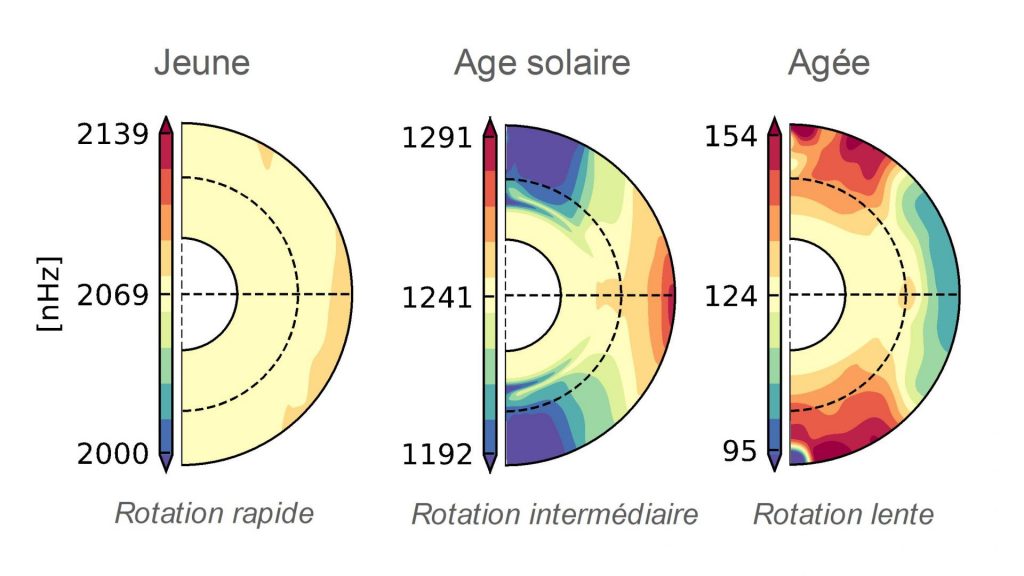
This change in rotation profile results from the different behaviour of the dynamo in the simulations, with one magnetic cycle and another not.
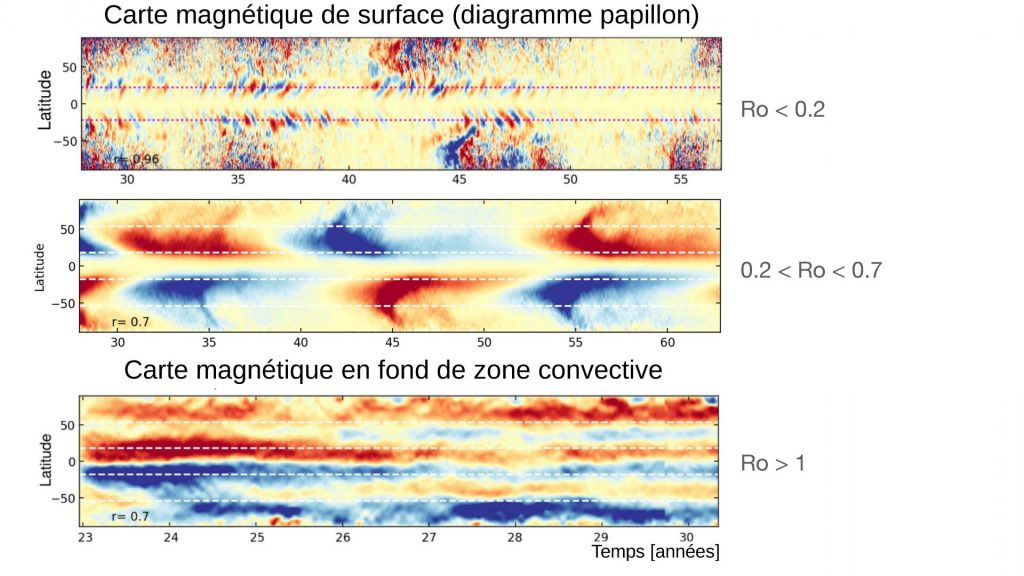
Figure 3 shows the synthesis of the magnetic state of stars according to their Rossby number.
There are 3 main classes:
- short-period cyclic dynamos (< 2 years) for small Rossby numbers (top figure),
- long cycles for intermediate Rossby numbers (middle figure), i.e. similar to the Sun,
- and finally stationary dynamos for Rossby numbers greater than 1 (bottom).
It would therefore seem that for slow rotators, an anti-solar state of rotation does indeed lead to a transition from a cyclic to a stationary dynamo regime.
In order to confirm this stationary dynamo state in the case of antisolar rotation, the team of researchers at Irfu undertook a specific study of antisolar dynamos in Noraz et al. (2022a), using a reduced but faster 2-dimensional model in order to extend the parameter space covered (since 3D simulation is very costly in terms of computing time, this would make a systematic study of the parameter space far too time-consuming).

Figure 4: At the top of the solar scenario (fast equator and slow poles), between the first and last images of the row, we can see that the poloidal field arrows have reversed (pointing downwards vs. upwards initially), implying the presence of an alternating magnetic polarity and therefore of a cycle (AC dynamo).
The conclusions of this study confirm those reached with the 3D simulations.
We show (Figure 4) that in the antisolar case, the dynamo loop reinforces the field at the poles in most cases, rather than cancelling it and changing its polarity, as in the case of the Sun. Remember that the sign of the Sun’s global (dipolar) magnetic field reverses every 11 years on average. It therefore seems that slow rotators have a high probability of having a non-cyclic magnetism.
However, does this mean that the large-scale magnetic geometry of the simulation has changed, for example from the dominance of a large-scale dipole to a small-scale, multipolar magnetic field structure? If this were the case, the effectiveness of braking by the wind would be greatly reduced, because this magnetic field acts like a lever to slow down the star during its lifetime. The larger the magnetic field and the more intense it is, the greater the leverage it provides, like the wings of a windmill covering a large surface area, effectively braking the star.
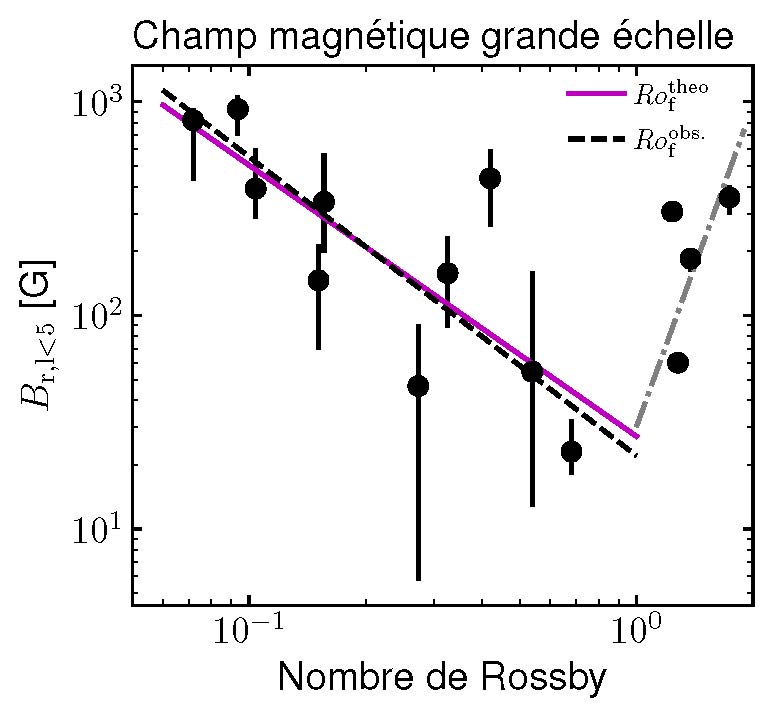
When the research team studied the global magnetic geometry of the antisolar dynamos and compared it with the fast rotators, they did not notice any flagrant change in the amplitude of the dipole (or of the other large-scale components of the magnetic field). Figure 5 shows the amplitude of the dipole in the 15 simulations as a function of the Rossby number and compares it with the observations (dotted black line). We can see that for Ro < 1 the agreement between simulations and observations is very good.
As for fast rotators up to the age of the Sun, the simulations reproduce well the observations of magnetic fields made by spectro-polarimetry as a function of the Rossby number, which confirms the authors that the simulations are robust and realistic.
On the other hand, when we consider the cases with Ro > 1, we see that the amplitude of these cases does not follow the same trend, or even an even steeper drop in the amplitude of the dipole. On the contrary, we see a possible rise in the dipolar magnetic field. The magnetic dipole of the slow rotators associated with their stationary dynamo (no cycle) is therefore not negligible, on the contrary it is even dominant.
It therefore seems unlikely that it is the disappearance of the magnetic dipole that is stopping the slowing down of stars suggested by the Kepler study cited above (Van Saders et al. 2016). On the other hand, it is interesting to note in Figure 5 that the possible existence of a local minimum around the age of the Sun in the large-scale field raises the question of whether stars could get ‘stuck’ there, thus explaining their inefficiency in slowing down according to Skumanich’s law. However, once this minimum has passed, the stars are likely to experience more intense braking. The duration of this stalling phase will depend on the shape of the minima, either U-shaped or V-shaped to put it simply.
In search of stars with anti-solar rotation in observation catalogues
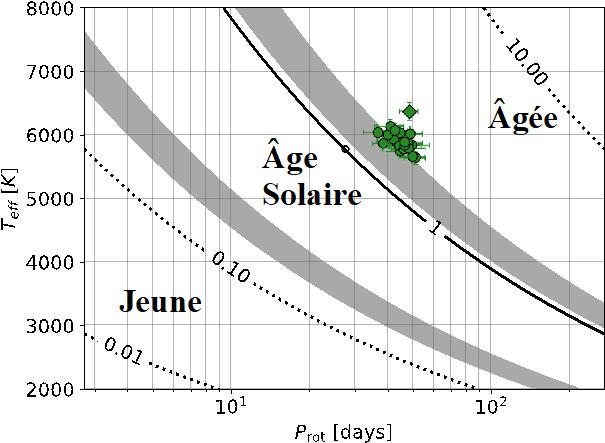
In this context, we have undertaken to identify candidate stars in the Kepler satellite data whose rotation profile could be anti-solar, in order to confirm the existence of this profile (Noraz et al. 2022b). Of the 200,000 stars in the catalogues consulted (Kepler, etc.), only 55,000 had an estimate of their rotation. From this sub-sample, the researchers calculated their Rossby number and only 22 of them have R>>1!
Figure 6 shows the stars in the Kepler sample with high observational Rossby numbers, which are likely to have antisolar rotation. To confirm the predictions of the 3D model, seismological observations with PLATO are planned.
This magneto-rotational scenario of stars will partly guide ESA’s PLATO space mission (mission 2026), for which Irfu is supplying software and sub-systems for high-speed cameras, because understanding the origin of magnetism and its variability will improve the detection of exoplanets using transit methods. Studying the magnetism of stars not only enables us to reconstruct their magneto-rotational history, but can also help us to better characterise the many exoplanets in our immediate environment, which very often orbit active stars that interfere with transit measurements.
Contacts Irfu : Allan-Sacha BRUN, NORAZ Quentin, Antoine STRUGAREK
References :
- van Saders J. L. , Ceillier T., Metcalfe T. S, Silva Aguirre, V., Pinsonneault M. H., García R. A., Mathur,S., Davies G. R., 2016 ,Nature , 529
https://ui.adsabs.harvard.edu/abs/2016Natur.529..181V/abstract
- Noraz Q., Breton S. N., Brun A. S., García R. A., Strugarek A., Santos A. R. G., Mathur S., Amard L., 2022, “Hunting for anti-solar differentially rotating stars using the Rossby number. An application to the Kepler field”, A&A 667, A50
https://ui.adsabs.harvard.edu/abs/2022A%26A…667A..50N/abstract
- – Brun A. S., Strugarek A., Noraz Q., Perri B., Varela J., Augustson K., Charbonneau P., Toomre J., 2022, “Powering Stellar Magnetism: Energy Transfers in Cyclic Dynamos of Sun-like Stars”, ApJ, 926, 21
https://ui.adsabs.harvard.edu/abs/2022ApJ…926…21B/abstract
- Noraz Q., Brun A. S., Strugarek A., Depambour G., 2022, “Impact of anti-solar differential rotation in mean-field solar-type dynamos. Exploring possible magnetic cycles in slowly rotating stars”, A&A, 658, A144
https://ui.adsabs.harvard.edu/abs/2022A%26A…658A.144N/abstract
- Ahuir J., Strugarek A., Brun A.-S., Mathis S., 2021, “Magnetic and tidal migration of close-in planets. Influence of secular evolution on their population”, A&A, 650, A126
https://ui.adsabs.harvard.edu/abs/2021A%26A…650A.126A/abstract
- Strugarek A., Beaudoin P., Charbonneau P., Brun A. S., do Nascimento J.-D., 2017, “Reconciling solar and stellar magnetic cycles with nonlinear dynamo simulations”, Sci, 357, 185
https://ui.adsabs.harvard.edu/abs/2017Sci…357..185S/abstract