





The TRAPPIST-1 system, fascinating for its seven Earth-sized rocky planets, three of which are located in the habitable zone, represents a unique opportunity to study the atmospheres of exoplanets. The James Webb Space Telescope (JWST) plays a key role in measuring the thermal emission of these temperate planets. An initial observation campaign at λ=15 µm revealed a temperature of 503 K on the day side of the planet TRAPPIST-1 b, suggesting the absence of an atmosphere and a very dark surface. However, based on the observations of a second campaign at λ=12.8 µm, this new study conducted by the IRFU Astrophysics Department at CEA Paris-Saclay measured a temperature much lower than that expected by the previous scenario, forcing the researchers to explore new avenues. Among the hypotheses considered, an atmosphere rich in CO₂ and mists is one possibility, although a volcanic ultramafic surface scenario seems more likely. To solve this mystery, a new phase of observations has been launched, aimed at tracking the planet’s luminous flux throughout its orbit.
This result was published in the prestigious journal Nature Astronomy: “Combined analysis of the 12.8 and 15 μm JWST/MIRI eclipse observations of TRAPPIST-1 b“
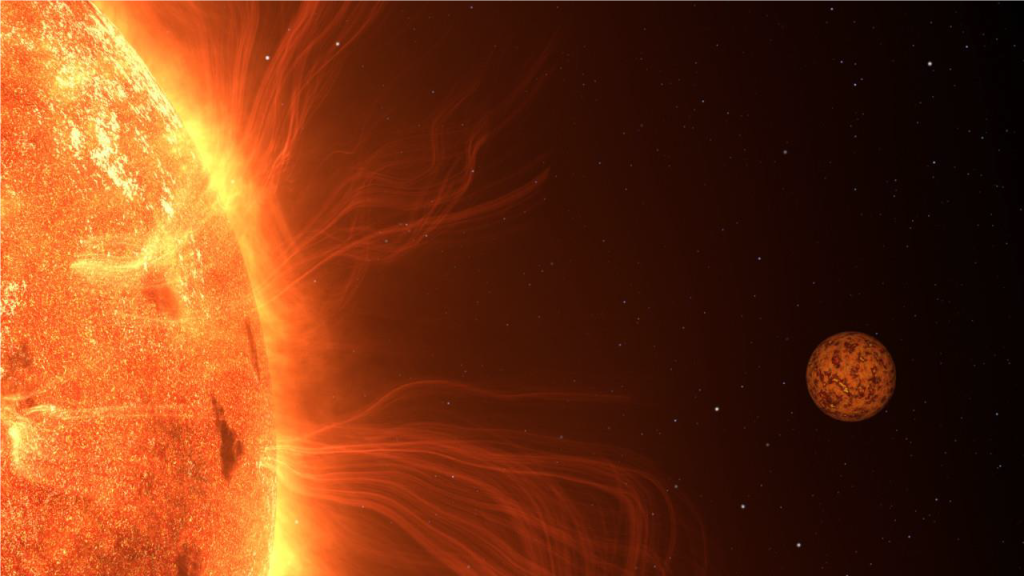
TRAPPIST-1: an ideal laboratory for studying the atmospheres of rocky planets
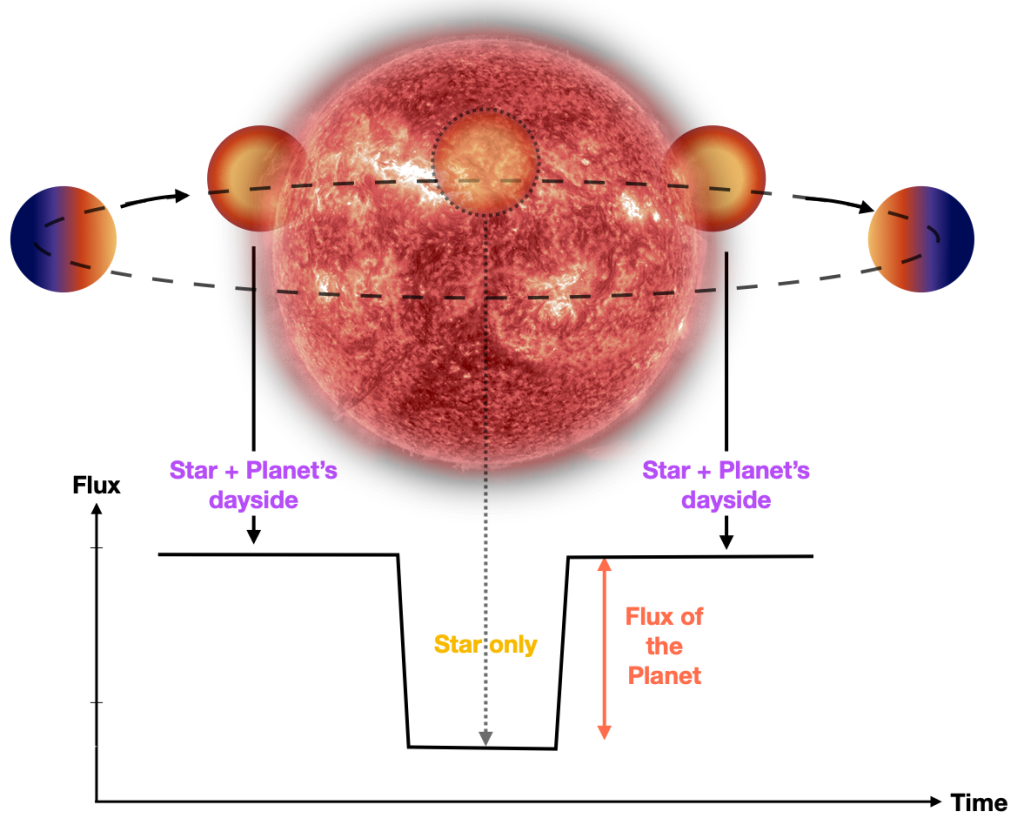
The TRAPPIST-1 system is characterised by its ultra-cool dwarf star surrounded by seven Earth-sized rocky planets, three of which are located in the habitable zone, offering an exceptional scientific opportunity for the study of exoplanets and their atmospheres. This system is therefore a prime target for the James Webb Space Telescope (JWST), whose infrared spectroscopic capabilities make it possible to study this type of planet in detail. In particular, the JWST is capable of directly measuring the heat emitted by a planet, by comparing the luminous flux of the star during an occultation – when the planet passes behind the star – with the flux observed just before and after this event (see Figure 2). This method makes it possible to deduce the infrared light emitted by the illuminated face (day side) of the planet, while avoiding stellar contamination that can complicate measurements in other configurations, such as transits.
Thermal emission quickly became the preferred method for studying rocky exoplanets around M dwarf stars during the first two years of JWST, explains Pierre-Olivier Lagage, co-lead author of the study and Director of the Astrophysics Department at CEA. As far as the TRAPPIST-1 planets are concerned, the first information comes from emission measurements, because it is still difficult to distinguish between atmospheric and stellar signals in transit.
Two observation campaigns with the JWST have been carried out to study the TRAPPIST-1 b planet because, being the closest to the host star, it emits more infrared radiation than the other planets in the system. These observations were carried out with the MIRIm imager, developed at CEA Paris-Saclay, using carefully chosen filters to detect the presence of carbon dioxide (CO₂) and measure its content.
The first campaign, carried out in 2023 by a NASA team in collaboration with the IRFU Astrophysics Department at CEA Paris-Saclay, used a filter centred at λ=15 µm. These observations determined that the day side of TRAPPIST-1 b has a temperature of around 503 K (+/- 26 K), marking the very first direct measurement of the temperature of a temperate rocky planet in the history of the study of exoplanets.
With such a temperature, scientists have suggested that TRAPPIST-1 b would instead have a “bare, dark surface”, where the planet would have no atmosphere, and its surface would absorb almost all the incident starlight (Greene et al., 2023). This hypothesis is based on the fact that CO₂ absorbs strongly at this wavelength; a CO₂-rich atmosphere would therefore have considerably reduced the observed flux. However, a single measurement at one wavelength is not sufficient to rule out all possible atmospheric scenarios.
Bare surface or complex atmosphere?
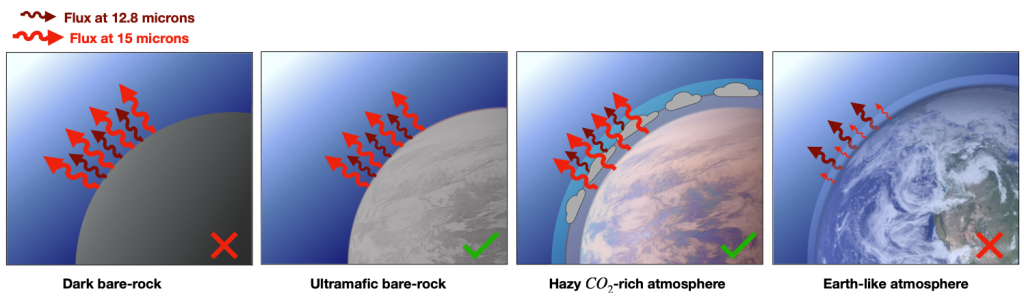
This new study, led by a team from CEA Paris-Saclay, complements previous observations by this time measuring the TRAPPIST-1 b flux at 12.8 microns, a second absorption band characteristic of CO₂. While the initial “naked dark surface” scenario proposed by Greene et al. (2023) predicted a temperature of around 227°C at this wavelength, the researchers measured a much lower temperature of 150°C. This result invalidates the previous scenario, based on observations at 15 microns, forcing the researchers to explore other surface and atmospheric models. Two new scenarios seem to have emerged (see Figure 3):
- Ultramafic bare surface” scenario: TRAPPIST-1 b would have no atmosphere, but its surface would be composed of ultramafic rocks, mineral-rich volcanic rocks that emit less light at 12.8 microns than a conventional dark surface. This result suggests the possible existence of volcanism, because without this process creating new rocks, the rocks would be rapidly altered and blackened by the star’s activity.
- Atmosphere rich in CO2 haze” scenario: TRAPPIST-1 b would have a CO₂-rich atmosphere with thick mists, formed of tiny particles or droplets from chemical reactions linked to volcanic activity or solar radiation. These mists would absorb starlight and cause the upper layers of the atmosphere to heat up, creating a thermal inversion where the temperature increases with altitude. This phenomenon, similar to that in the Earth’s stratosphere – although linked here to CO₂ and not ozone – would explain a higher emission at 15 microns compared with 12.8 microns, an unexpected behaviour compared with the CO₂ observed on Earth or Venus.
Although mists are already known to influence temperature and atmospheric appearance, as on Titan, their impact on TRAPPIST-1 b remains surprising. However, the authors believe that the ‘ultramafic bare surface’ scenario is more likely, given the complexity and uncertainties associated with the formation of such mists.
We were surprised to measure a significantly lower temperature than expected. We thought that the case of TRAPPIST-1 b was closed, but this new wavelength reminds us of all the ambiguities that exist when describing a planet from discrete observations, emphasises Elsa Ducrot, researcher in the CEA’s Astrophysics Department and principal author of this study. What’s more, this measurement stimulated our curiosity and enabled us to propose an atmospheric scenario with novel mists in line with the data. Although it seems less likely, it is very interesting that the scientific community can take it into account in the interpretation of future observations of rocky exoplanets.
How can we solve the mystery?
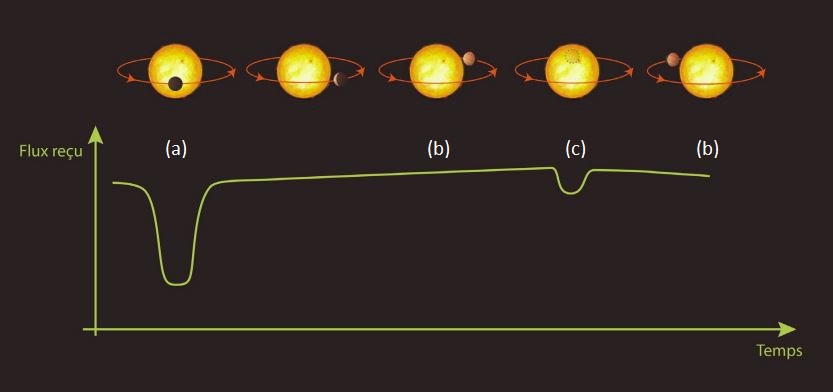
This new study highlights the challenges posed by the definitive determination of the presence of an atmosphere on a planet based solely on measurements of thermal emission during occultations. To definitively solve the mystery of the presence of an atmosphere on TRAPPIST-1 b, the researchers launched a new observation campaign with the JWST aimed at measuring the flux of the planet throughout its complete orbit, and not just on its day side (see Figure 4). Subsequently supplemented by complex 3D atmospheric simulations, this method, although costly in terms of observation time, is essential for deciding on the existence or absence of an atmosphere around TRAPPIST-1 b.
If an atmosphere is present, the heat will be redistributed from the day side to the night side of the planet. Without an atmosphere, this redistribution will be minimal, explains Michaël Gillon from the University of Liège, co-author of the study.
These answers could herald a new era in the study of the atmospheres of rocky exoplanets.
CEA/IRFU contacts: Elsa Ducrot, Pierre-Olivier Lagage