


The Einstein Probe (EP) mission, launched in January 2024, aims to detect in real time cosmic explosions in X-rays in real time, releasing extreme energy. These phenomena, known as Fast X-ray Transients (FXTs), act as powerful background lamps to explore the Universe. Since its launch, EP has identified about 80 such events, with around twenty followed up from the ground to date their host galaxies.
On March 15, 2024, EP observed the event EP240315a in a very distant galaxy (redshift z = 4.859, corresponding to 1.2 billion years after the Big Bang). Analysis of its optical counterpart (AT2024eju) using the Very Large Telescope revealed, for the first time at such a distance, UV photons capable of ionizing hydrogen. This proves that some young galaxies were leaking this energetic light, contributing to the reionization of the Universe. These results were published in Nature Astronomy (“Fast X-ray transient EP240315A from a Lyman-continuum-leaking galaxy at z ≈ 5“).
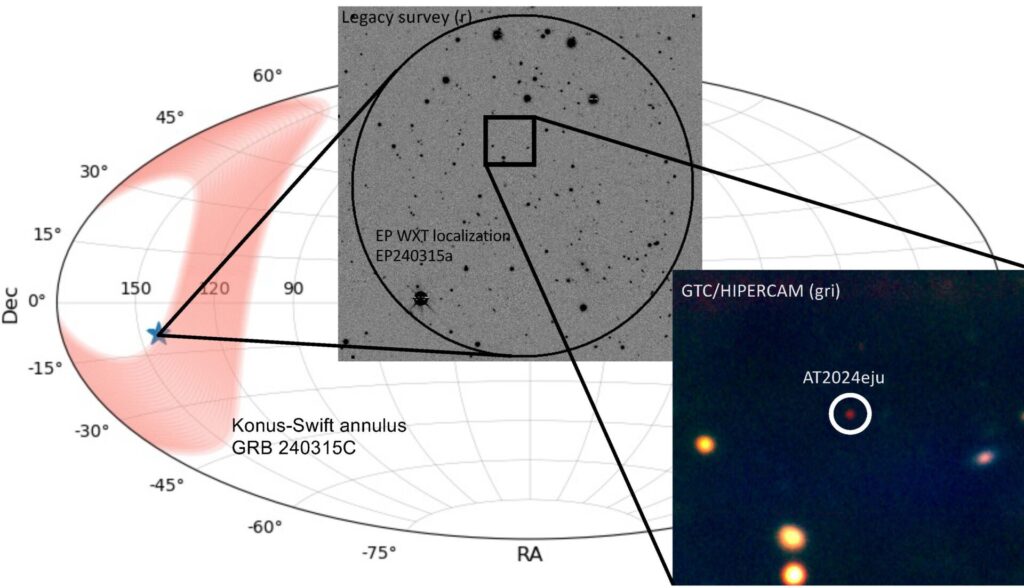
Timeline of the EP240315a Event
Researchers used an initial precise position provided by Einstein Probe, refined from the ground using the ATLAS optical telescope, and then pointed the VLT (European Southern Observatory) in Chile and the GranTeCan (GTC) in Spain toward this region of the sky.
- T0 (blue star, black zoom circle): Intense X-ray detection in the 0.5–4 keV band, with no initial strong gamma-ray emission, distinguishing it from classical Gamma-Ray Bursts (GRBs). The X-ray emission lasted about 1,600 seconds, classifying it as an FXT.
- T0+1h (red dot, white circle): ATLAS optical counterpart detected.
- T0+20h: X-ray burst reported to the General Coordinates Network by the EP collaboration.
- T0+26h: Optical counterpart reported to the General Coordinates Network by ATLAS.
- T0+29h: Very Large Telescope points toward the optical counterpart.
- T0+16.5 days: Very Large Telescope points toward the host galaxy.
Yet, this explosion held one more surprise
Fast X-ray Transients (FXTs) and their associated optical counterparts act as extremely powerful natural background lamps. As their light passes through the host galaxy and the intergalactic medium, it allows us to determine whether ionizing ultraviolet photons—those capable of turning neutral hydrogen into plasma—have managed to escape the galaxy. This means that in certain galaxies, massive stars can produce enough ionizing photons, and these photons can leave the galaxy without being absorbed by gas or dust. If they reach the intergalactic medium, they can contribute to the reionization of the Universe, a fundamental process that made the Universe transparent to light. Therefore, thanks to transient sources like FXTs or Gamma-Ray Bursts (GRBs), we can identify the galaxies where this mechanism is at work—and understand how the first stars changed the state of the cosmos.
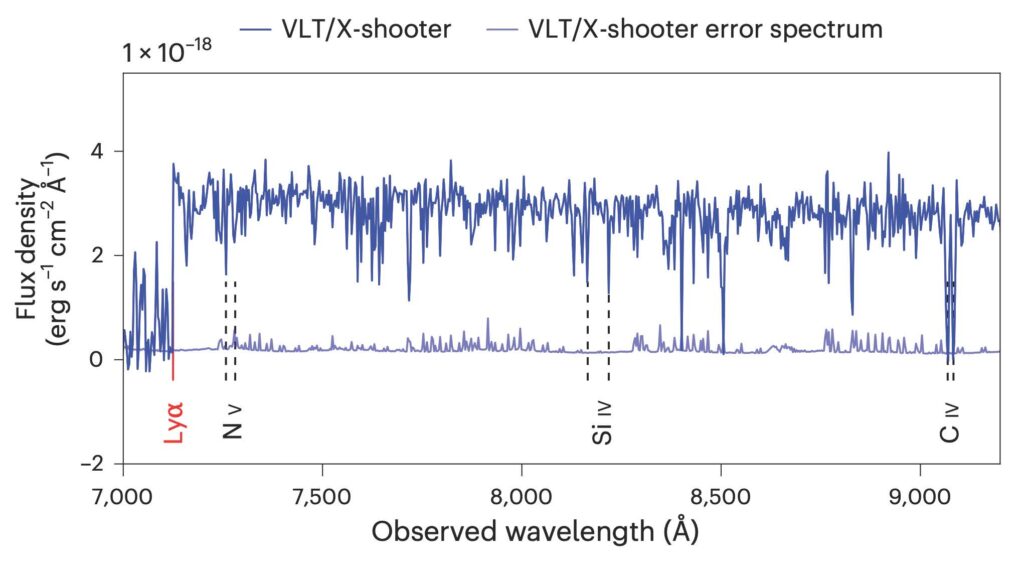
By examining the Very Large Telescope data from the observation of event EP240315a, researchers found that there was very little surrounding matter—particularly hydrogen—around this explosion. Hydrogen acts as a filter for ultraviolet light, preventing it from passing through the galactic medium. The UV light produced by stars is typically blocked by the hydrogen within their own galaxy. However, at the time of this fast transient, the Universe was undergoing its last major transformation: reionization, a process during which intergalactic hydrogen was struck by UV light and reionized.
“Our observations with the VLT showed that about 10% of the UV light produced in the host galaxy of this fast transient escapes to ionize the Universe. This is the most distant event where we can directly observe this escaping light around stars. Galaxies of this type are probably crucial for reionization” adds Andrea Saccardi.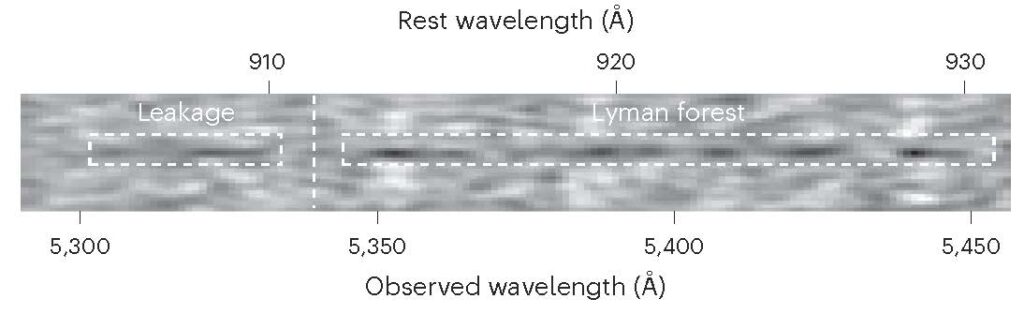
The Host Galaxy
Photometric and spectroscopic observations at the precise location of the afterglow (the optical counterpart), once it had faded, allowed the study of the continuum and emission lines of the host galaxy to determine integrated properties such as the star formation rate.
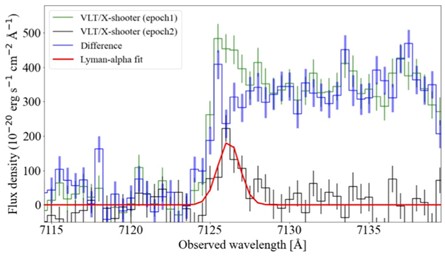
A second spectrum obtained with the VLT/X-shooter instrument on March 31, 2024—16.5 days after the burst—confirmed the presence of Lyman-α emission, previously detected (but contaminated by the FXT’s optical counterpart) during the first observation. By this time, the afterglow had significantly faded, clearly revealing the Lyα emission line from the host galaxy. This detection provides a lower limit for the star formation rate in the host galaxy, estimated at over 0.43 solar masses per year.
Einstein Probe and SVOM Joint Science
Combining data from the Einstein Probe mission with those from SVOM is expected to advance our understanding of the early Universe.
A collaboration agreement states that each satellite automatically and rapidly monitors transient sources detected by the other. Since the launch of SVOM, the two missions have jointly worked on numerous events. This coordination optimizes multi-band coverage and enriches the scientific analysis of observed events.
EP primarily observes in soft X-rays (0.5–4 keV), while SVOM covers 4 keV to 5 MeV with the ECLAIRs and GRM instruments, and extends to optical wavelengths with the VT instrument. Thanks to the sensitivity of FXT, it plays an important role for SVOM in X-ray detection, and conversely, VT’s capabilities are crucial for identifying the optical counterparts of EP bursts.
The CNES and the Department of Astrophysics at CEA Paris-Saclay are members of the Einstein Probe collaboration. The combined exploitation of data from this mission with SVOM is expected to advance our understanding of the young Universe.
In the longer term, much weaker X-ray events—and potentially even more distant ones—could be detected by future missions dedicated to gamma-ray bursts, such as THESEUS (Transient High Energy Sky and Early Universe Surveyor). These missions could push the boundaries of observation in the early Universe and reveal how and when the first stars formed and how their explosions enriched the interstellar medium with the first metals.
Contact IRFU/DAP : Andrea SACCARDI