

The COMCUBE-S project has successfully completed a key milestone: the feasibility study phase, known as Phase A. Validated by ESA, this step confirms the scientific and technical viability of the mission, which can now begin prototyping. Led by a European collaboration between CEA, CNRS, the Royal Institute of Technology (Sweden), and University College of Dublin (Ireland), the project aims to deploy a constellation of 27 nanosatellites by 2035, covering the entire terrestrial equator. The major innovation of this project is that each identical satellite will be equipped with a fast, high-performance gamma-ray spectro-polarimeter which, despite its small size, could revolutionize our understanding of gamma-ray bursts and the distant Universe.
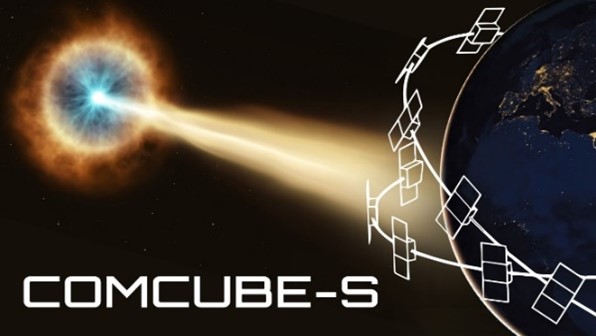
Multi-messenger and multi-wavelength astronomies require continuous monitoring of the sky in the gamma-ray domain to quickly detect and locate gamma-ray bursts produced by the collision of compact celestial bodies or the implosion of supermassive stars. These extremely short bursts, lasting from a few tens of milliseconds to several hundred seconds, remain highly mysterious. The COMCUBE-S project aims to provide a new understanding of these gamma-ray bursts and offer an unprecedented diagnosis of the physics of the jets produced in the bursts, as well as the nature of their astrophysical progenitors.
To achieve this, 27 nanosatellites will be deployed around the Earth in a 500 km orbit to detect gamma-ray bursts and measure their spectral, temporal, and polarimetric properties—studies that have currently only been conducted for a handful of very bright bursts. Furthermore, the observation of the same burst by multiple satellites in the constellation will allow the position of the gamma-ray burst in the sky to be determined by triangulation, enabling rapid ground notifications. This will trigger follow-up observations of the source by other ground-based telescopes.
Observations of the host galaxies of gamma-ray bursts, such as those conducted by the SVOM mission, have confirmed that these extraordinary events can occur at cosmological distances. Due to their extreme intensity over a short period, they can be detected in the most ancient galaxies. Gamma-ray bursts are thus on their way to becoming new standard candles for studying the structure and evolution of the Universe. It is therefore essential to understand the physical phenomena producing this intense high-energy beam of light.
By measuring the polarization of the emitted gamma-ray light, we will be able to better interpret these phenomena by adding complementary information to the spectral and temporal signatures. For example, the presence of a strong, ordered magnetic field in the burst jet produces a flux of gamma photons via synchrotron radiation, whose spectrum is similar to that produced by other phenomena (such as inverse Compton scattering), but which has a very specific polarimetric signature that only COMCUBE-S will be able to decipher!
COMCUBE-S: A Swarm of 27 Identical Nanosatellites
The payload of each COMCUBE-S nanosatellite consists of:
- A spectro-polarimeter
- A high-energy spectrometer
- A control unit
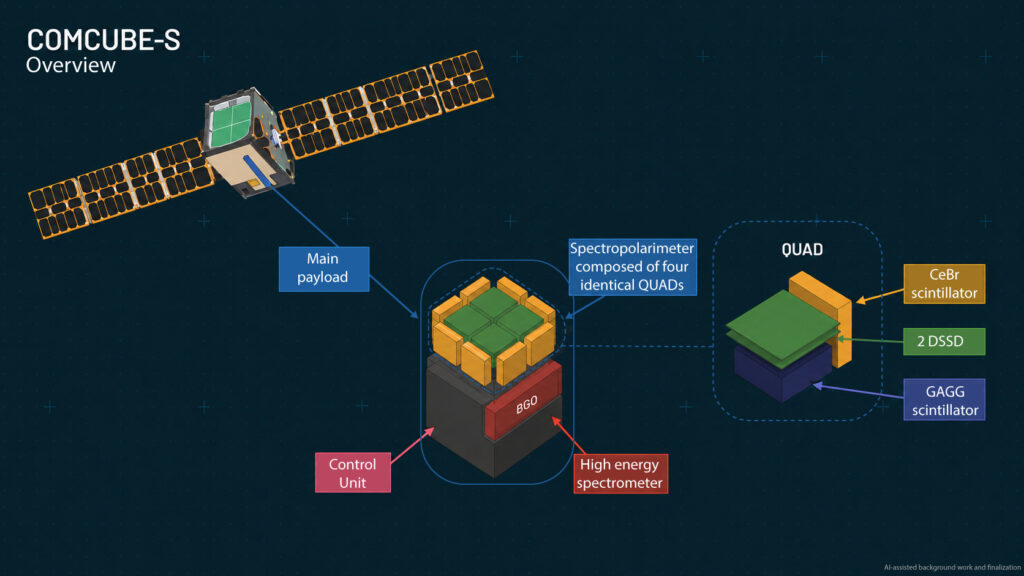
The spectro-polarimeter will consist of 4 identical quads and will measure polarization between 100 keV and 460 keV, covering the majority of observed bursts. It will also produce spectra in the range of 30 keV to 2 MeV, similar to SVOM. Each quad is composed of two layers of DSSD (double-sided silicon strip detector), facilitating Compton scattering (learn more about the principle of Compton polarization), and two scintillators—one CeBr3 on the side and another GAGG below—which will absorb the scattered photons (see Figure 2).
The CEA-IRFU/DAp is responsible for the system study and electrical architecture design of the COMCUBE-S payload, in collaboration with our colleagues from IJCLab, KTH, and UCD, as well as for determining the radiation environment of the nanosatellites. The goal is to study the entire satellite by examining the performance of the various detectors based on external factors (temperature, radiation, pressure, etc.), their respective influences, and spatial constraints such as size and the power required for operation.
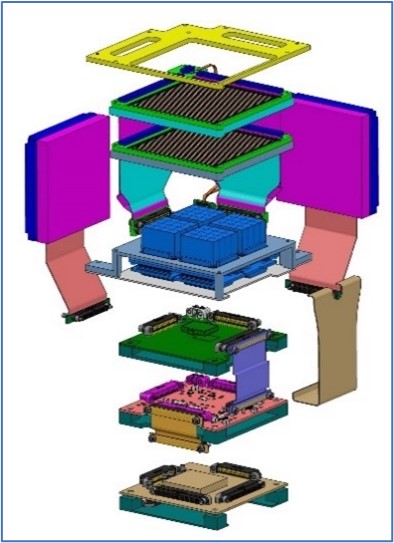
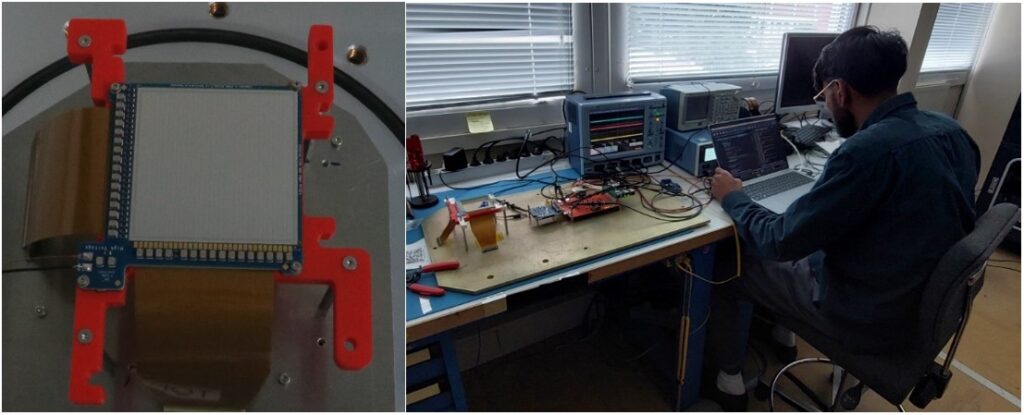
Our team must also design, manufacture, calibrate, and deliver the top-face detector of the polarimeter and its readout chain, consisting of a DSSD manufactured by Micron Semiconductor Ltd and readout by the low-noise, space-qualified IDeF-X HDBD ASICs developed at IRFU (see Figure 3). We also contribute to the control unit by providing all the low-noise power supplies for the instrument.
A dedicated test bench is currently under development at the Astrophysics Department, where the detector will be illuminated by radioactive sources. The signal produced by the DSSD after detecting a gamma photon from this source will pass through the entire readout chain to be digitized. This will allow us to characterize the DSSD by measuring its response at different energies, all at temperatures ranging from -20°C to 20°C, representative of what the satellite will experience as it orbits around the Earth (see Figure 3).
What’s Next?
The mission’s development schedule, supervised and funded by the European Space Agency (ESA), includes the launch of two nanosatellites by 2030 to conduct an in-orbit demonstration (IOD) of the technologies used in COMCUBE-S.
Following the success of the first phase (Phase A), after a comprehensive review by the ESA of the scientific objectives and the design of the nanosatellite and its spectro-polarimeter, the teams are now entering Phase B. This one-year phase will involve building a first prototype of the instrument to demonstrate its performance.
Contact: P. Laurent
IRFU Contributors: D. Baudin, C. Boreux, A. Claret, E. Doumayrou, A. Meuris, A. Poitaya, D. Renaud