





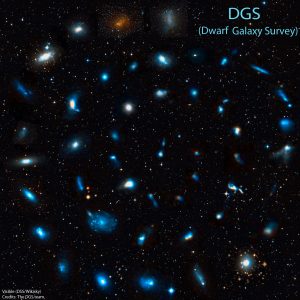
The Herschel Dwarf Galaxy Survey
“The ISM in Low Metallicity Environments: Bridging the Gap Between Local Universe and Primordial Galaxies”
The Herschel Dwarf Galaxy Survey is a Guaranteed Time Key Program led by Suzanne Madden.
Abstract:
While much of what we have gleaned of the details of dust and gas properties and the processes of dust recycling and heating and cooling in galaxies has been limited to Galactic studies, with Herschel we will be able to explore these issues in low metallicity dwarf galaxies which are known by now to exhibit dust and gas properties different from more metal-rich galaxies. Because these objects are relatively nearby, it is possible to relate the observed variations in the SEDs to the actual physical phenomena occuring within the ISM of the galaxy, allowing the construction of a rich interpretative framework for unresolved, more distant galaxies in the early universe. Using the SPIRE and PACS instruments on Herschel, we propose to map the dust and gas in a 50 dwarf galaxies, sampling a broad metallicity range of 1/50 to 1/2 solar. These data, in conjunction with other ancillary data, will be used to construct the emission spectrum of the dust plus that of the gas in the most important cooling lines. The combination of these instruments onboard Herschel will provide the first opportunity to study the dust and gas in extremely low metallicity environments that have not yet experienced repeated recycling through the ISM. The interpretation of this data will open the door to comprehending primordial ISM conditions and star formation in the young universe.
Sample
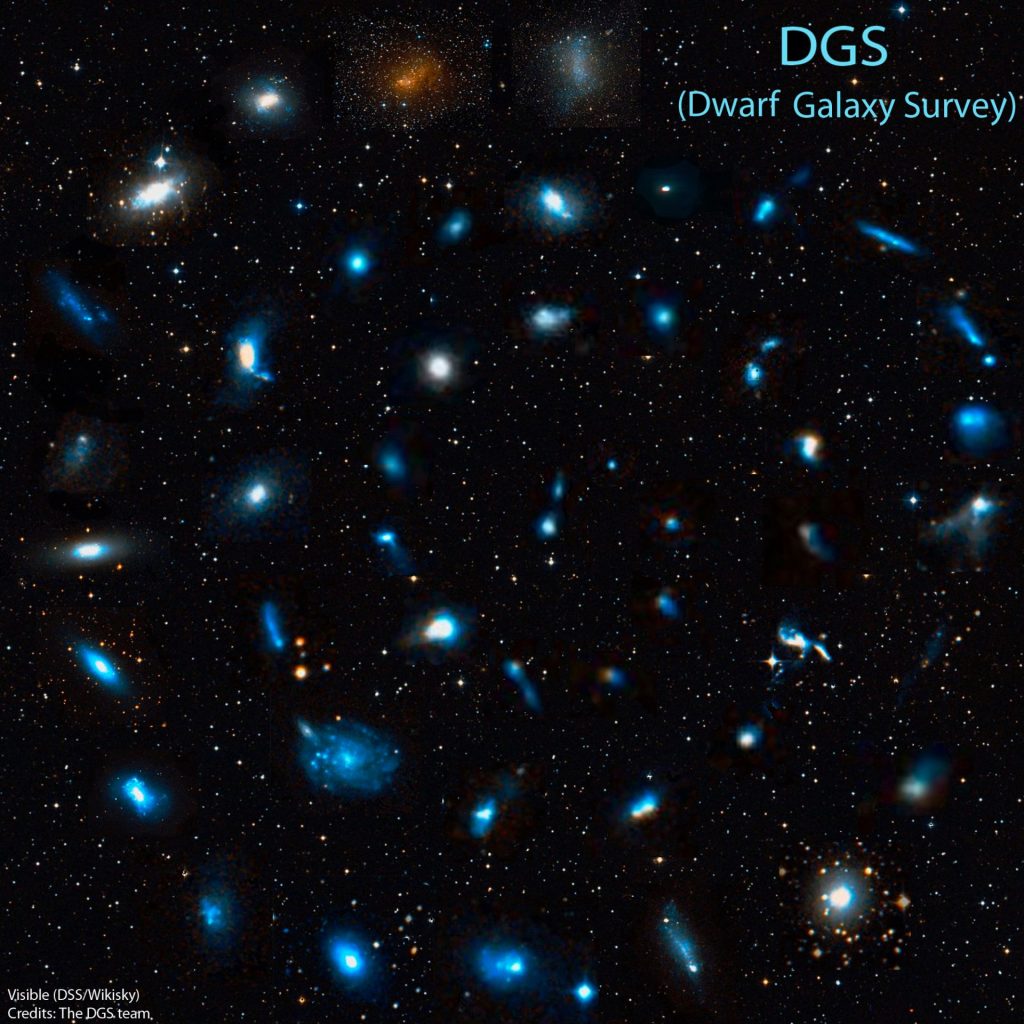
The Herschel Dwarf Galaxy Survey has observed 50 galaxies, including regions of the Magellanic Clouds, Local Group galaxies, and galaxies out to a distance of 200 Mpc. They were chosen to cover a broad range of metallicities, from 1/50 to 1/2 solar. The sample was selected from surveys of metal-poor Blue Compact Dwarf galaxies and of emission line galaxies identified in the Hamburg/SAO Survey and the First and Second Byurakan Surveys.
Herschel PACS and SPIRE Observations
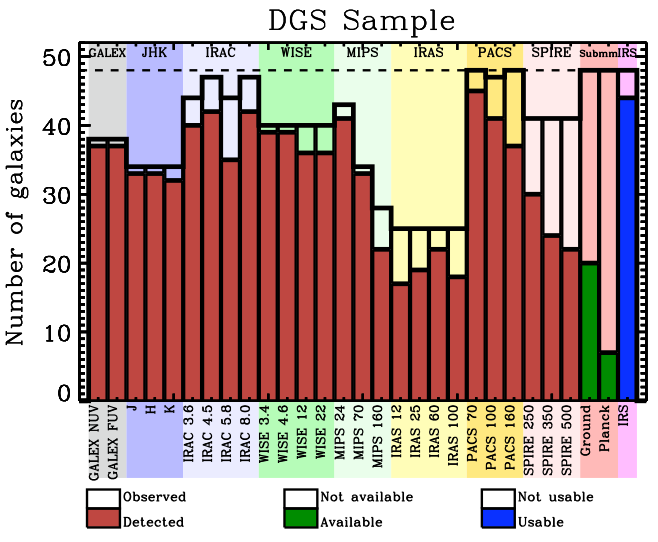
Our sample consist of 50 galaxies observed with PACS and SPIRE in photometry and spectroscopy (Madden et al. 2013). The spectroscopy of the extended sources was observed as part of the SHINING program (Sturm et al. 2011). The photometry of the Magellanic Clouds belongs to the HERITAGE program (Meixner et al. 2013).
Table keys: • = in our program • = in the archive • = no 70 or 100µm
Team Members
Suzanne Madden (PI) AIM, CEA Saclay suzanne.madden [at] cea.fr Mélanie Chevance Universität Heidelberg chevance [at] uni-heidelberg.de Diane Cormier AIM, CEA Saclay diane.cormier [at] cea.fr Ilse De Looze Universiteit Gent ilse.delooze [at] ugent.be Maud Galametz AIM, CEA Saclay maud.galametz [at] cea.fr Frédéric Galliano AIM, CEA Saclay frederic.galliano [at] cea.fr Sacha Hony Universität Heidelberg sacha.hony [at] free.fr Vianney Lebouteiller AIM, CEA Saclay vianney.lebouteiller [at] cea.fr Min-Young Lee MPIfR Bonn mlee [at] mpifr-bonn.mpg.de Fiorella Polles Observatoire de Paris fiorella.polles [at] cea.fr Aurélie Rémy-Ruyer —– —– Ronin Wu Observatoire de Meudon ronin.wu [at] obspm.fr and the SAG2 consortium
Publications
2019♣Cormier et al. 2019, A&A, in press
The Herschel Dwarf Galaxy Survey: II. Physical conditions, origin of [CII] emission, and porosity of the multiphase low-metallicity ISM2018♣Polles et al. 2019, A&A, 622, 119
Modeling ionized gas in low-metallicity environments: the Local Group dwarf galaxy IC102017♣Lebouteiller et al. 2017, A&A, 602, 45
Neutral gas heating by X-rays in primitive galaxies: Infrared observations of the blue compact dwarf I Zw 18 with Herschel♣Cormier et al. 2017, MNRAS, 468, 87
New ALMA constraints on the star-forming interstellar medium at low metallicity: a 50 pc view of the blue compact dwarf galaxy SBS 0335-0522016♣Lee et al. 2016, A&A, 596, 85
Radiative and mechanical feedback into the molecular gas in the Large Magellanic Cloud. I. N159W♣Chevance et al. 2016, A&A, 590, 36
A milestone toward understanding PDR properties in the extreme environment of LMC-30 Doradus2015♣Rémy-Ruyer et al. 2015, A&A, 582, 121
Linking dust emission to fundamental properties in galaxies: The low-metallicity picture♣Cormier et al. 2015, A&A, 578, 53
The Herschel Dwarf Galaxy Survey: I. Properties of the low-metallicity ISM from PACS spectroscopy2014♣De Looze et al. 2014, A&A, 568, 62
The applicability of far-infrared fine-structure lines as star formation rate tracers over wide ranges of metallicities and galaxy types♣Cormier et al. 2014, A&A, 564, 121
The molecular gas reservoir of 6 low-metallicity galaxies from the Herschel Dwarf Galaxy Survey: A ground-based follow-up survey of CO(1-0), CO(2-1), and CO(3-2)♣Rémy-Ruyer et al. 2014, A&A, 564, 31
Gas-to-Dust mass ratios in galaxies over a 2 dex metallicity range2013♣Rémy-Ruyer et al. 2013, A&A, 557, 95
Revealing the cold dust in low-metallicity environments – I. Photometry analysis of the Dwarf Galaxy Survey with Herschel♣Madden et al. 2013, PASP, 125, 600
An Overview of the Dwarf Galaxy Survey♣Karczewski et al. 2013, MNRAS, 431, 2493
A multiwavelength study of the Magellanic-type galaxy NGC 4449 – I. Modelling the spectral energy distribution, the ionization structure and the star formation history2012♣Lebouteiller et al. 2012, A&A, 548, 91
Physical conditions in the gas phases of the giant H II region LMC-N 11 unveiled by Herschel – I. Diffuse [C II] and [O III] emission in LMC-N 11B♣Cormier et al. 2012, 548, 20
The nature of the interstellar medium of the starburst low-metallicity galaxy Haro 11: a multi-phase model of the infrared emission2010♣O'Halloran et al. 2010, A&A, 518, 580
Herschel photometric observations of the low metallicity dwarf galaxy NGC 1705♣Cormier et al. 2010, A&A, 518, 57
The effects of star formation on the low-metallicity ISM: NGC 4214 mapped with Herschel/PACS spectroscopy♣Galametz et al. 2010, A&A, 518, 55
Herschel photometric observations of the nearby low metallicity irregular galaxy NGC 6822
Links
|
For Herschel PACS data reduction and analysis, we used the PACSman software. It includes IDL routines for line fitting and map making. For more information, go see Vianney's website here. |
|||
|
The HErschel DAtabase in Marseille (HEDAM) is the repository of several Herschel Key Programs and will soon host data products of the DGS. Access the HEDAM website here. |