

Matteo BUGLI, an astrophysicist specializing in numerical modeling of supernovae, has just been awarded the prestigious European ERC Starting Grant for his project BlackJET, which aims to provide a unified description of the formation of long gamma-ray bursts (LGRBs). The project will consistently model all stages of these phenomena, from the onset of stellar collapse to the observed electromagnetic emission.
Matteo BUGLI, a postdoctoral researcher at CEA’s Department of Astrophysics (DAp) from 2018 to 2022, is currently based at the Institut d’Astrophysique de Paris. He will join the Astrophysics Department at Irfu in March 2026 to launch his ERC project.

BlackJET (Unified models of long gamma-ray bursts: from stellar progenitors and Black holes to Jets and Electromagnetic Transients) is expected to have a groundbreaking impact in three main areas of research:
- The gravitational collapse of a massive star
- The modeling of relativistic particle jets emerging from gravitational collapse,
- The observation of gamma-ray bursts by satellite missions (such as the SVOM satellite, recently launched in 2024).
For the first time, this global theoretical approach will combine different simulation strategies to capture the complexity of stellar explosions producing relativistic outflows, spanning eight orders of magnitude in spatial scales and five orders of magnitude in time. By simulating the collapse of a wide variety of stars with different masses and rotation speeds, the project will bridge the current gap between ab initio numerical models of collapsing stars and high-energy observational data. This will provide crucial insights into the fundamental mechanisms driving the formation of long gamma-ray bursts (LGRB).
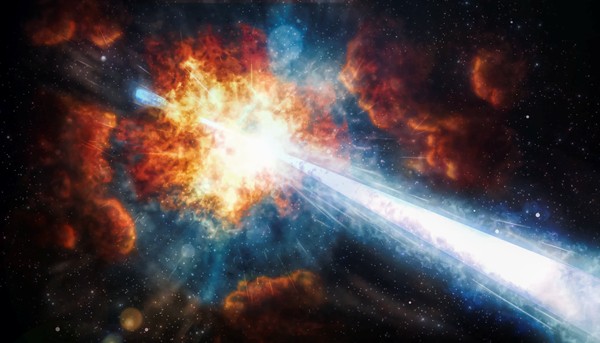
Long gamma-ray bursts (LGRBs) are the most powerful explosions in the Universe since the Big Bang. In less than a second, a single gamma-ray burst can release more energy than the Sun will emit over 10 billion years. These events occur when a massive star, more than 20 times the mass of the Sun, undergoes gravitational collapse at the end of its life. This collapse leads to the formation of a compact object and the emission of powerful relativistic jets—streams of atomic nuclei and electrons moving close to the speed of light.
More than 55 years after their discovery, the exact mechanism behind the electromagnetic emission of LGRBs remains uncertain. So does the nature of the accreting compact object—either a black hole or a highly magnetized neutron star (a millisecond magnetar)—which powers the relativistic jet.
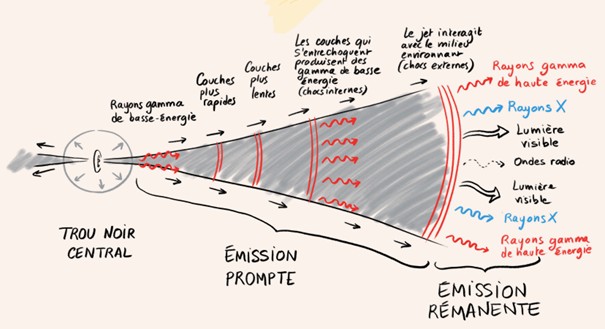
The enormous disparities in spatial and temporal scales between the key stages :
- the gravitational collapse and supernova explosion,
- the propagation of the jet through and beyond the star,
- and the generation of high-energy emissions at large distances (prompt and afterglow phases)
have so far forced theoretical and numerical models to focus on isolated stages of the LGRB process, rather than treating the phenomenon as a whole.
Two fundamental questions remain unanswered:
- What is the primary mechanism behind the emission of matter? Several competing models have been proposed, often mutually exclusive, depending heavily on jet properties and central engine dynamics.
- What powers the central engine of an LGRB? Two main hypotheses are currently debated: an accreting black hole, or a rapidly spinning, highly magnetized proto-neutron star (a millisecond magnetar).
By combining state-of-the-art core-collapse supernova models with GPU-accelerated simulations of relativistic jets run on high-performance supercomputers (such as Joliot-Curie at TGCC, Adastra at CINES, and Leonardo at CINECA), the BlackJET project will deliver a unified description of LGRBs, coherently modeling all phases from stellar collapse to observed electromagnetic emission.
This holistic approach, directly connecting the key stages of LGRB production, will uncover the close relationships between the stellar progenitor, the accreting central engine, and the relativistic jet. Ultimately, it will reveal the observational signatures that a realistic LGRB progenitor should produce. By bridging the gap between the end-of-life processes of massive stars and gamma-ray burst astronomy, BlackJET will enable the scientific community to effectively answer fundamental questions about the nature of long gamma-ray bursts.
Contact: Matteo Bugli