
That's one wall the White Walkers won't cross. An international collaboration bringing together the IRFU (Université Paris-Saclay), the Astronomy Institute of the University of Hawaii, the LPC (Université Clermont Auvergne), the IP2I (Université Claude Bernard de Lyon), and the Racah Institute of Physics (Hebrew University of Jerusalem), has discovered an immense structure in the distribution of galaxies, called the “South Pole Wall”.
Thanks to a method based on the velocity fields of galaxies, this region of the sky, previously unknown because it is masked by molecular clouds and dust located in the foreground of our galaxy, brings a new piece to the puzzle of the cosmic web of our nearby Universe. This cosmic web consists of nodes connected by filaments, separating voids. Galaxies are pulled from the voids to the filaments and then to the gravitational attractors located at the nodes of the web. The filaments, sandwiched between the voids, can take a flattened shape to form walls.
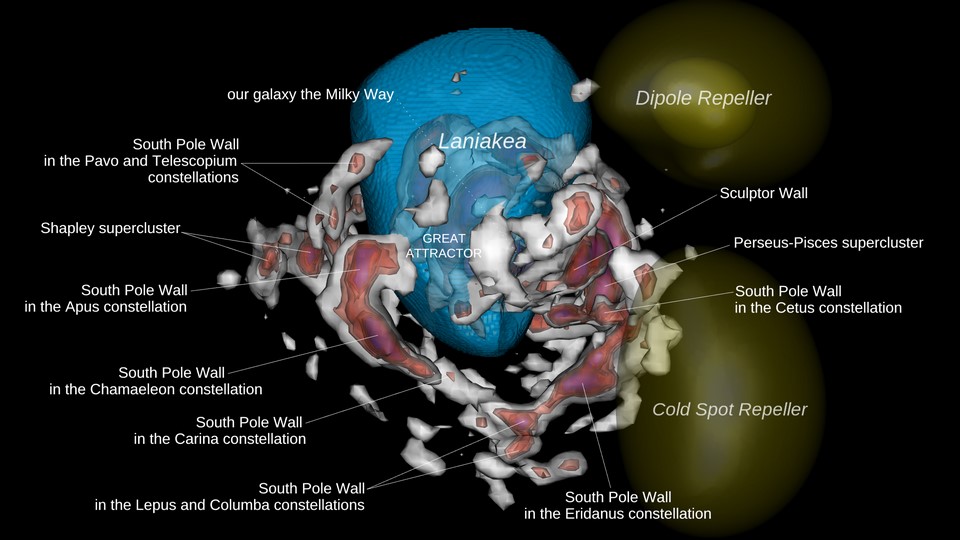
The South Pole Wall has a huge rectilinear section (220 Mpc) at the ends of which it curves to follow the Laniakea border.
These works are published in APJ journal https://doi.org/10.3847/1538-4357/ab9952
A little history…
Research in cosmology over the last forty years has been marked by the discovery of ever larger structures as instruments have made it possible to probe ever larger and more distant regions of the Universe:
- In 1986, a team from the Smithsonian Center for Astrophysics discovered the Great Wall, a structure 500 million light-years in size connecting clusters of galaxies in the constellations of Hercules and Berenice's Hair.
- In 2003, thanks to the automated SDSS Sloan Digital Sky Survey, the Great Wall of Sloan, a filamentary structure 1.4 billion light-years in size and located about 1 billion light-years away, was discovered.
- Thirteen years later, as part of the Baryon Oscillation Spectroscopic Survey, the BOSS Great Wall, a complex of similar morphology to the Sloan Great Wall, but at a much greater distance, was identified.
Unexplored regions…
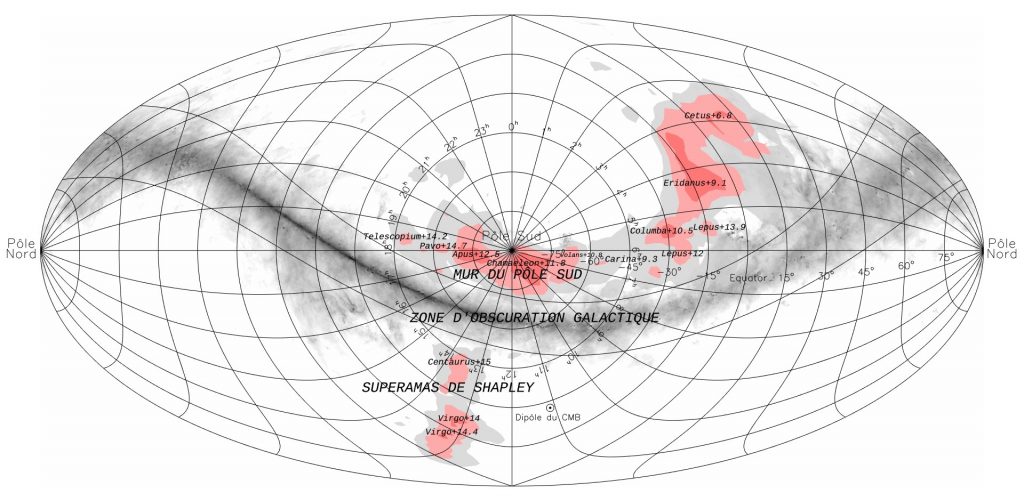
In this history of discoveries of large structures, a region of the sky remained essentially unexplored, an “Astra Incognita”, in the direction of the Celestial South Pole (i.e. along the line defined by the axis of rotation of our planet, in the Southern direction). This region, located at the observational limits of telescopes located in the southernmost observatories, such as the Siding Springs Observatory in Australia, is characterized by the presence of thick clouds of galactic dust, such as the Cloud Complex in the Chameleon constellation, or the presence of the Magellanic Clouds, two satellite galaxies of ours, which mask entire sections of the deep sky. Galaxy surveys have therefore been penalized by the presence of holes in their sky cover in this southernmost region.
Exploiting galaxy motions
However, a new study, based on the analysis of galaxy motions, has made it possible to explore this region for the first time. Indeed, the movement of the latter, generated by gravitation, betrays the presence of matter even in regions not directly observed. Using the latest generation of the galaxy velocity catalogue, Cosmicflows-3, which includes about 18,000 velocity measurements of galaxies or groups of galaxies, a reconstruction of the distribution of matter in 3D in the southern sky revealed the presence of a previously unknown wall: the South Pole Wall. It is similar in morphology and dimension to the Sloan Great Wall, while being twice as close to us. Its heart is located in the Chameleon Constellation, and it comprises a long, almost straight filament connecting particularly dense sectors in the Bird of Paradise and Hare constellations. Extending curving to reach the sector of the constellation of Eridan near the celestial equator, it describes an immense arc that embraces the southern borders of Laniakea, the gravitational basin of attraction in which our galaxy, the Milky Way, is located.
Visualization of cosmic currents. The 3D velocity field is represented using lines of currents initiated in high density regions, such as the South Pole Wall, represented by a grey surface.
The current lines ending at the Shapley Attractor, the Great Attractor, and the Persea- Fish Supercluster Attractor are shown in black, blue, and red, respectively.
The catalogue is expanding…
Continuing the Cosmos mapping project, the collaboration is now working on the preparation of the future generation of galaxy velocity catalogue, Cosmicflows-4, made up of about 30,000 galaxies, with the inclusion of new measurements obtained in the Northern Hemisphere with the Green Bank and Arecibo radio telescopes.
Contacts: Daniel Pomarède ; Hélène Courtois (Université Lyon 1)
- The article of this study to be published in The Astrophysical Journal https://doi.org/10.3847/1538-4357/ab9952: “Cosmicflows-3: The South Pole Wall” Daniel Pomarède, R. Brent Tully, Romain Graziani, Hélène M. Courtois, Yehuda Hoffman, Jérémy Lezmy, ApJ (2020), accepted.
- A 6-minute video detailing this discovery, interactive visualizations and high-resolution images are available at http://irfu.cea.fr/southpolewall.