
The muon tomography team at IRFU has published a study in Physical Review X [1] on the muon tomography of the G3 reactor at CEA Marcoule. Machine learning methods were used to improve the quality of the obtained image. The results revealed unexpected structural anomalies, highlighting areas where the reactor differed from its originally documented design. This information is crucial for the dismantling of these nuclear facilities. Muon tomography, enhanced through the use of machine learning techniques, is thus entering a new era, once again demonstrating, after the two discoveries of chambers in the Great Pyramid of Khufu [2, 3], that it can address diverse challenges, notably in the field of nuclear dismantling.
Context
The G2 and G3 reactors at CEA Marcoule are the first two reactors of the French nuclear program (see Figure 1). These natural uranium graphite gas (UNGG) reactors were designed to each deliver a thermal power of 250 MW. Commissioned in 1958 and 1959, they operated until 1980 and 1984, respectively, before entering the dismantling phase. During this period, the CEA is required to report to the Nuclear Safety Authority, ensuring the safety and monitoring of the installations. In this context, muon tomography proves valuable due to its ability to probe dense structures non-invasively.
Introduction
Following the first 3D imaging performed in 2023 on the G2 reactor, using 27 positions and four telescopes [4], the IRFU muon tomography team redeployed these four muon telescopes (named Bose, Dirac, Einstein, and Fermi) around the G3 reactor. Over several months, they recorded muons from 46 different viewpoints (see Figure 2), with exposure times ranging from three weeks to two months per position. This approach significantly improved the observational coverage compared with the G2 campaign.
Each telescope is composed of four gaseous MultiGen detectors, based on Micromegas technology with multiplexed resistive strips, an IRFU invention [5]. Each MultiGen detector records the position of passing muons via Clas12 electronics, which use DREAM chips also developed at IRFU. Each detector, corresponding to a plane, provides a crossing point for the muon. By combining these points across several planes, it is possible to reconstruct a straight line representing the muon’s trajectory. Furthermore, the experience gained during the ScanPyramid mission helped make IRFU’s telescopes more compact and familiarized the team with deployment under real-world conditions. Such conditions, tight spaces, dust, and specific constraints, mirror those of nuclear facilities undergoing dismantling.
Results
The data analysis begins with the production of 46 muographies corresponding to the various telescope positions. For each position, the image of the muon trajectories that passed through both the reactor and the telescope was reconstructed. Then, 3D imaging was obtained by assembling the different projection images using the SART algorithm (Simultaneous Algebraic Reconstruction Technique) [6]. Originally developed for medical CT scanners, this algorithm is particularly well suited to limited or noisy data. The density imaging of the G3 reactor obtained with this algorithm is shown in Figure 4. Artefacts appear near the ground, since the telescopes were located there, high densities close to them are more prominently considered in the reconstruction.
To improve the quality of the tomography, a denoising technique was applied to the raw data before reconstructing the muon trajectories. A machine learning model was then trained on synthetic data generated from a large number of models similar to G2 and G3. Figure 5 shows an example of a randomly generated reactor model with modified parameters (position, density, rotation, etc.) of key elements. The machine learning algorithm was then applied (post-processing) to the tomography. Figure 6 shows a significant improvement in the density distribution within the concrete containment volume of the reactor.
Finally, Figure 7 compares the benefit of this new analysis applied to G3 with that performed on G2 [4].
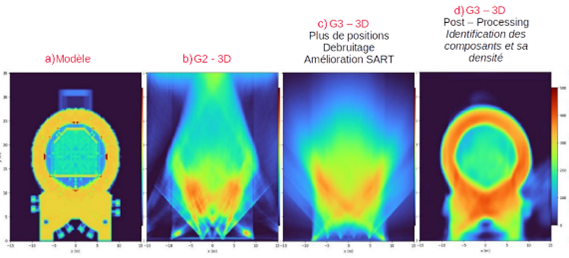
In addition, the 3D reconstruction revealed discrepancies between the reactor’s existing structure and its original design specifications. Some components, expected to be present, were entirely missing, and the density of the reactor’s graphite core was found to be lower than previously estimated. These results suggest that the reactor may have undergone significant modifications over time, possibly due to radiation effects and wear from years of operation.
This new understanding is crucial to the reactor dismantling process. The detailed, non-invasive imaging method not only helps assess the reactor’s internal condition but also provides valuable information to ensure safe dismantling. This penetrating imaging technique is proving to be an essential tool for inspecting the internal components of the G2 and G3 reactors during their dismantling.
Beyond nuclear applications, muon tomography also holds promise for addressing other challenges. Thanks to its ability to evaluate large structures non-invasively, it can be used to inspect aging infrastructure, conduct geological surveys, or explore archaeological sites buried underground or in hard-to-access locations. The results obtained on the G3 reactor fully illustrate the versatility and effectiveness of this innovative technique. The IRFU team is also involved in using muon tomography to inspect waste packages.
Conclusion
Muon tomography, applied to the structural analysis of nuclear reactors, opens new perspectives for strengthening the safety and monitoring of facilities in the dismantling phase within the nuclear industry. This achievement not only provides a solution for the G2 and G3 reactors at CEA Marcoule but also sets an important precedent for the use of this technique in the dismantling of certain nuclear installations. Moreover, this breakthrough could pave the way for similar applications in other fields, such as the structural analysis of aging buildings or the exploration of archaeological sites buried underground.
For a more detailed examination of the methodologies and results, see the full article: 10.1103/PRXEnergy.4.013002.
References
- Lefèvre, B. et al., 3D Reconstruction of a Nuclear Reactor by Muon Tomography: Structure Validation And Anomaly Detection, PRX Energy 4, p. 013002 (2025), https://doi.org/10.1103/PRXEnergy.4.013002
- Morishima, K., Kuno, M., Nishio, A. et al., Discovery of a big void in Khufu’s Pyramid by observation of cosmic-ray muons. Nature 552, 386–390 (2017). https://doi.org/10.1038/nature24647
- Procureur, S., Morishima, K., Kuno, M. et al., Precise characterization of a corridor-shaped structure in Khufu’s Pyramid by observation of cosmic-ray muons. Nat Commun 14, 1144 (2023). https://doi.org/10.1038/s41467-023-36351-0
- Procureur, S. et al., 3D imaging of a nuclear reactor using muography measurements. Sci. Adv. 9, eabq8431 (2023). https://doi.org/10.1126/sciadv.abq8431
- Bouteille, S. et al., Large resistive 2D Micromegas with genetic multiplexing and some imaging applications, Nucl. Instrum. Methods Phys. Res. A, 834 (2016), p. 187-191.
https://doi.org/10.1016/j.nima.2016.08.006
A.H. Andersen, A.C. Kak, Simultaneous Algebraic Reconstruction Technique (SART): A superior implementation of the ART algorithm, Ultrasonic Imaging, 6 (1984), p. 81-91. https://doi.org/10.1016/0161-7346(84)90008-7
Animation