
ARIEL (Atmospheric Remote-Sensing Infrared Exoplanet Large-survey) is the M4 mission of ESA’s Cosmic Vision program, with a planned launch in 2029. This mission is entirely dedicated to studying the atmospheres of exoplanets, with around a thousand exoplanets to be observed over four years. France is making a major contribution by providing the ARIEL Infra-Red Spectrometer (AIRS), which operates in the 1.95 to 7.8 micron wavelength range. This development is led by CEA-IRFU, with significant contributions from IAS (Institut d’Astrophysique Spatiale) and LIRA (Laboratoire d’Instrumentation pour la Recherche en Astrophysique), and CNES overseeing the project.
A key milestone was achieved in the summer of 2025 for the AIRS instrument with the delivery of its avionics model (AIRS AVM) to Airbus in Toulouse. This delivery marks the culmination of four years of work on the design of electronic boards and the entire detection chain of the AIRS infrared spectrometer. The efforts of a team of about 20 people from IRFU’s laboratories (DAp-AIM, DIS, and DEDIP) made it possible to achieve the required levels of quality and performance to continue activities at the satellite’s service module level, for which Airbus is responsible. Generally, the avionics model is used to validate electrical interfaces and, in the case of AIRS, to verify the instrument’s nominal functions and the integrity of scientific data. At the satellite level, it will validate the operation of all subsystems implemented for the ARIEL mission.
The development of space equipment requires various intermediate models to progressively validate mechanical, thermal, electrical, and software designs. Structural and Thermal Models (STM) validate mechanical and thermal designs, while avionics (AVM) and engineering models (EM) enable full electrical and functional validation, on which initial scientific performance tests are conducted. The flight model is then produced based on these results or on a qualification model integrating all equipment functions. This flight model must meet the mission’s space environment requirements and final scientific performance standards.
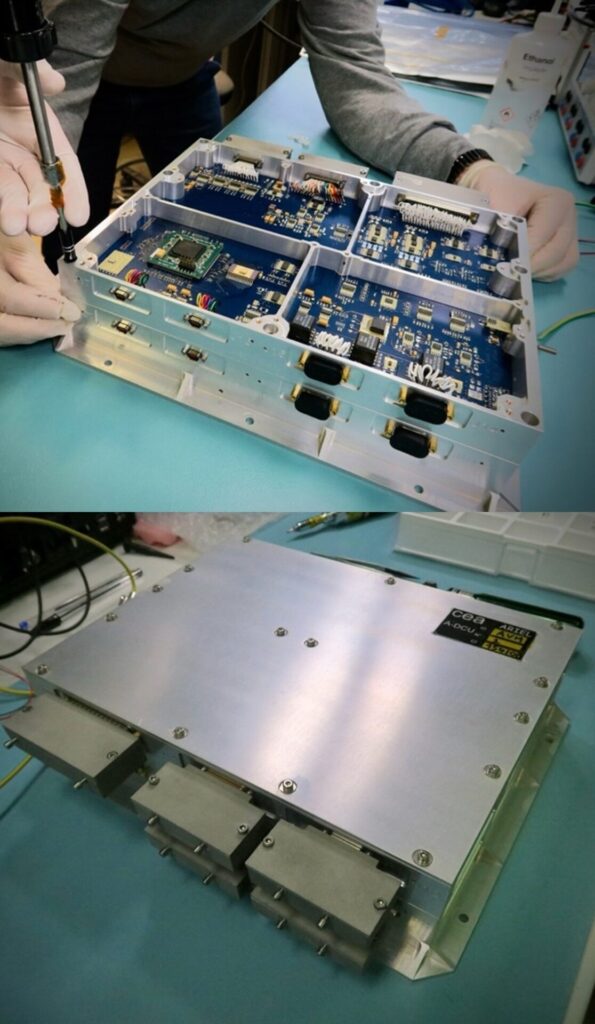
The AIRS AVM instrument consists of the ADCU (AIRS Detector Control Unit) electronic box, paired with simulators that replicate the electrical operation of the integrated focal planes. It primarily comprises two similar boards that enable simultaneous control and acquisition of the spectrometer’s two channels, CH0 and CH1, covering wavelengths from 1.95 to 7.8 microns. As the interface with the instrument’s control unit, it must ensure—alongside the detector focal plane—the scientific performance of the entire instrument detection chain.
|
Left: CAD diagram of the DCU board. Right: The board with all components, including the FPGA (Field-Programmable Gate Array) and its mechanical structure. |
For the electronic unit, the next step is the production of the engineering model (ADCU EM). This model will be coupled with AIRS’s cold unit, which includes the focal planes and optical benches, to form the complete instrument. Calibration is scheduled for spring 2026 at Meudon (LIRA – Paris Observatory).
Left (complet instrument): The cold unit with the two focal planes and associated optical benches for channels CH0 and CH1, covering the wavelength ranges [1.95–3.90] µm and [3.90–7.80] µm, respectively. Right: The ADCU box. Specific harnesses electrically connect the two systems. The production of cryogenic harnesses is a contribution from the Canadian Space Agency (CSA), while the service module (SVM) harnesses are provided by Airbus.In parallel with these activities, the implementation of a CMOS amplifier located on the focal plane’s proximity board for detector signal readout is noteworthy. The choice of this component, operating at approximately 50 Kelvin (-220°C), proves highly promising for future instrumental developments.
Following calibration, the AIRS EM instrument will be delivered to RAL Space (Rutherford Appleton Laboratory) in England for platform and payload integration activities. The year 2026 will also be significant, with the completion of the instrument’s Critical Design Review (iCDR), leading to the production of the flight model.
Contacts IRFU/DAp : Christophe CARA , Benoit HOREAU
More:
- ESA adoption of ARIEL: https://irfu.cea.fr/en/dap/2020/11/the-european-space-agency-adopts-ariel-mission-irfu-is-the-project-manager-of-airs-instrument/
- ARIEL mission website: https://arielmission.space