
SEASON has just achieved a major milestone in Finland with its installation at IGISOL (University of Jyväskylä, Finland) and its successful first data acquisition using a beam of radioactive ions. This project, initiated in 2019 and entirely developed at Irfu, aimed to design a detector for nuclear physics dedicated to ion counting and precise decay spectroscopy. Two important characteristics required were a high efficiency and an excellent energy resolution. The first results, obtained from a previously studied reaction, are very encouraging. They partially validate the detector’s operation, and the level of performance achieved paves the way for new physical results.
Scientific Objectives
The SEASON detector (Spectroscopy of Electron and Alpha in Silicon bOx couNter) was designed to study the structure of actinides and heavy nuclei (i.e., nuclei with a proton number Z ≥ 89) using an original approach: comparing observables from laser ionization spectroscopy (an atomic physics technique) with results obtained from decay spectroscopy (a nuclear physics technique). Both together, fundamental properties of the nucleus such as its mean square charged radius can be extracted, allowing to deduce information about its shape for example.

SEASON: A Detector and Multiple Technical Challenges
The mechanical design, the choice of materials, and the technologies developed for this detector, entirely designed at Irfu, were driven by two requirements:
- Optimizing detection efficiency (up to ~70% for alpha particle detection, according to simulations): The heavy nuclei to be studied with SEASON generally have low production cross-sections, so ideally, we want to miss as few as possible.
- Optimizing energy resolution (less than 15 keV FWHM for 6-10 MeV alpha particles): The alpha particles emitted during nuclear decay can have very similar energies, which must be distinguishable. The same thing is true for the conversion electrons.
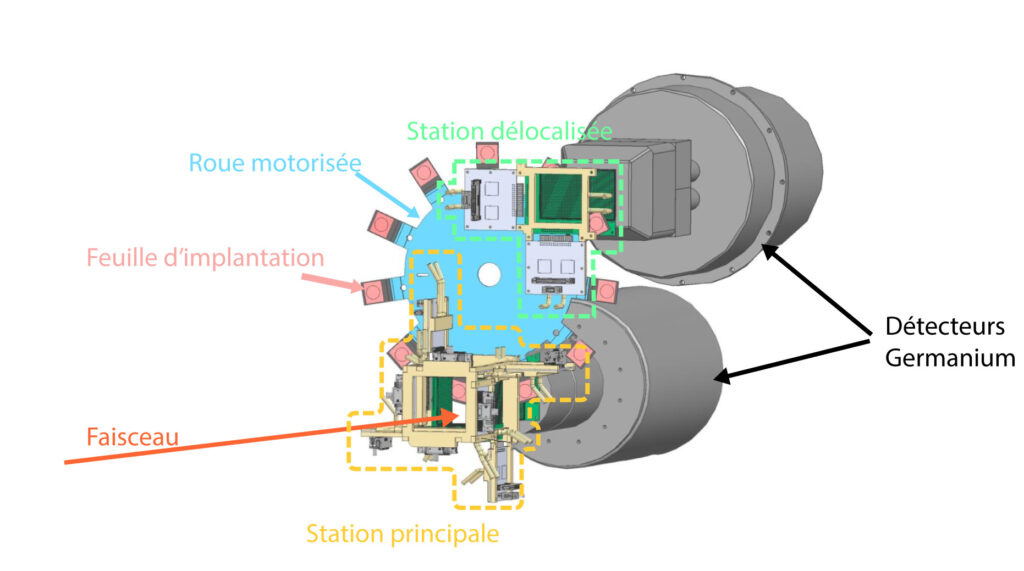
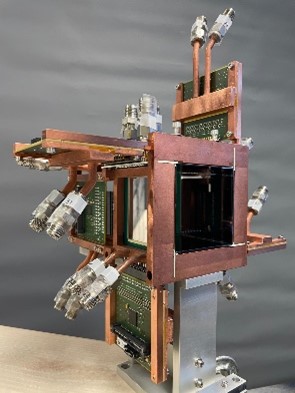
To meet these objectives, SEASON was designed as a compact, millimeter-adjustable detector, entirely under vacuum within its enclosure.The figure below illustrates SEASON’s inside geometry and operating principle. The detector consists of two measurement stations called the “main” station (in yellow) and the “remote” station (in green).
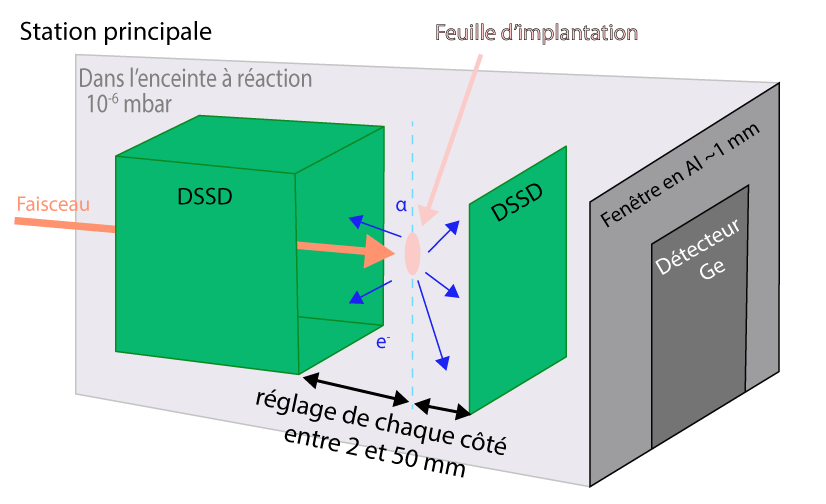
The nuclei of interest, after being separated by mass or selected by laser, are transported as a beam to SEASON’s main station to be implanted on a 90 nm-thick carbon foil, depicted in pink. It is from this foil that particles resulting from the decay of stopped nuclei will be emitted.
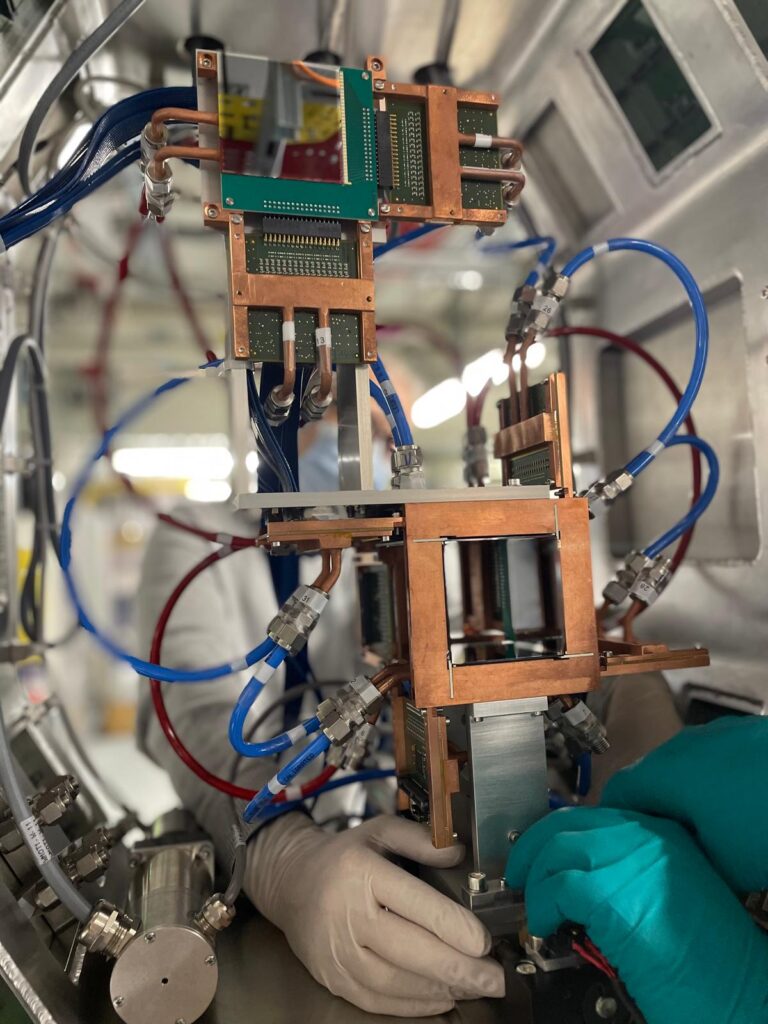
Cooled, double-sided silicon stripped detectors (DSSDs) are installed on both side of the implantation foil. Their purpose is to detect alpha particles (α) and conversion electrons (e⁻). Notably, the four DSSDs of the main station placed upstream of the foil are assembled in a tunnel configuration to allow the beam to pass through.
Gamma rays, also emitted during nuclear decays, are measured at each station by a germanium (Ge) detector installed on a mobile structure connected to the rear of the vacuum chamber via two large bellows.
All DSSD detectors are mounted on remotely controlled mobile structures. The goal is to position them of the two stations at a distance relative to the foils ranging from 2 mm* to 50 mm, allowing the physicists to choose the trade-off between efficiency and counting rate of decay particles.
At the operator’s request, the implantation foil of the main station is replaced with a clean foil, free from any contamination. This operation is performed by an automated rotating mechanism (in blue) equipped with 11 foils. This wheel also allows the old foil from the main station to be placed at the remote station.
Finally, SEASON is equipped with a calibration system based on two types of radiological sources (3-alpha and 133Ba), emitting alphas of 5 to 6 MeV and electrons of 40 to 400 keV, respectively. Each source is mounted on a mobile arm, allowing the active face to be oriented toward the DSSDs to be calibrated and positioned in place of the implantation foil.
* To date, this requirement has not been met. The minimum adjustable distance has been set at 8 mm for safety reasons. This is a point that still needs to be optimized.
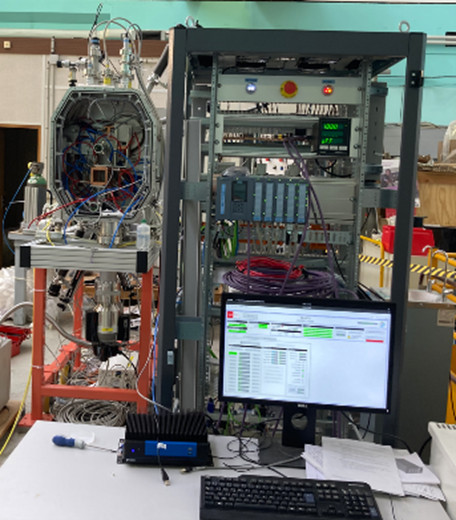
The first partial assembly of the detector took place in Saclay in 2024 without the acquisition electronics nor the sources. It allowed for testing and partially validating the assembly procedures and several functions of the instrument. The second assembly was carried out at GANIL in 2025 in the experimental hall which will soon host S3. SEASON was in its near-complete configuration. It allowed for correcting some technical flaws, improving integration procedures, and validating the detector. Finally, the third assembly took place in Jyväskylä from September 2025 to March 2026, with the goal of commissioning SEASON with a radioactive beam.
The FEANICS Electronics
To meet the energy resolution requirements, the performance of the electronics coupled with the DSSDs is critical. This electronics must collect, process, digitize, and store signals from the DSSDs while minimizing noise. Consequently, the DSSDs were coupled with the state-of-the-art FEANICS electronics. This electronics, developed at DEDIP, consists of a charge preamplifier with an automatic gain-switching system. This allows for the most suitable gain, whether detecting an electron of a few tens of keV or an alpha particle of around ten MeV. The coupling between the detector and the electronics is made under vacuum to limit signal degradation during propagation.
Jyväskylä, March 2026: The First Nuclei Implanted in SEASON
The commissioning experiment involved a fusion-evaporation reaction of a proton beam on a 232Th (Z = 90) target to produce various isotopes, including 225Pa (Z = 91), which served as the reference beam for this first experiment. This reaction is well-known since it has been studied in the past at IGISOL by the SEASON team from DPhN using devices with the same technology as SEASON but less efficient. This reaction, therefore, serves as a good benchmark for the commissioning of SEASON. The preliminary results obtained online show that the expected performance is being met. Thus, in addition to validating SEASON’s operation, new physical results on the alpha decay of 225Pa are expected.
The path to acquiring this first data was not without obstacles, whether optimizing vacuum conditions or ensuring the mechanical stability of the entire setup. Each difficulty was overcome by a DIS/DEDIP team with diverse skills and strong commitment. Thank you to all!
SEASON will remain at IGISOL for a campaign of experiments dedicated to studying the structure of heavy nuclei until the start-up of S3. Then, it will move to GANIL-SPIRAL2 and be installed at the end of the low-energy S3-LEB line.
The SEASON project is a collaboration between DPhN, DIS, and DEDIP. This project was funded by the ANR under grant ANR-20-CE31-0005.