
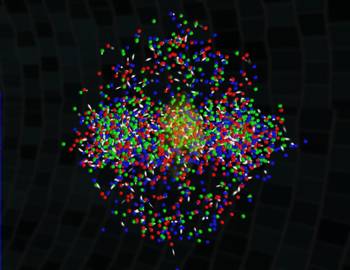
The Phenix and Star collaborations, which include physicists from CEA-IRFU and CNRS-IN2P3, have announced major discoveries on the nature of the quark-gluon plasma. These conclusive results, which advance our understanding of nuclear material subjected to extreme conditions, shed new light on the birth of the universe. They have been published in the journal Physical Review Letters.
(1) Institut pluridisciplinaire Hubert Curien – IPHC (CNRS/Université de Strasbourg), Laboratoire Leprince-Ringuet – LLR (CNRS/École Polytechnique), the Nuclear Physics Institute at Orsay – IPNO (CNRS/Université Paris 11), Laboratoire de physique corpusculaire of Clermont-Ferrand – LPCClermont (CNRS/Université Blaise Pascal), Laboratoire de physique subatomique et des technologies associées – SUBATECH (CNRS/École des mines/Université de Nantes)
(2) Institute for research on the fundamental laws of the universe – IRFU
(3) Laboratoire Leprince-Ringuet – LLR (CNRS/École Polytechnique)
(4) Institut pluridisciplinaire Hubert Curien – IPHC (CNRS/Université de Strasbourg), Institute of Nuclear Physics of Lyon – IPNL (CNRS/ University Claude Bernard), the Nuclear Physics Institute at Orsay – IPNO (CNRS/Université Paris 11), Laboratoire de physique corpusculaire de Clermont-Ferrand – LPC-Clermont (CNRS/Université Blaise Pascal), Laboratoire de physique subatomique et de cosmologie – LPSC (CNRS/Université Grenoble1/Polytech-Grenoble), Laboratoire de physique subatomique et des technologies associées – Subatech (CNRS/École des mines/Université de Nantes), IN2P3 Computing Centre (CNRS)
(5) Institute for research on the fundamental laws of the universe – IRFU
Research contacts
- CEA: Alberto Baldisseri
- CEA: Hervé Borel
- CNRS: Christelle Roy
- CNRS: Frédéric Fleuret