

At CERN’s Large Hadron Collider (LHC), atomic nuclei are collided at high energies to investigate the quark-gluon plasma (QGP), believed to resemble the matter that filled the universe just microseconds after the Big Bang. The shape of the two colliding nuclei have been shown to leave specific fingerprints in the flow of particles emitted during these explosive events. In a recent work, an international team of nuclear theorists including IRFU researchers have suggested to exploit the peculiar shape of the neon-20 nucleus to study QGP formation in small systems using a well-identified signature, which was so far out of reach. Following this proposal, the 2025 LHC schedule was modified to accommodate neon-neon collisions in July. The results of the neon run, in remarkable agreement with theoretical predictions, open a new chapter in our understanding of the strong force at the interface between low- and high-energy nuclear physics.
When heavy ions collide at high speed at CERN’s Large Hadron Collider (LHC), they create an extremely hot and dense state of matter called quark-gluon plasma (QGP). Having features similar to those of a perfect fluid, after formation the QGP expands following the classical laws of hydrodynamics. Once its temperature drops below a critical value, quarks and gluons recombine to form a gas of hadrons, which are eventually detected in the LHC experimental halls. By analysing the distributions of the emitted hadrons, scientists not only infer the properties of the initial QGP but also, perhaps surprisingly, of the nuclear systems prior to the collision. In recent years, in particular, several studies have shown that the shape of the colliding isotopes impacts the spatial anisotropy of the hadronic distributions, and thus constitutes a key quantity in the modelling of these high-energy experiments.While the hydrodynamic picture, fingerprint of the QGP formation, is well established for collisions of heavy nuclei, its realisation in small systems, e.g. in light-nuclei collisions, remains an open question. To investigate this problem, the LHC had scheduled a run of oxygen-oxygen (A=16) collisions for July 2025. For such small nuclei, however, one significant complication comes from the fluctuations in the initial position of nucleons, whose effect is comparable to the one induced by the nuclear shape and thus hinder a clean hydrodynamic signature of the latter To overcome this issue, a collaboration of high- and low-energy nuclear theorists, including physicists from the PAN@CEA collaboration at CEA DRF, DAM and DES, proposed to complement the oxygen run with collisions of neon (A=20) [1]. While close in mass to the nearly-spherical oxygen-16, neon-20 presents one of the most extreme deformations across the nuclear chart, with a conjectured α-clustered elongated structure. By comparing the two types of collisions, many systematic uncertainties are thus expected to cancel out, giving access to a clean probe of the collective QGP behaviour.To substantiate this idea, the theory collaboration first computed the structure of oxygen-16 and neon-20 using two ab initio approaches, the projected generator coordinate method (PGCM) and the nuclear lattice effective field theory (NLEFT). In spite of following very different strategies to solve the nuclear many-body problem, the two methods yielded very consistent predictions, in particular regarding the highly exotic matter density distributions of both nuclei (see Fig. 1). Using these densities as a starting point, and a model to generate the droplet of hot nuclear matter formed at the time of impact, hydrodynamic simulations of the subsequent QGP expansion were performed by the collaboration for both oxygen-oxygen and neon-neon collisions at LHC energies. These simulations were then coupled to a hadronization framework to produce the final predictions for the distributions of the emitted particles in the transverse plane of the reaction.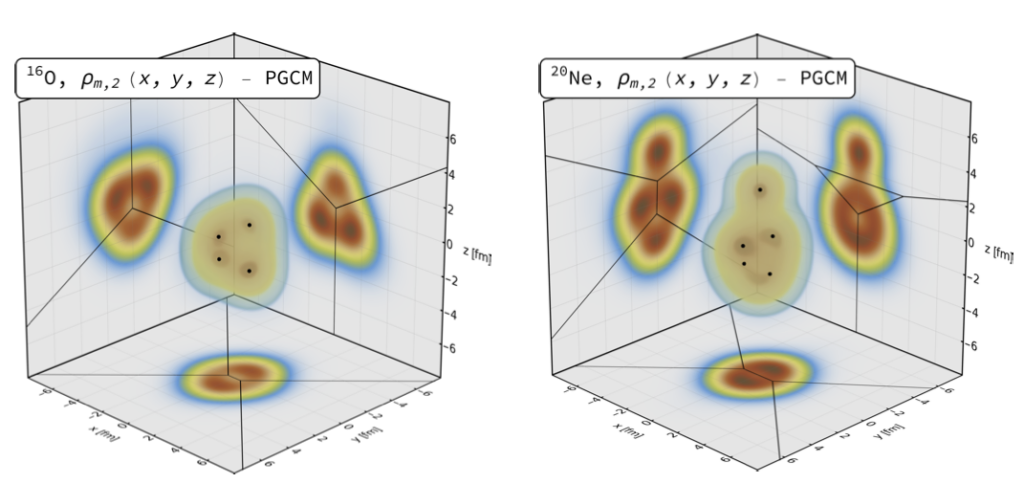
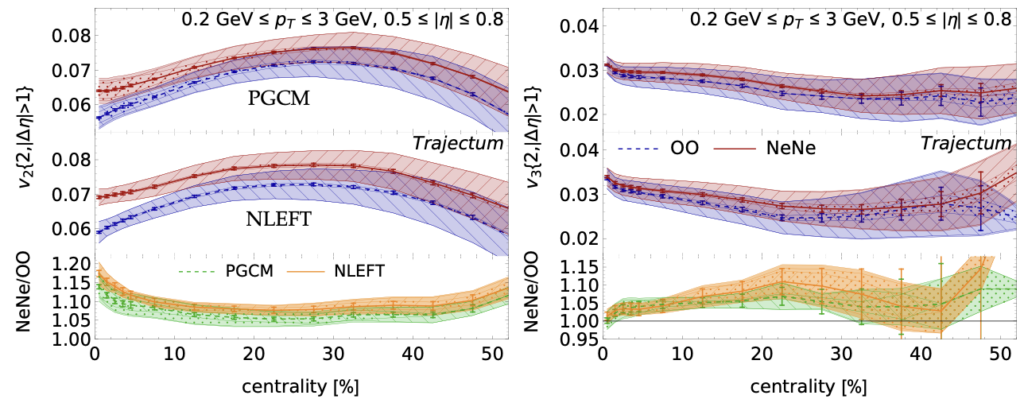
Following these predictions, the LHC management decided to change 2025 experiments’ schedule to fit in one day of neon-neon collisions, right after the planned oxygen-oxygen run. Both runs were successfully performed in July 2025. In the autumn 2025, LHC collaborations released their preliminary results [2-4], revealing measured ratios of elliptic flows that are remarkably consistent with the theory predictions (see Fig. 3 for the CMS collaboration [4]).
These results have far-reaching implications for both low- and high-energy nuclear physics. For nuclear structure, these experiments constitute a novel complementary way of probing many-body correlations, especially of interest for the rapidly progressing ab initio methods. In this context, recent formal developments, conducted also by a researcher from IRFU, have established the connection between the inter-nucleon correlations at play in the colliding nuclei and the observable azimuthal flow of particles emitted after the QGP expansion [5]. For high-energy collisions, the success of the light-ion runs constitutes an important step forward in the understanding of the emergence of collective dynamics in strongly-interacting matter. This study also opens the way to systematic investigations of the QGP paradigm in collisions of few-nucleon systems.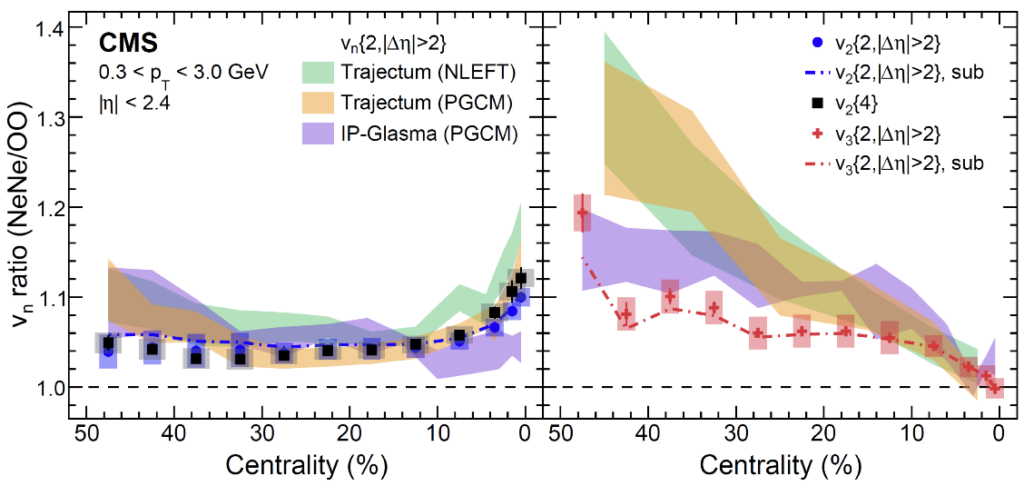
Last but not least, the SMOG2 gas injecting system of the LHCb collaboration enables beam-fix target collisions and allows for a flexible selection of target isotopes that can be collided with heavy beams. In this context, the use of oxygen and neon targets has been proposed by the same theory collaboration in Ref. [6]. Preliminary results from neon-lead collisions [7] show that this is also a very promising direction of research.
References
[1] G. Giacalone et al., Phys. Rev. Lett. 135 012302 (2025)
[2] The ATLAS collaboration, arXiv:2509.05171 (2025)
[3] The ALICE collaboration, arXiv:2509.06428 (2025)
[4] The CMS collaboration, arXiv:2510.02580 (2025)
[5] T. Duguet, G. Giacalone, S. Jeon, A. Tichai, Phys. Rev. Lett. 135 182301 (2025)
[6] G. Giacalone et al., Phys. Rev. Lett. 134 082301 (2025)
[7] The LHCb collaboration, arXiv:2509.12399 (2025)
Contacts
Thomas Duguet
Vittorio Somà