
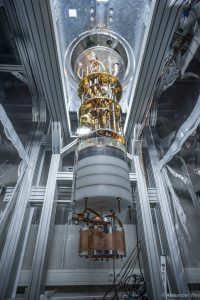
The NUCLEUS experiment aims to demonstrate bolometric detection of reactor antineutrinos, based on an interaction process known as coherent neutrino nucleus scattering. After a year devoted to setting up the shielding and cryogenic infrastructure on the premises of Munich’s Technical University, the project reached an important milestone this autumn with the conclusion of a 50-day data acquisition. The main aims were to demonstrate that the experiment was working properly, to validate the performance and stability of a first version of the detection system, and to study background noise. It was essential to demonstrate these objectives before venturing into the Ardennes at the Chooz nuclear power plant!
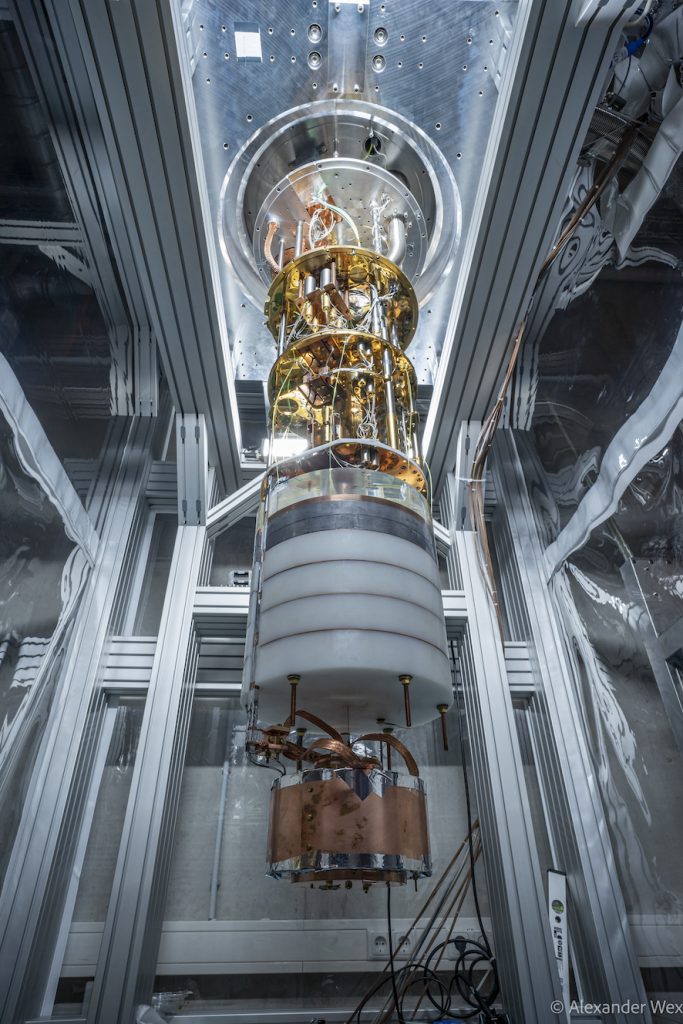
Detecting coherent scattering of reactor antineutrinos on cores
Coherent scattering is a process by which a low-energy neutrino (< 50 MeV) interacts with an atomic nucleus as a whole, without any distinction between the nucleons that make it up [1]. In this regime, the probability of neutrino interaction is multiplied by a factor of ten compared with the interaction channels previously used to study them, such as reverse beta decay (also known as antineutrino capture on proton). Mastering the detection of low-energy neutrinos via this process offers the hope of reducing the size of current neutrino detection devices, which could in the long term open up very interesting prospects for neutrino astronomy or for societal applications relating to nuclear energy. Coherent Neutrino Nucleus Scattering (CNNS) is also sensitive to a wide range of new physics, and can be used to test the Standard Model in a previously unexplored energy regime. In particular, a precision measurement could help to better understand certain neutrino properties (see [2] for some examples).
Observing this process is not without its difficulties, the main one being that the signal is reduced to a tiny nuclear recoil induced by the interaction of a neutrino, rather like a ping-pong ball colliding with a huge bowling ball. For gas pedal neutrinos with energies of the order of ten MeV, the process has been detected and studied since 2017 [3]. The induced nuclear recoils, of the order of ten keV, are then more easily measurable. The challenge is quite different for reactor antineutrinos, since their energies are at least ten times lower, and give nuclear recoils of less than or well below keV. After some ten years of effort, the CONUS collaboration has just announced a first observation of the process with a sub-keV Germanium semiconductor detector deployed at the Leibstadt power plant in Switzerland [4]. Cryogenic calorimeters are a promising way of accurately measuring DCNN. These devices, first developed for the direct search for dark matter and the double beta decay process without neutrino emission, are capable of reaching thresholds below a hundred electron volts, while maintaining a sufficiently large detection volume. The NUCLEUS collaboration has embarked on this path and is developing a system of cryogenic calorimeters equipped with superconducting transition edge sensors (TES) with a payload of the order of 10 grams of CaWO4 [5]. These detectors, whose design is directly derived from those of the CRESST experiment, reach detection thresholds of around twenty eV [6].
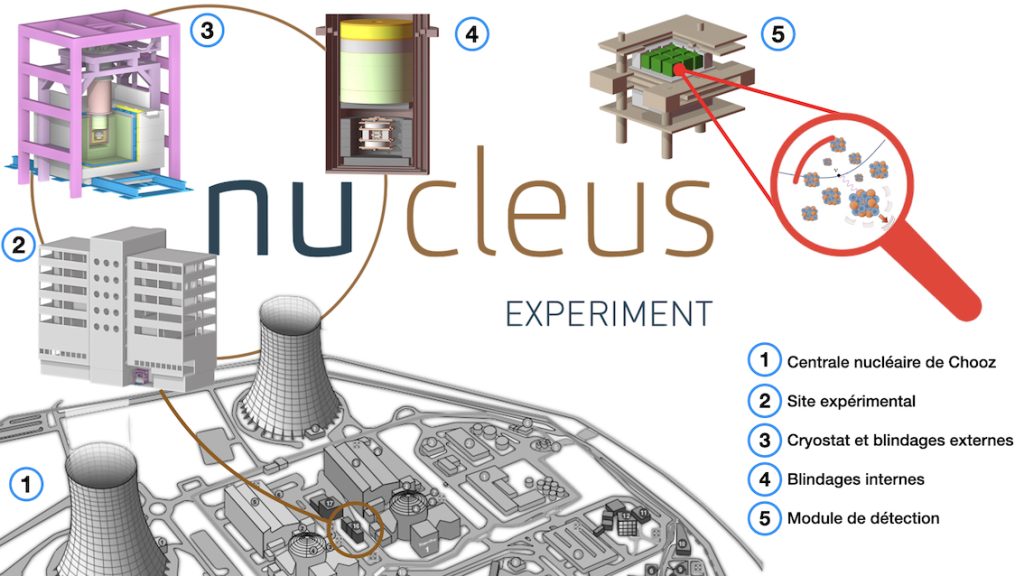
Figure 2: Principle of the NUCLEUS experiment
A successful and instructive first commissioning run
The NUCLEUS collaboration is aiming for a first measurement at the Chooz nuclear power plant by 2025. To this end, Irfu teams have joined forces with EdF to complete in 2023 a new experimental site located less than 100 meters from the plant’s two units, in the basement of a tertiary building (see figure 2). Reducing and controlling background noise is another major challenge, mainly because the experimental site offers little protection from cosmic radiation, but also because nuclear recoil is a much less obvious and irrefutable signature of reactor antineutrino interaction than are the products of inverse beta decay, the interaction channel usually used to detect them. Drawing on its past expertise with the Double Chooz, Nucifer and STEREO experiments, Irfu designed and built the entire shielding chain, from the external muon veto [7] to the cryogenic outer veto (COV), a cryogenic shield made of high-purity Germanium crystals surrounding the cryogenic calorimeters and read out in ionization mode (see figure 2 and [8]).The entire system was installed in 2023 at the Technical University of Munich, albeit with a simplified version of the VOC. An initial commissioning run, coordinated from start to finish by the team of DPhP and DPhN physicists last summer, successfully operated a simplified version of the cryogenic calorimeter system for 9 weeks without interruption or failure. This commissioning run enabled us to demonstrate the stability and performance of all sub-systems (cryostat, muon veto, shielding and cryogenic calorimeters), an essential condition that had to be met before the experiment could be moved to Chooz. It was also a question of putting in place all the tools needed to acquire, diagnose, reduce and analyze a large volume of data (~0.2 TB/day), an objective successfully achieved by the development of a complete analysis chain by the DPhP teams. Finally, this commissioning run was also an opportunity to study in detail the energy response of the cryogenic calorimeters, thanks to an on-board calibration system, and to study the background noise, two aspects essential to the future measurement of the DCNN, for which DPhP and DPhN physicists also played a leading role in the data analysis and simulation work.
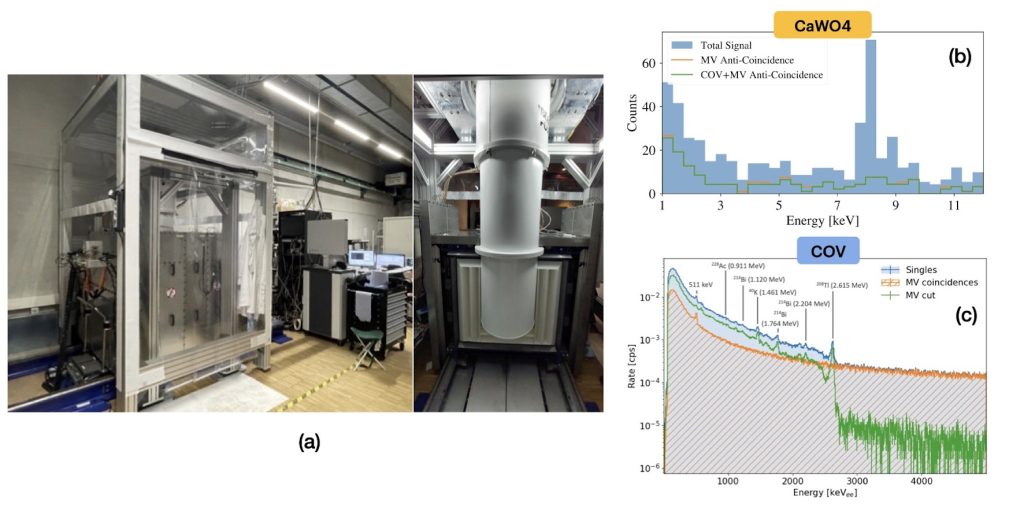
Figure 3: First data from the NUCLEUS experiment during its commissioning run (a). The top-right figure (b) illustrates the background reduction due to muon veto and VOC in the keV region in one of the cryogenic CaWO4 calorimeters. The reconstructed peak at ~8.5 keV corresponds to fluorescence radiation emanating from the copper mechanical supports. The rise in the low-energy event rate already points to the presence of excess (see text for details). The data recorded by the COV are shown in the lower right plot (c), with and without the application of an anti-coincidence cutoff with muon veto. The low-energy part of the spectrum ( ≤ 3MeV) is dominated by the interaction of gammas from natural radioactivity. The descending plateau in the high-energy part of the spectrum is due mainly to the interaction of cosmic muons.
The Chooz adventure is about to begin
Data analysis of the first commissioning run is nearing completion, with the aim of publication before summer 2025. In particular, major simulation work is underway to separate and better understand two background noise components in the DCNN signal region of interest: (i) events originating from external radiation (natural radioactivity, cosmic rays, etc.), a major part of which is attenuated by the shielding chain, and (ii) what the bolometric detector community refers to as EXCESS [9], a noise source of unknown origin that manifests itself particularly at energies close to threshold. The latter is a major obstacle to the measurement of a DCNN signal, and is the subject of much speculation. The most widely accepted interpretation is that stress relaxation in the crystals at the level of the supports mechanically holding the calorimeters and/or at the interface between the crystal and the thermometer, releasing puffs of phonons and creating reconstructed signals at low energies. This scenario was partly investigated by a cryogenic calorimeter with double reading by TES during the commissioning run, but without any firm conclusions. In addition to the complete validation of the shielding chain under real background conditions, studying the origin of the excess with a new module containing an instrumented mechanical support is therefore the major objective of the next technical run during 2025 at Chooz. Stay tuned for more news soon, especially as the experiment’s shielding has already completed its journey to Chooz to be reassembled and commissioned by spring 2025!
Contacts
Matthieu Vivier (Irfu/DPhP)
Fabien Jeanneau (Irfu/DEDIP)
References
[1] D. Freedman, Phys. Rev. D 9 (1974)
[2] J. Billard et al., JCAP 11 016 (2018)
[3] D. Akimov et al., Science 03 (2017)
[4] N. Ackermann et al., arXiv : 2501.05206 (2025)
[5] G. Angloher et al., EPJC 79 1018 (2019)
[6] R. Strauss et al., Phys. Rev. D 96 022009 (2017)
[7] V. Wagner et al., JINST 17 T05020 (2022)
[8] C. Goupy et al., NIM A 1064, 169383 (2024)
[9] P. Adari et al., Sci. Post. Phys. Proc. 9, 001 (2022)