
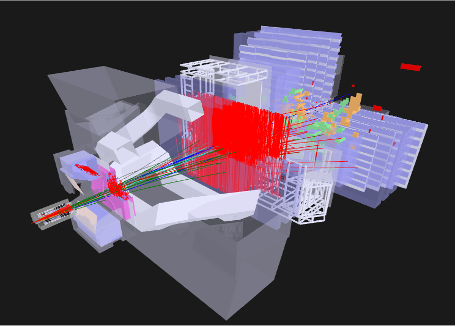
At the heart of high-energy heavy-ion collision research lies the study of the quark–gluon plasma (QGP), an extreme state of nuclear matter in which its fundamental constituents, quarks and gluons—normally confined inside hadrons (such as protons and neutrons)—can evolve almost freely within the plasma. This nearly perfect fluid, the least viscous known, reaches extremely high temperatures (~10¹² degrees Celsius). This particular form of matter is believed to have filled the Universe in the microseconds following the Big Bang.
Despite major experimental and theoretical progress, the QGP still holds several mysteries: how does it form so rapidly in heavy-ion collisions? Can it also appear in very high-energy proton collisions? And how exactly do quark and gluon deconfinement and reconfinement processes take place inside hadrons?
It is to address some of these questions that DPhN joined the LHCb collaboration[1], with the first milestone being the collection and analysis of the brand-new data recorded in autumn 2024. These datasets stand out as unique in several respects.
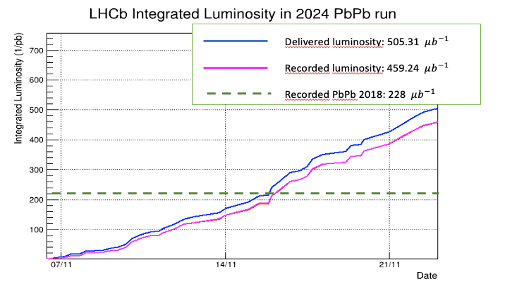
First, by their quantity (defined by the integrated luminosity Lint): twice as many events as during the 2018 data-taking period (Fig. 2).
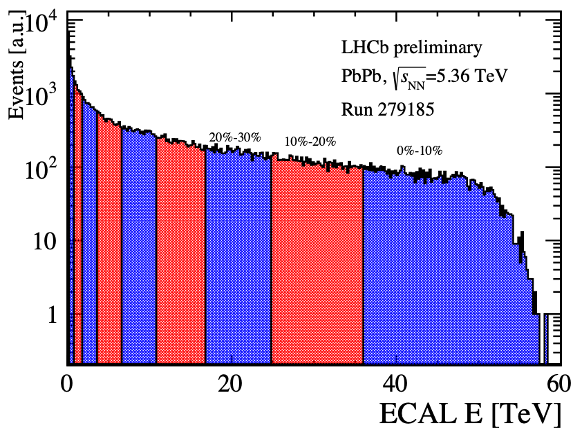
Second, by improved detector performance, allowing access to greater centrality¹ in Pb–Pb collisions (Fig. 3). The probability of QGP formation is higher in central collisions, since they generate greater energy density than peripheral ones. Semi-peripheral collisions, where QGP formation is also expected, are now within reach thanks to the new tracking detector.
¹Centrality is linked to the geometry of the collision between two nuclei. The higher the centrality, the more “head-on” the collision is. In this case, the amount of matter involved in the collision is larger, as are the energy density and the number of produced particles.
During this data-taking campaign, DPhN played a decisive role at several levels. Its researchers contributed to designing the data collection strategy, particularly the various filtering stages. Several physicists were on site for extended periods to support local teams, both for operations and for real-time data quality control. Analyses and physics measurements are now underway, with results expected in the coming years.
And DPhN does not intend to stop there, as its researchers are also preparing for the long-term future. Around 2035, LHCb will undergo another major upgrade, including the installation of new tracking detectors: the Upstream Pixel (UP) and the MIGHTY Tracker [2]. DPhN teams are currently working on the design of the UP in collaboration with DEDIP teams. Based on CMOS technology, these detectors will primarily enhance LHCb’s performance for the most central Pb–Pb collisions, covering the entire domain where QGP formation is expected.
This new stage will complete the ongoing physics program and open up new perspectives for our understanding of the QGP.
[1] LHCb collaboration, A. A. Alves Jr. et al., The LHCb detector at the LHC, JINST 3 (2008) S08005.
[2] LHCb collaboration, Framework TDR for the LHCb Upgrade II: Opportunities in flavour physics, and beyond, in the HL-LHC era, CERN-LHCC-2021-012
Contact: Benjamin Audurier