An powerful decay station for studying (super) heavy nuclei
The region of (super)-heavy nuclei has for long been a vast playground for experimental nuclear physicists in quest of understanding the limits of stability of nuclear matter in extreme conditions. Indeed many phenomena such as shell effects or deformation are in play to favorise or hinder the existance of these nuclei. On an experimental point of view, studying this region is a real challenge because both the production and the observation of the (super)-heavy nuclei is limited.
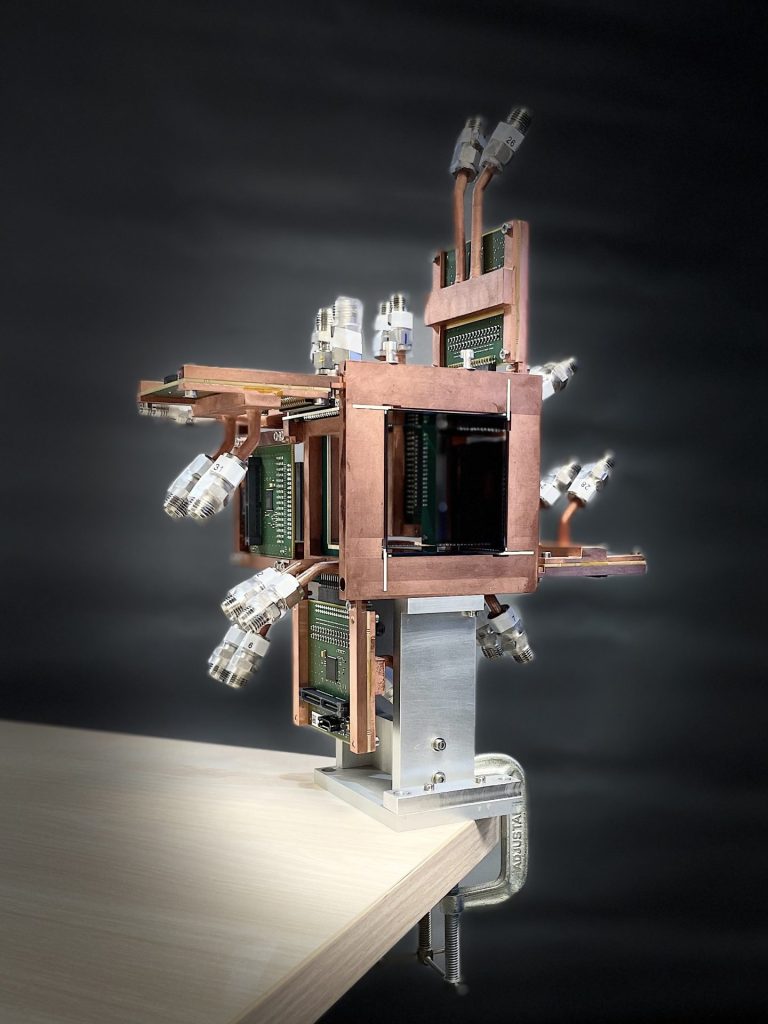
SEASON (Spectroscopy of Electron and Alpha in Silicon bOx couNter) has been developped in order to provide a high energy-resolution decay-station for the alpha-electron-gamma decay-spectroscopy of actinides and heavier elements, which will be implanted in very thin (90 nm) carbon foils evenly reparted on a rotating wheel. The detection system is made of 7 DSSD (Double-sided Silicon Stripped Detector)(5 on the main station, 2 on the deported one) in compact configuration. Thanks to its high efficiency (80 % for alpha – 50 % for electron), and the possibility of removing the accumulated radioactivity by making the wheel rotate, it will also be suited to act as a counter for laser spectroscopy. The coupling of both these approaches will permit to have a more complete view of the nuclei properties in this region.
The SEASON detector, mainly financed by an ANR JCJC grant, has been designed and developped entirely at IRFU. SEASON is currently being commissioned. This commissioning should be concluded at the end of 2025, with the first beam experiment occuring at IGISOL (University of Jyväskylä – Finland), after few months of source commissioning at GANIL.