

General overview
The IRFU, Institute for Research on the fundamental laws of the universe, of the Fundamental Research Division of the CEA, brings together three scientific disciplines, astrophysics, nuclear physics and particle physics, as well as al the associated technological expertise.
Irfu is positioned to answer the main questions we face in understanding the four fundamental interactions, at different scales, from the very smallest (building blocks of matter, nuclear matter) to the largest (energy content and structure of the Universe). This research requires the processing of large volumes of data, as well as expertise in the use of complex simulation tools. Irfu also takes part in developing and operating GANIL (national large heavy ion accelerator) a very large research infrastructure, through a CEA-CNRS EIG. The Institute’s technological position is aimed at developing the instruments needed for this research (accelerators, magnets, detectors, electronics, engineering systems). These developments, carried out in close conjunction with industry, go well beyond the scientific community of the physics of the two infinites, with the institute being called on for its technologies by other scientific communities, at the heart of CEA. It aims to exploit its developments for various societal applications.
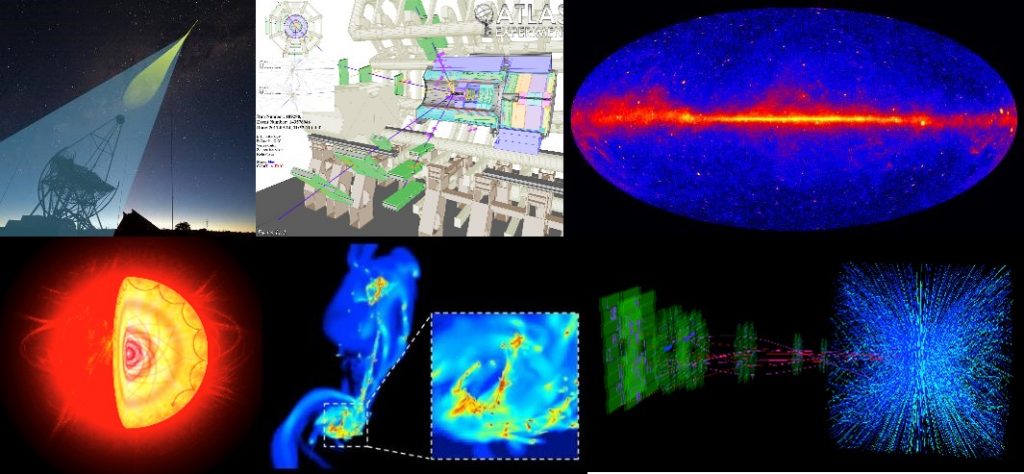
In order to answer key questions concerning the basic components of matter, the organisation of nuclear matter, the structure and the energy content of the Universe, IRFU is organised around several scientific themes, to which can be added technological themes devoted to the accelerators and superconducting magnets, to the field of detectors (microelectronic circuits and signal processing) and to the development of algorithms for scientific computing.
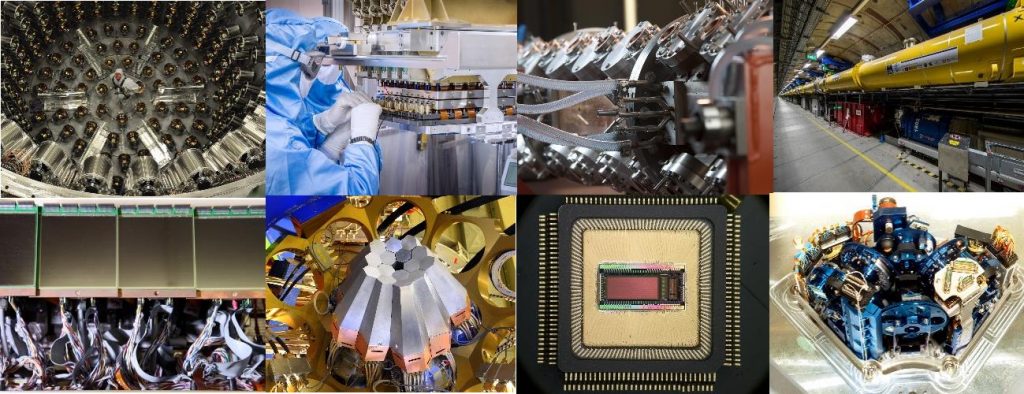
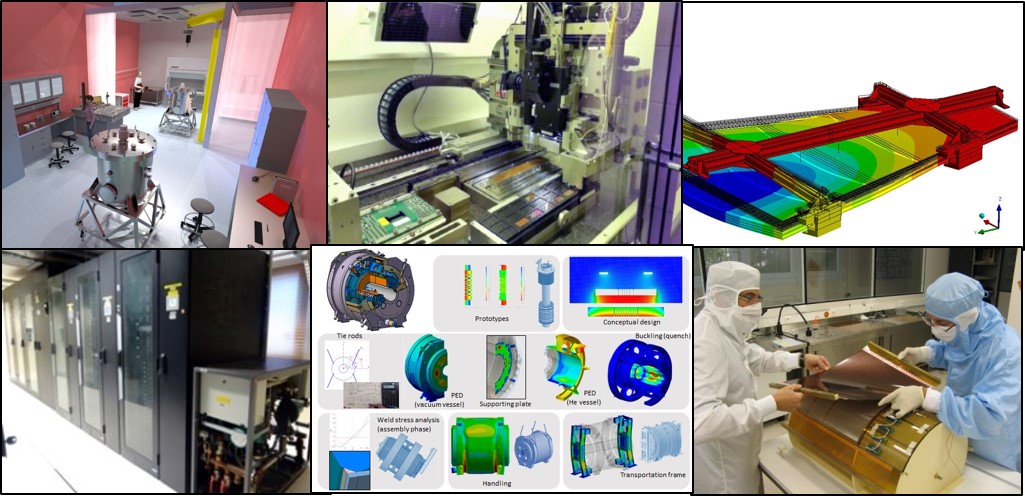
The technological developments and the integration of the large instruments for which Irfu is responsible require platforms.
Main platforms
At the Saclay site, 50,000 m² are dedicated to several thematic platforms (space, microelectronics, accelerators and magnets, design office, computing), which evolve over the course of the projects. Ganil, in Caen, is a TGIR jointly operated by the CEA and the CNRS, delivering beam several months a year for nuclear physics research as well as for multiple applications.
Divisions
Irfu is organised into seven departments, themselves consisting of laboratories (or departments in the case of GANIL):
The accelerators, cryogenics and magnetism department (DACM)
The systems engineering department (DIS)
The electronics, detectors and computing department (DEDIP)
The astrophysics department (DAp) which broadly covers the AIM joint research unit under CEA-CNRS-Paris-Diderot University co-supervision
The nuclear physics department (DPhN)
The particle physics department (DPhP)
The GANIL department (GANIL), which is part of the GIE CEA-CNRS
Since 2015, the Institute has been home to the physical sciences research laboratory (LARSIM) and 5 researchers from the astrophysics department and the particle physics department are assigned to the APC joint research unit, under CEA-CNRS-Paris Diderot University-Paris Observatory co-supervision.
Localisation
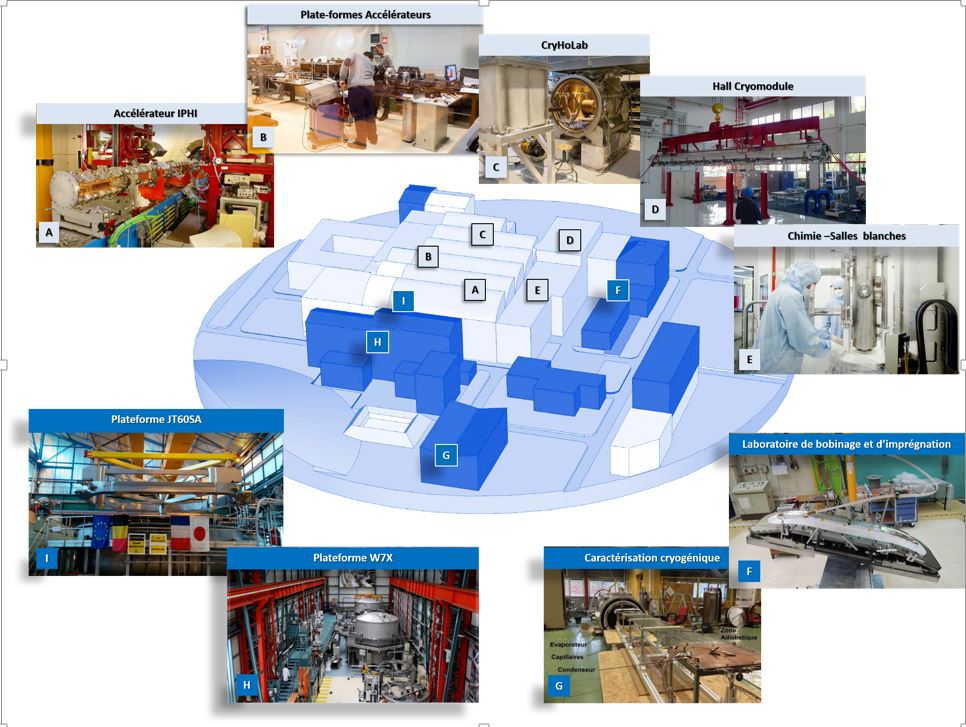
Irfu is built around three main hubs. The primary hub is located on the main CEA site of Paris-Saclay. It employs about 580 management staff and includes the DPHP, DEDIP, DIS and DACM departments. The Orme des Merisiers site about 2 km away from the main site comprises nearly 255 DAP and DPHN staff. Finally, 115 CEA employees work at GANIL in Caen on the Jules Horowitz campus.
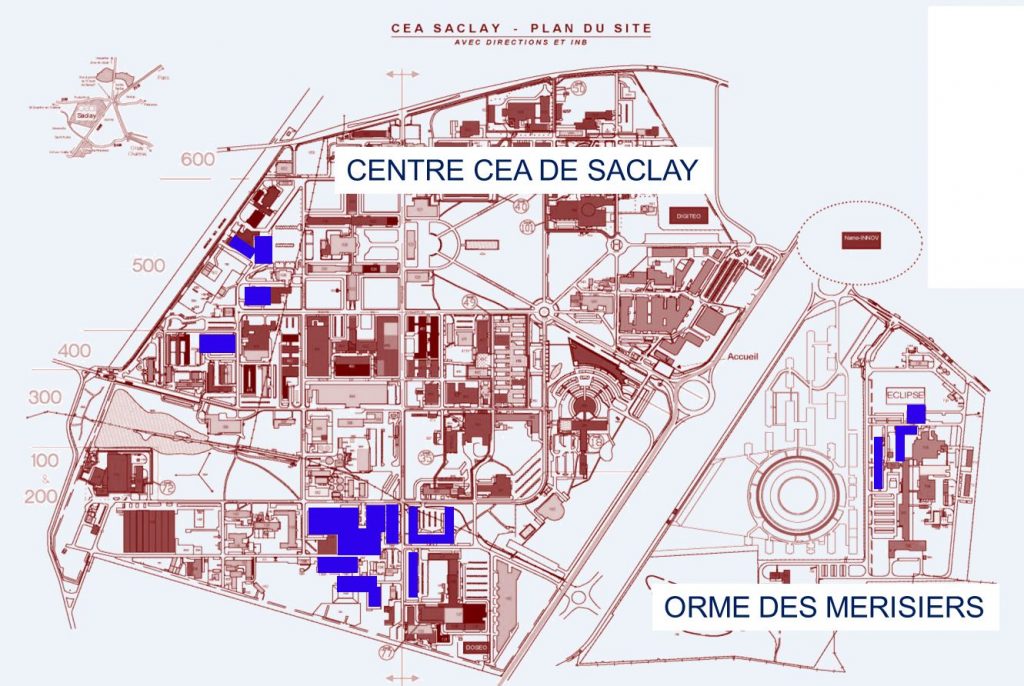
IRFU locations (in blue) in the CEA centres of Saclay and Orme des Merisiers
(the buildings cover about 50,000 m2)
Irfu in numbers
- 200 physicists
- 300 engineers
- 190 technicians
- 105 PhD students (average of 30 per year)
- 155 CDD and post-doctoral students
- Number of sandwich students: 30
- 60 projects
- Number of publications per year: 800
- Number of patents in portfolio: 65 patents
- Number of theses defended per year: 30