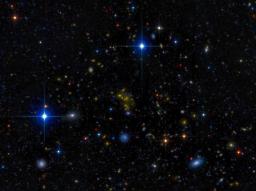
A research team has just published the most precise measurement ever of the rate of gravitational collapse supernovae observed in the Universe 3.7 billion years ago
The Supernova Legacy Survey (SNLS) team at the Canada-France-Hawaii Telescope facility has just obtained the world’s best measurement of the explosion rate of massive stars when the Universe was only 10 billion years old. A research team at IRFU’s particle physics department at the CEA-Saclay centre worked on the first three years of SNLS data to obtain this result, which makes a crucial contribution to our understanding of the origins and evolution of chemical elements in the interstellar medium. The measurement seems to show that there are two to four times fewer supernovae today than 3.7 billion years ago. Could the Universe be burning out?
Contacts:
Nathalie PALANQUE-DELABROUILLE