

The Baryon Oscillation Spectroscopic Survey – known as Boss – delivered its first data during the night of 14-15 September. This experiment, devoted to the search for baryon oscillations, heralds the start of a new era of research into dark energy and the evolution of the Universe. Several teams are involved in BOSS, in particular from IN2P3(1)/CNRS, INSU(2)/CNRS and CEA.
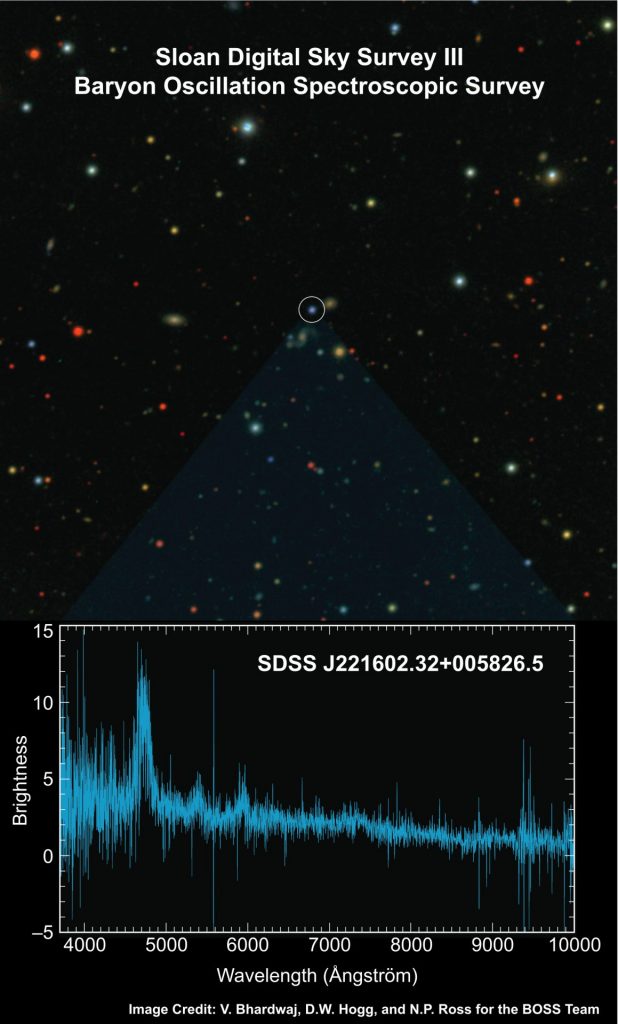
Boss is one of the four projects making up SDSS-III, the Sloan Digital Sky Survey III. Its priority goal is to seek out baryon oscillations which began when pressure waves travelled through the early Universe. Researchers believe that measuring these “fossil” waves will give us a key for understanding the nature of dark energy. Thus, by measuring the length of baryon oscillations, we might be able to learn how dark energy affected the history of the evolution of the Universe.
That night, astronomers used the Sloan Foundation’s 2.5 m diameter telescope at Apache Point Observatory in New Mexico to measure the spectra of a thousand galaxies and quasars. This was the first step in a campaign to gather the spectra of 1.4 million galaxies and 160,000 quasars between now and 2014. The Sloan telescope has been equipped with new spectrographs, specially designed for the purposes of the survey. They have been optimised at the extremities of the spectrum, i.e. at the infrared and far blue ends.
(1) French National Institute of Nuclear Physics and Particle Physics
(2) French National Institute for the Sciences of the Universe
For further details
- SDSS-III website: http://www.sdss3.org/
Research team contacts
- APC : Éric Aubourg
- Irfu/SPP: Christophe Yèche
- IAP: Emmanuel Rollinde