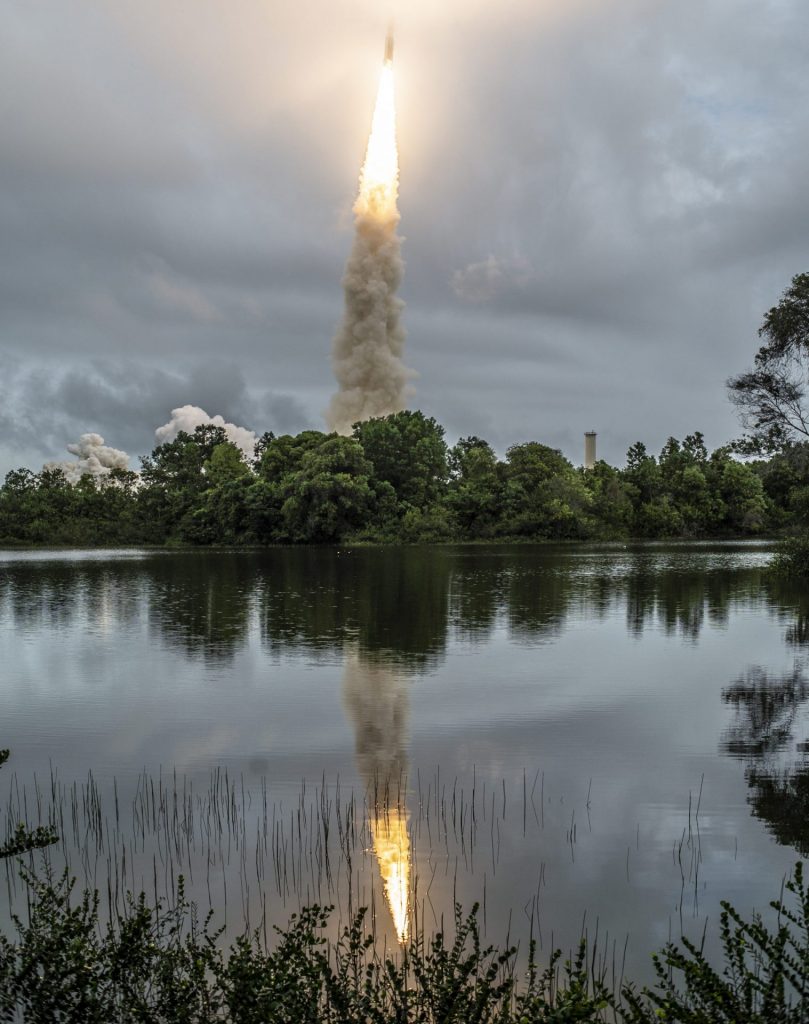

On 25 December 2021, Ariane 5 successfully completed its 112th mission from the Guiana Space Centre (CSG), successfully launching NASA’s James Webb Space Telescope, developed in cooperation with ESA and the Canadian Space Agency (CSA). Ariane 5 placed Webb on a trajectory that will take it directly to its final destination: the second Lagrange point (L2), an orbit located 1.5 million kilometres from Earth, which the telescope will reach 29 days after launch. Fully deployed on arrival at L2, it will then switch on and test all its 4 instruments before becoming operational around June 2022.
A look back at the launch of this extraordinary instrument:
https://youtube.com/watch?v=ghi3qg29j3a
Sébastien Avila ©Universcience 2022
To follow the rest of the mission, go to the JWST website.
And, in the images below, everything you need to know about the James Webb and the French contribution.
The James Webb Space Telescope and the MIRI imager
The James Webb space telescope has been designed to answer major astrophysical questions, such as the formation in the Universe of the first galaxies and their first stars, planets and exoplanets, and the composition of the atmospheres of extrasolar planets. It will be launched on 22 December by an Ariane 5 rocket from the Kourou space centre in French Guiana. Its deployment and the commissioning of its four instruments, including MIRI, represent a number of technical challenges. Here we take a closer look at the innovations and operation of the MIRI imager.
Scientific expertise: P-O. Lagage (CEA), C. Cossou (CEA), A. Boccaletti (Paris observatory), P. Baudoz (Paris observatory), D. Dicken(CNRS)
https://youtube.com/watch?v=jqzevhm6nfa
This animated film was produced and co-financed by the CEA, CNES, CNRS, Observatoire de Paris and OSUPS, and directed by Fab&Fab.
Pierre-Olivier Lagage and DAvid Elbaz tell you all about the James Webb
Internal CEA webinar on 9 December 2022
Observing the Universe beyond the visible
Launched at the end of 2021, Webb, the successor to Hubble, will be the largest telescope ever launched. Its Mirim camera, which uses the mid-infrared, will enable researchers to observe further into space… and therefore further back in time. Thanks to its 3 modes of observation: imaging, coronography and spectrography, it will probe the Universe when it was less than a billion years old, enabling researchers to study the formation of the first stars, the assembly of galaxies… and to search for possible exoplanets. Discover the first episode of the ScienceLoop series devoted to the Webb telescope.
https://youtube.com/watch?v=ndmznshbfmu
© CEA
Astuces astronomiques
To carry out measurements at the very edge of the Universe, the mirror of the Webb telescope measures 6.5 metres in diameter and the screen that protects it from the heat of the Sun is 22 metres long. How do you get them into a rocket? Where and when will the solar panels, antennae, screens and mirrors be deployed before arriving 1.5 million km from Earth, the end of the journey from where the instruments will send back the information that astrophysicists are eagerly awaiting? Find out in this 2nd episode of ScienceLoop devoted to the Webb telescope.
https://youtube.com/watch?v=pptjamei7uq
© CEA
Pauline goes to see Achrène, doctoral student in astrophysics
In this latest ScienceLoop episode devoted to the Webb telescope, Pauline meets Achrène, a doctoral student in astrophysics who is working on exoplanets. This recent field of research – the first exoplanet was discovered 25 years ago and since then 4,000 have been discovered – is exciting because everything remains to be done: the instruments, the observations, the models, etc. Achrène is working specifically on these simulations of exoplanetary systems and their atmospheres. Join her as she goes behind the scenes of the CEA’s Astrophysics Department!
https://youtube.com/watch?v=cl–rue64rs
© CEA
Contacts: Pierre-Olivier Lagage, Patrice Bouchet