

One of the 4 instruments of the JWST and the only one operating in the mid-infrared, MIRI is providing spectacular images and data that are redefining our understanding of the cosmos.
The Royal Astronomical Society today announced that their prestigious Group Achievement Award has been presented to the international team that developed the Mid InfraRed Instrument (MIRI) for the James Webb Space Telescope (JWST). The award recognises the team’s impressive achievement in bringing such a long and complex international project to a successful conclusion, as well as enabling some impressive scientific results to emerge from MIRI.
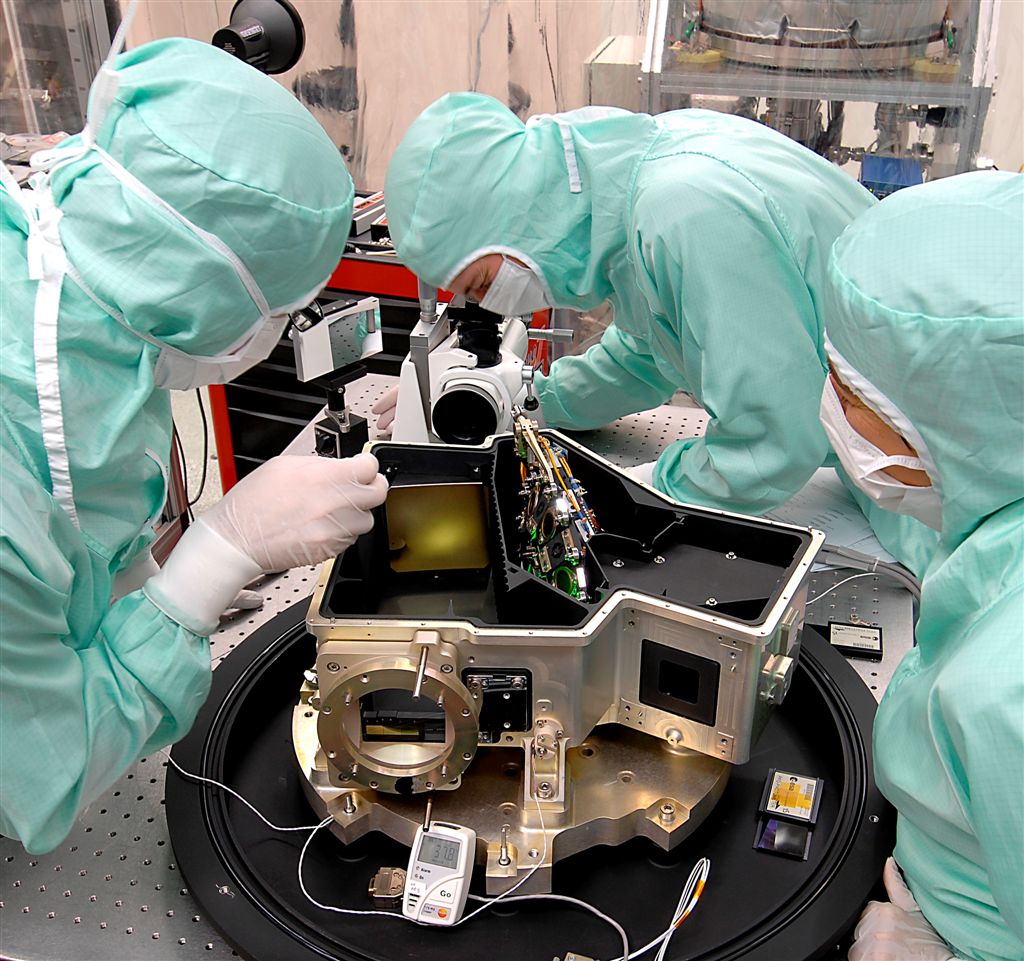
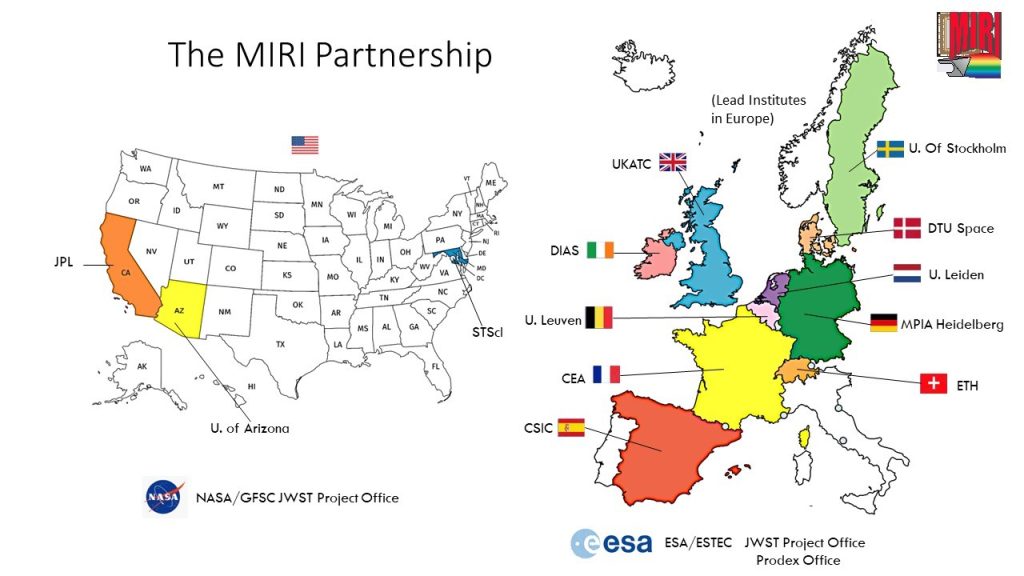
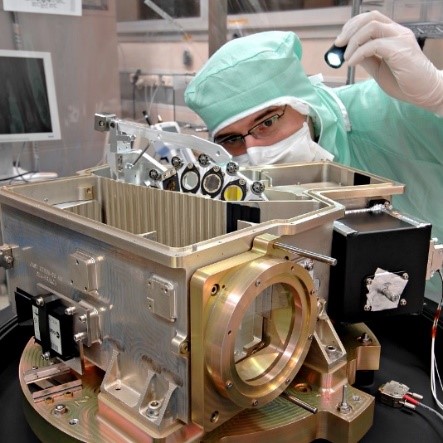
MIRI is the result of a collaboration between Europe and the United States of America (Figure 2). The team that designed and developed the JWST MIRI instrument was led by Gillian Wright from the Royal Observatory of Edinburgh (ROE) and George Rieke from the University of Arizona. MIRI, the only space telescope instrument to work in the mid-infrared, between 5 and 28 microns, consists of a spectrograph, MRS (MIRI medium-resolution spectrometer), and an imager, MIRIm (Figure 1). Under the aegis of CNES, the astrophysics department of CEA-Irfu, with extensive expertise in the mid-infrared field since the 1980s, has been the prime contractor for MIRIm.
What wonderful news for the team at the start of this year!” comments Pierre-Olivier Lagage, scientific leader of the French participation in MIRI and who has been involved in the project since 1998. “We felt that we had done an excellent job with the development of MIRI, and that MIRI was making it possible to obtain information that was crucial to the progress of many astrophysical problems. To have this recognised by the Royal Astronomical Society is very satisfying.
French teams have made a major contribution to the MIRI instrument. They were responsible for the design, production, testing and delivery of the MIRIm imager (excluding the detector supplied by NASA).
This contribution was carried out under the project management of the CEA; four Irfu departments participated (DEDIP, DIS, DACM and DAp) as well as three French laboratories: LESIA (Coronographs), IAS (Design of the telescope simulator), and LAM (Carrying out vibration tests).
Other European countries have contributed to MIRIm under UK management: Belgium – Centre Spatial de Liège (production of the mirrors), Germany – Max Planck Institute (supply of the filter wheel mechanism), Sweden – University of Sweden and Ireland (production of the optical filters).
Credit M. Garcia-Marin, ESA
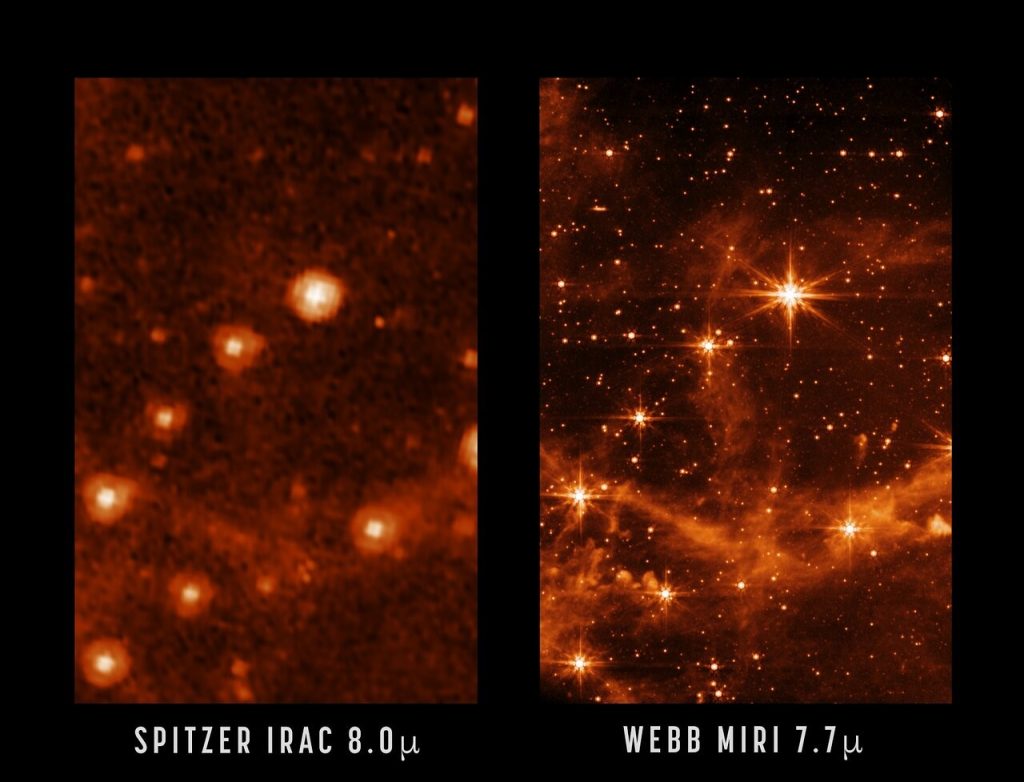
The first observations of the sky with MIRI (in 2022) immediately demonstrated the enormous gain in performance that the JWST would bring (Figure 3).
I was very moved by this first image from MIRI,” said Pierre-Olivier Lagage in April 2022. “The images are of excetional quality. They are much finer than those produced by the Spitzer telescope, which also photographed the Large Magellanic Cloud.
The ExO-MIRI programme
A small part of the observing time is reserved for the astrophysicists involved in instrument development (450 hours for the European MIRI consortium). Within this framework, the CEA is coordinating the ExO-MIRI programme devoted to the observation of exoplanets.
This programme has already achieved some major successes, demonstrating MIRI’s unique potential,” says Pierre-Olivier Lagage, head of the programme. All of MIRI’s observational modes have been used.
- The imaging mode has made it possible to detect the very faint glow emitted by the temperate rocky planet Trappist-1 b and to constrain the presence of an atmosphere (1st series of observations in November 2022: article and highlight March 2023, and 2nd series of observations in July 2023, Ducrot, E., Lagage, P.-O. et al. submitted to Nature Astronomy).
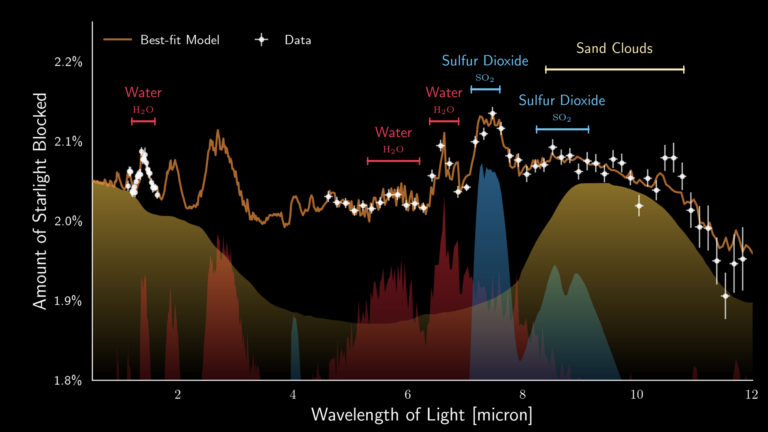
- The spectroscopy mode made it possible for the first time to detect sulphur dioxygen in the atmosphere of WASP-107 b (Figure 4), a ‘cottony’ giant planet, and also to determine the nature of the aerosols present in this atmosphere, silicates (Dyrek, A. et al., Nature and highlights November 2023).
- Thanks to the coronagraphic mode, the 4 giant planets around the star HR8799 (Boccaletti et al., A&A 2024) were observed by direct imaging (Figure 5).
- The medium-resolution spectroscopic (MRS) mode has made it possible to detect the presence of ammonia in the Wise sub-stellar object J1828 and to determine the ratio between the two isotopoloids 15NH3 and 14NH3, which makes it possible to constrain the formation of this object (Barrado et al. Nature, article and highlights November 2023).
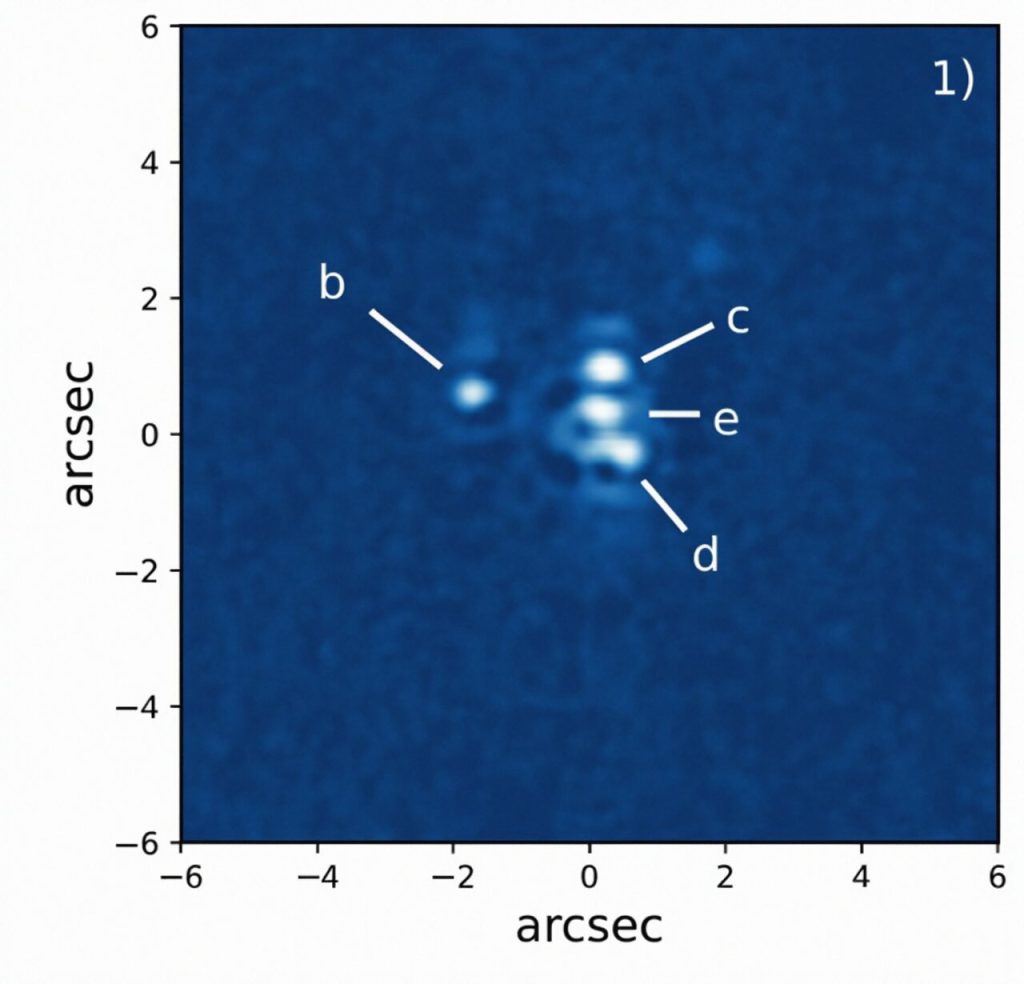
Credit: Boccaletti et al. 2023
MIRI is one of four scientific instruments on board JWST, and the only one to operate at mid-infrared wavelengths (5-28 microns). With its imaging, spectroscopy and coronagraphy capabilities in the mid-infrared, MIRI considerably broadens the range of scientific activities carried out by the observatory. The spectacular images and scientific data provided by MIRI are redefining our understanding of the cosmos. They offer new insights into the atmospheres of planets beyond our solar system, and provide new data on the formation of stars and galaxies. Many of the scientific highlights from MIRI’s first two years of operation can be found on the comprehensive webbtelescope.org/news website.
DAp Contact: Pierre-Olivier LAGAGE
Find out more
MIRIm observation modes
- “Imaging” to photograph the sky,
- “spectrography” to break down the light and find the signatures of cosmic elements and molecules,
- and “coronography” to “extinguish” the light from a very luminous source, be it a star or the nucleus of a galaxy, in order to better observe its surroundings.
It was a challenge to come up with an optical concept that allowed us to have these 3 modes with a single mechanism! To perform these functions, the CEA team designed MIRIm around a filter wheel, which allows a choice of 15 treatments of the light received by the James Webb Space Telescope.
An original optical concept includes an optical bench with 5 mirrors (aluminium, diamond machining), a filter wheel for choosing between different treatments of the light received by the telescope and an entrance window supporting the spectrograph slit, as well as a mask (Lyot) and 3 masks with 4 quadrants for the coronography function known as Phase Mask.
The filter wheel, driven by a ratchet mechanism designed in Germany, carries 10 wide-bandwidth filters for conventional imaging, 4 filters fitted with masks for coronography, and a double prism for low-resolution spectroscopy.
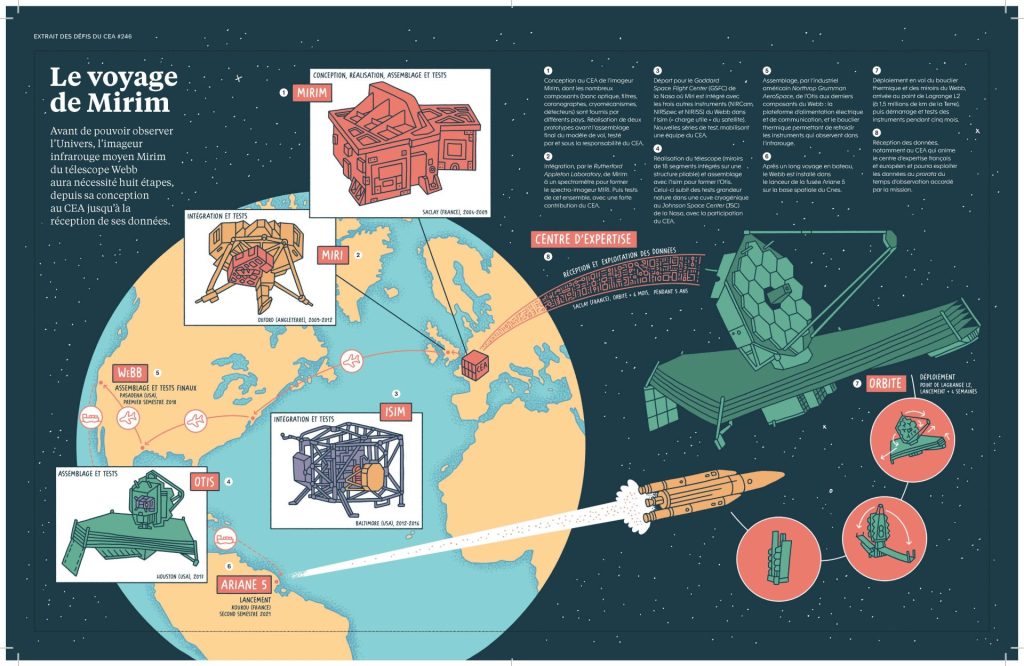
The history of MIRIm from 2008 to 2021
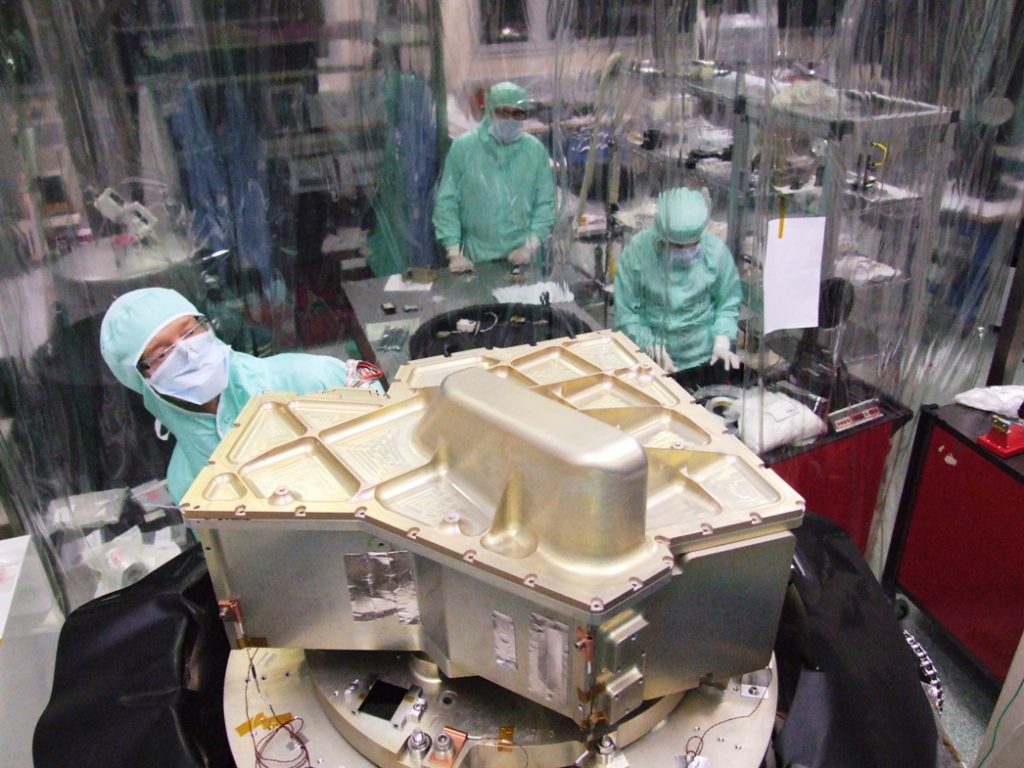
The flight model of the MIRIm imager was assembled and tested at CEA Paris-Saclay in 2008 and 2009, with a test bench developed specially for the occasion to reproduce the vacuum and cold conditions encountered by MIRIm once in space.
In 2010, MIRIm was delivered to the Rutherford Appleton Laboratory in England to be coupled with the other part of MIRIm, the MRS spectrometer, and then tested in a vacuum chamber large enough for the complete instrument.
In 2012, MIRIm was sent to NASA’s Goddard Space Center, near Washington, where it was paired with the other three JWST instruments.
Three series of cryogenic tests followed between 2012 and 2016.
The 18 hexagons of the telescope’s primary mirror were also assembled at Goddard Space Center between November 2015 and February 2016.
The instruments were mounted on the back of the telescope’s primary mirror and the whole assembly was sent to Houston for testing in 2017, as the test station at Goddard Space Center was not large enough to accommodate the telescope. The CEA team was on site for testing when Hurricane Harvey hit. More fear than harm; just a few nights in the laboratory without being able to get back to the hotel and a car completely drowned!
Once the tests were completed, MIRIm left for the premises of Northrop Grumman, in California, where it arrived in early 2018. There, the telescope was coupled with the satellite and the large heat shields (parasol), which will prevent the Sun’s, Earth’s and Moon’s rays from reaching the telescope. The telescope will then be able to passively reach a temperature of around 45K (-228℃), which is necessary to avoid interfering with infrared observations.
Finally, at the end of September 2021, Webb left California for Kourou, where he arrived after a 16-day boat trip that took him through the Panama Canal (blocked a few months earlier!).
Credit CEA