

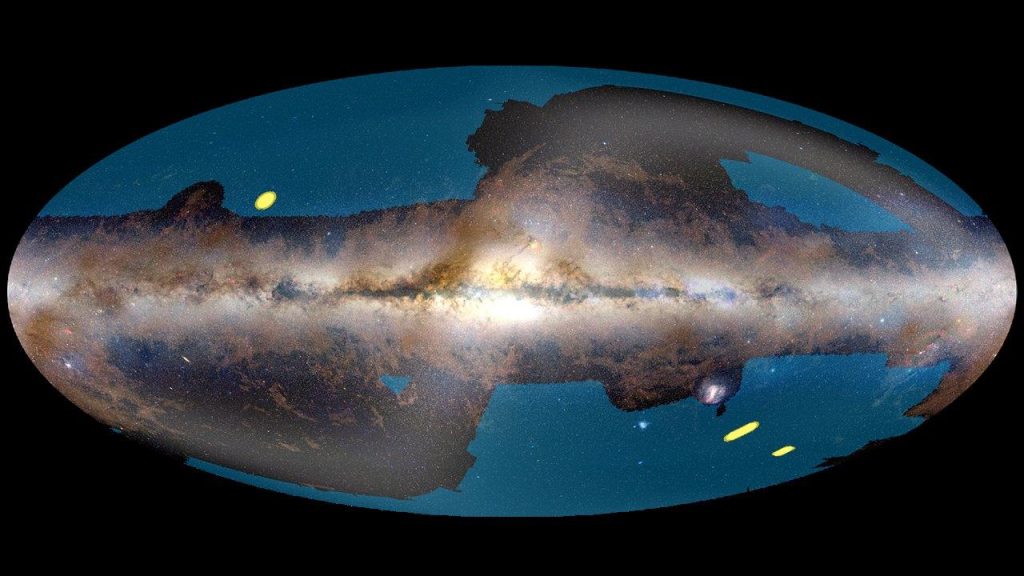
ESA – Euclid’s wide and deep surveys. Crédits : ESA/Euclid/Euclid Consortium/NASA/Planck Collaboration/A. Mellinger
On 14 February, Euclid officially began its survey in the direction of the constellations of the Burin and the Painter in the southern hemisphere. Over the coming year, Euclid will cover around 15% of its survey. The first cosmology data will be published in the summer of 2026, preceded by the publication of data from deep-field observations in the spring of 2025.
Animation representing Euclid’s cosmological survey, the largest ever carried out in the visible and near infrared. Over a period of six years, Euclid will scan more than a third of the sky, represented here by the different shades of grey/blue. The areas not covered are mainly concealed by the Milky Way and the light emitted by the solar system.
Credit: ESA/Euclid/Consortium Euclid
Launched on 1 July 2023, the ESA space telescope Euclid will begin its exploration of the dark Universe. Over the next six years, Euclid will map more than a third of the sky, observing billions of galaxies over 10 billion years of cosmic history, to study their distribution and shape, and to provide a 3D view of the distribution of dark matter in our Universe and dark energy.
Before the survey began, tests revealed an anomaly: a small amount of unwanted sunlight was reaching Euclid’s Visible Instrument (VIS) at certain angles, even when the lens hood was turned towards the Sun. The teams then readjusted the telescope’s various fields of view, adjusting all the rotation angles to minimise this effect. Although this slightly limits the efficiency of the scan, all the necessary areas of the sky can still be reached.
For further information: