

Ten years after the discovery of the Higgs boson, the LHC began in 2022, a phase of data collection at an unprecedented energy of 13.6 TeV. Such an energy opens the door to new tests of the Standard Model (SM). The Higgs boson, in particular, will be closely scrutinised. For the ICHEP 2024 conference, the CMS experiment is unveiling its first measurements on the properties of the Higgs boson, in the H→γγ (diphoton) and H→ZZ*→4l (4 leptons) decay channels, at this record energy, highlighting the major contributions of the IRFU teams to the analysis of the diphoton channel. These first measurements, in line with theoretical predictions, confirm the SM, but the hunt for physics beyond the SM has only just begun at such a high energy…
The Higgs boson, discovered at Cern in 2012 by the Atlas and CMS experiments, is the cornerstone of the Standard Model (SM) of particle physics. In the SM, the masses of the various particles are linked to their interaction with the Brout-Englert-Higgs (BEH) field via a theoretical mechanism known as ‘symmetry breaking’, proposed more than 50 years ago by the theorists Brout, Englert and Higgs. In 2022, the Higgs boson celebrated its tenth birthday, and the CMS collaboration is today presenting its first measurements of Higgs boson production using data collected that year, at the unprecedented collision energy of 13.6 TeV.
The production of a Higgs boson during proton-proton interactions is a rare event: there is a one-in-a-billion chance that the constituents of the colliding protons will produce the precious boson. To collect enough Higgs bosons, the LHC collides protons at a breathtaking pace of 40 million collisions per second, most of which are of no interest to physicists. To make things worse, the Higgs boson decays almost instantaneously after it is produced, in a variety of decay channels. Thus, its presence can only be inferred by carefully measuring its decay products.
In this measurement, physicists from the CMS collaboration targeted the H→γγ (diphoton) and H→ZZ*→ 4l (4 leptons) decays of the Higgs boson. Indeed, these two signatures make it possible to clearly distinguish the production of the Higgs boson from that of the much more abundant backgrounds.
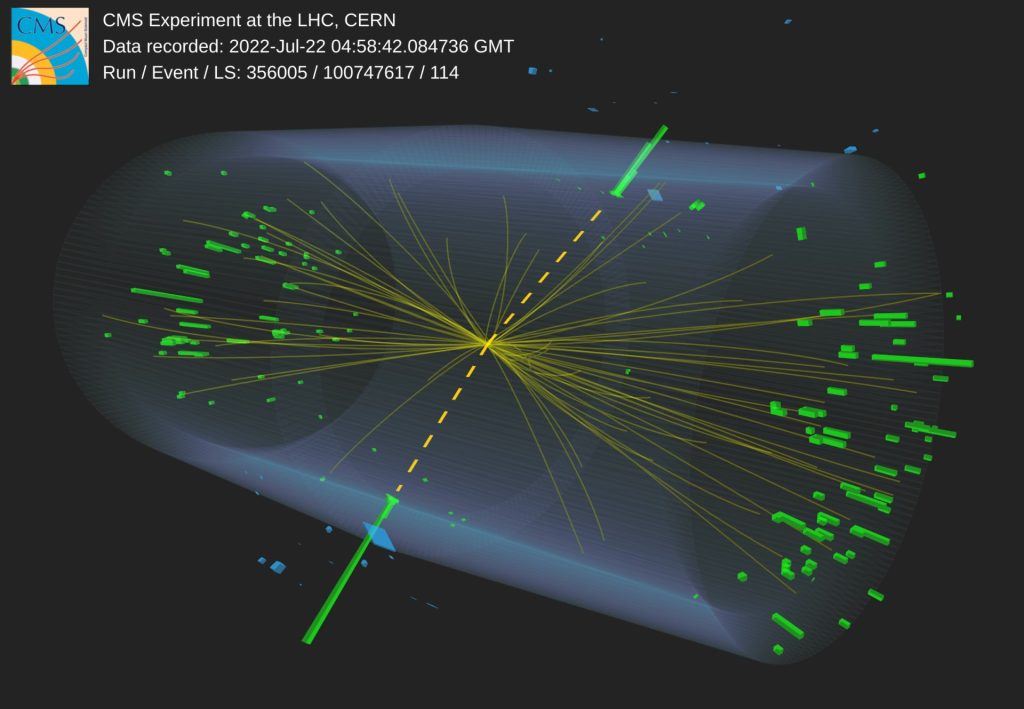
The signature of the Higgs boson decay in the diphoton channel is spectacular, as shown in Figure 1, and consists of two large, well-isolated energy deposits in the electromagnetic calorimeter. To identify the production of the Higgs boson among the large number of similar events producing two photons, the CMS physicists use sophisticated data analysis methods and machine learning techniques to reject background events and isolate the most hunted particle in the SM.
But here, artificial intelligence is not enough! The quality of the discrimination between signal and background noise depends above all on the precision of the measurements taken by the detector known as the Electromagnetic Calorimeter (Ecal) of CMS, which is the instrument dedicated to reconstructing photons. The Irfu teams in charge of calibrating Ecal’s response (stability over time, adjustment of the response of the 76,000 channels constituting the Ecal, equalisation of the response as a function of the rapidity of the particles) play a leading role in the Ecal calibration process and the excellence of its performance.
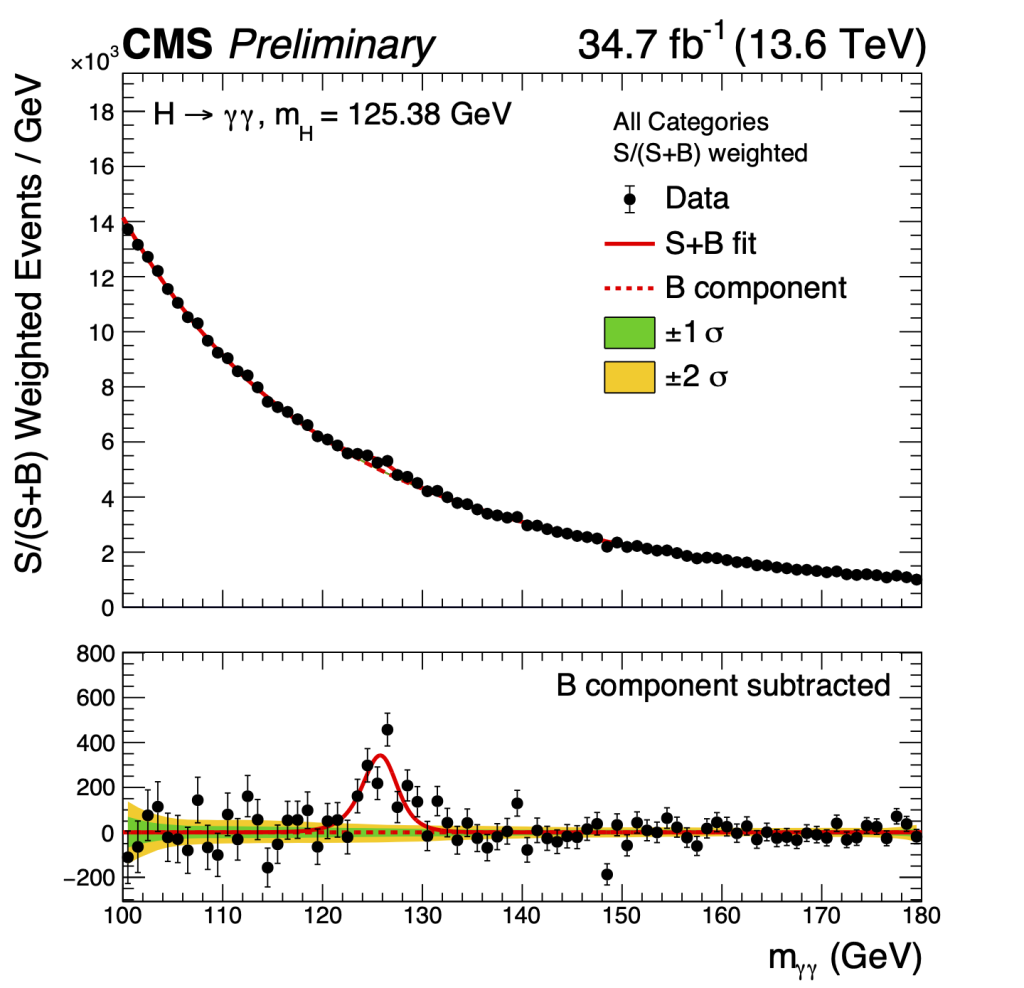
The search for the Higgs boson is therefore carried out by investigating the reconstructed mass of the system formed by the pair of photons in each event. Although the Higgs boson decays instantaneously, it leaves an imprint in the form of a peak at its mass, around 125 GeV (Figure 2). This characteristic is absent from background events, allowing physicists to count the total number of Higgs bosons produced and deduce the Higgs boson production rate (named cross section). The quality of the measurement depends on the width of this peak, which is directly proportional to the performance of the electromagnetic calorimeter.
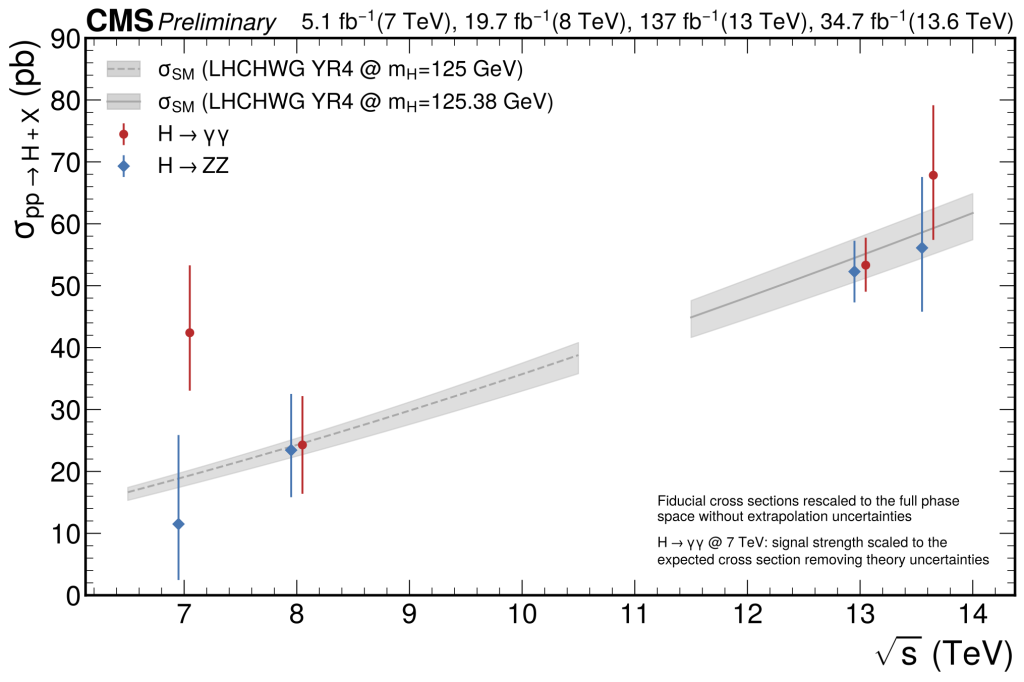
The CMS physicists were therefore able to measure the Higgs boson production cross section for the first time at an energy in the LHC centre of mass of 13.6 TeV. These measurements in the two decay channels (diphotons and 4 leptons) are presented in Figure 3, where they are compared with theoretical predictions and with other CMS measurements carried out at lower energies (7, 8 and 13 TeV).
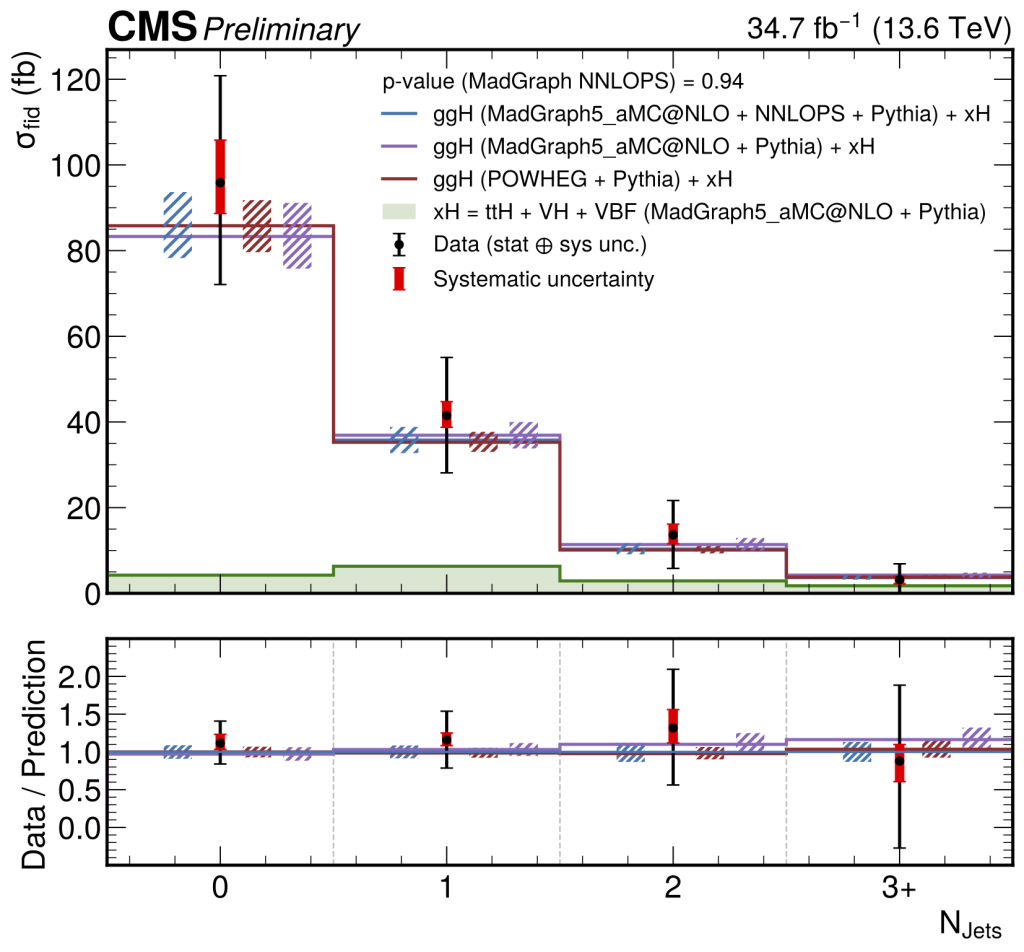
In addition, the dependence of the cross-section on different characteristics of the events, such as the transverse momentum, the rapidity of the Higgs boson, and the number of jets accompanying the Higgs boson, has been measured for the first time with the CMS data at 13.6 TeV, known as differential cross-sections. While the production of the Higgs boson generally seems to be in good agreement with the predictions of the SM, its detailed study could reveal a more complex truth. Indeed, most models beyond the SM predict deviations only for specific characteristics of the events, such as a large value for the transverse momentum of the Higgs boson or a large number of jets accompanying the production of the Higgs boson, see Figure 4.
The measured differential cross-sections are in good agreement with theoretical predictions, as shown in Figure 4, but the statistical precision is still too low to draw any conclusions about most models beyond the SM. Stay tuned…
The analysis team, coordinated by a member of IRFU, has thus rediscovered the Higgs boson and demonstrated that the SM remains infallible to this day. These new results pave the way for even more precise measurements of the properties of the Higgs boson, which will be compared with the predictions of the SM. The LHC should further increase its luminosity (number of collisions per second) at this energy of 13.6 TeV to provide an unequalled sample of Higgs bosons. Will the SM finally shake?
to find out more:
- CMS briefing
- CMS Hgg analysis à 13,6 TeV
- CMS HZZ analysis à 13,6 TeV
- Atlas collaboration, Eur. Phys. J. C 84 (2024) 78
Contact: Fabrice Couderc