

IRFU built the TPOT detector for the sPHENIX experiment in the United States in record time. This Micromegas detector emables the calibration of sPHENIX’s main tracking instrument, the Time Projection Chamber. Thanks to the expertise acquired in recent years in the MPGD laboratory, the design (2021), construction (summer 2022) and tests (autumn 2022) were completed so quickly. Data collection started successfully in 2023 and continued in 2024. Details of the detector’s performances are published in Nucl.Instrum.Meth.A 1066 (2024) 169615.
sPHENIX: Twenty years later, a new chapter for RHIC
The year 2023 saw the introduction of the new sPHENIX experiment. This device is located on the ring of the Relativistic Heavy Ion Collider (RHIC), the pioneer of heavy ion colliders, nestled in the grounds of Brookhaven National Laboratory on the Long Island peninsula in New York, USA.
The sPHENIX experiment stands out as the first and only initiative of a new experiment launched twenty years after the accelerator’s inauguration in 2000. It takes advantage of the final opportunity to collect data from collisions at RHIC, just before its transformation for the future electron-ion collider (EIC), scheduled to be operational by 2030.
The primary mission of this study is to analyze the characteristics of the quark-gluon plasma generated during collisions of gold beams at an energy of 200 GeV in the center of mass. This program includes measuring the production of jets, i.e. particle showers, as well as identifying heavy flavors, in particular particles containing a charmed or bottom quark. The RHIC can also circulate polarized proton beams, allowing for proton-proton and proton-gold collisions.
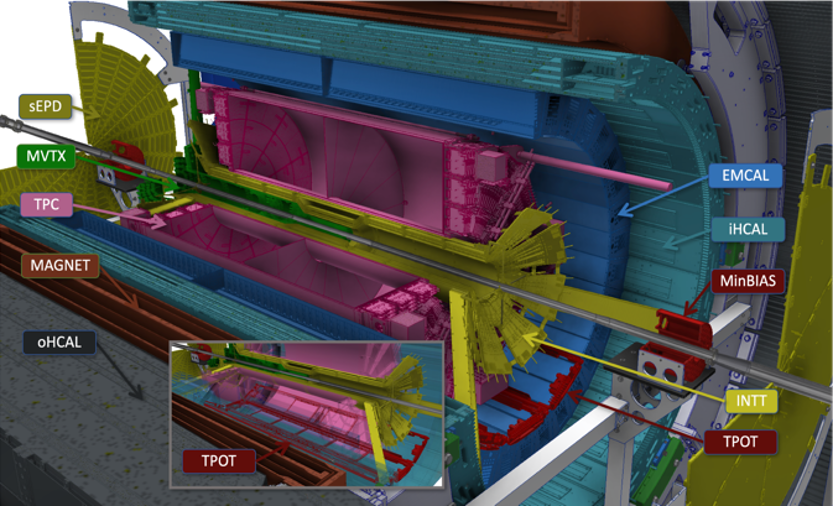
sPHENIX (Fig. 1) consists of a set of cylindrical detectors of increasing radii, inserted one around the other right up to the accelerator tube, where the ultra-relativistic beams meet and collide 15,000 times per second. The whole experiment weighs almost 1,000 tons, equivalent to a two-story house. Different types of detectors are used to identify the particles produced during the collisions, characterize them and reconstruct their trajectories.
The Tracking of sPHENIX
Particles first pass through two silicon detectors:
- the vertex detector (MVTX), which precisely determines the position of the collision using MAPS (Monolithic Active Pixel Sensor) silicon sensors with a resolution of 5 micrometers,
- the INTermediate Tracker (INTT), whose time resolution of 100 nanoseconds allows the pairing of the tracks measured to the collision that produced them.
Next, the charged particles are measured by the main detector of the experiment: the Time Projection Chamber (TPC), with a radius of 80 cm, filled with a mixture of Ar-CF4 gas. The charges are read by gaseous electron multiplier (GEM). The TPC is completed by a Micromegas detector (TPOT) developed at the IRFU to optimize its calibration.
Finally, the electromagnetic calorimeter (EMCAL) detects electrons and photons, followed by the two hadronic calorimeters (iHCAL and oHCAL) that measure the energy of particles sensitive to the strong interaction. These surround the 1.4 T superconducting magnet (MAGNET) inherited from the Babar experiment at SLAC on the other coast of the USA.
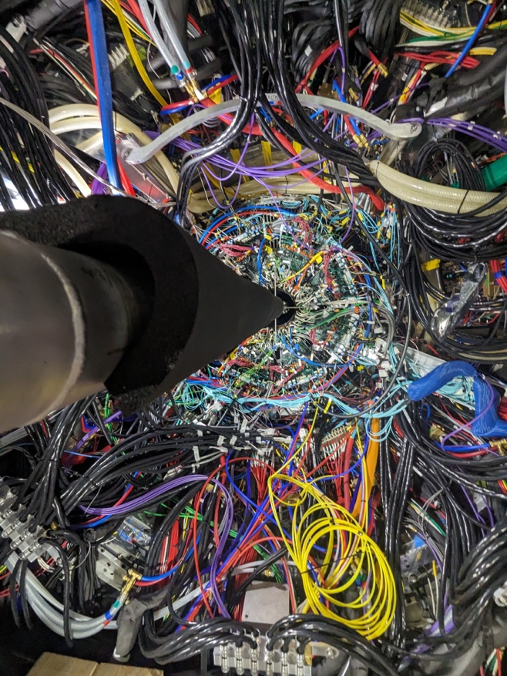
The assembly is also equipped with devices to measure beam luminosity and polarization, trigger data acquisition (MinBIAS) and characterize the recorded events (sEPD). Figure 2 shows the detector being assembled before the MVTX and sEPD wheels are inserted.
Micromegas to the rescue of tracking
IRFU played a key role in the construction of the detection modules for the TPOT tracker installed in sPHENIX. This detector, based on Micromegas technology, is designed to enable calibration of the TPC, which is the main detector of sPHENIX. The TPOT tracker covers the lower outer part of the TPC and provides additional measurements for accurate track reconstruction. The tracks measured between the inner tracking system and TPOT are then interpolated (Fig. 3).
The fulfillement of the physics program relies on a resolution of 150 μm in the TPC for track reconstruction. The environment created by the high collision rate and the large number of particles produced implies the presence of a large number of electric charges within the drift volume of the TPC. One of the challenges associated with its operation is dealing with local distortions in the electric field due to the accumulation of charges and fluctuations in its volume.
To achieve the required momentum and energy resolutions for tracking, it is necessary to measure and correct these centimeter-scale distortions varying on a scale of 10 ms with an accuracy below 100 μm. Various systems are implemented to achieve this: laser systems, the reading of currents on the pads of the central cathode of the TPC, the measurement of digital currents and the use of tracks measured by detectors located before the TPC. The TPOT detector plays a part in this last method by also providing the position of the tracks after the TPC. This will provide a reconstruction of the event-by-event distortions in the lower part of the TPC and their longitudinal dependence.
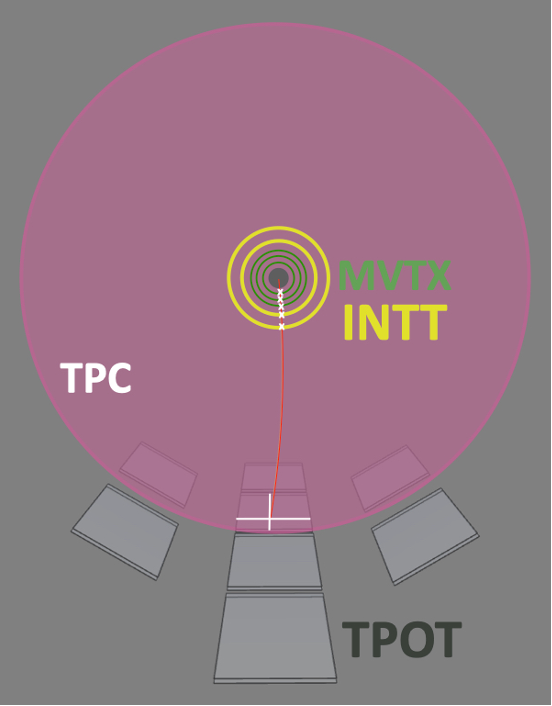
The TPOT detector is composed up of 8 modules arranged in three segments: a central segment with 4 modules aligned along the beam axis, flanked by two modules on each side (cf Fig 3) . Each module includes two stacked Micromegas detectors, enabling the position of the detected particles to be determined in two orthogonal directions. Figure 3 shows the reconstruction of a track between the internal tracking system and one of the TPOT modules.
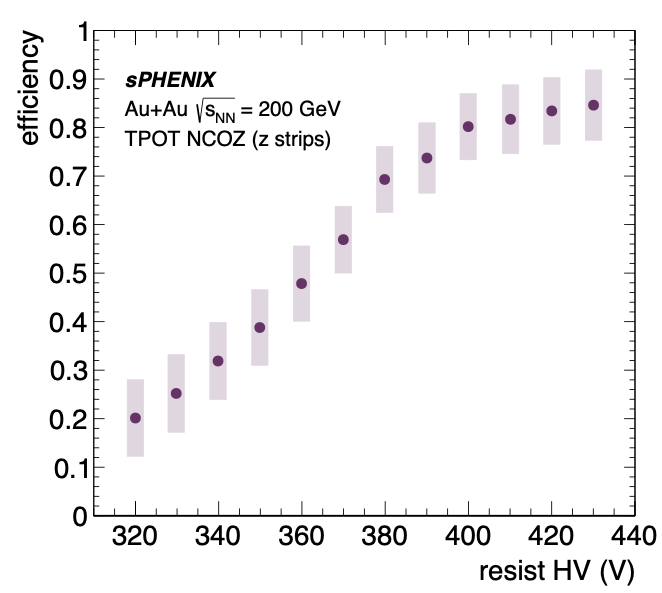
The efficiency of the detector was measured in 2023 during the data campaign of Au+Au collisions at 200GeV. An example of such a measurement is shown in Figure 4. Depending on the applied high voltage, around 90% efficiency is achieved under nominal operating conditions. The missing percentages are attributable in particular to the disconnection of a cable during final assembly.
From idea to reality: when responsiveness makes the difference!
The TPOT project at IRFU has been completed in record time, a feat made possible by the complete in-house realization of the detector, from design (completed in November 2021) to integration of the detection modules (in July 2022).
The design was guided by the requirements of the experiment and the tight deadlines. For example, among the constraints, the inaccessibility of the detector after installation entails a reliability need. The available space is also very limited. To meet these conditions, the detector integrates redundancy in the distribution of high voltage and is reinforced by an external carbon plate to ensure its flatness and sturdiness. The environment is also demanding, with heavy ion collisions at a frequency of 50 kHz and a magnetic field of 1.4 T.
Data is collected using the SAMPA electronics, developed for the time projection chamber of the ALICE experiment at the LHC and also used for the sPHENIX. It serves as the basis for the development of the SALSA electronics at IRFU with the University of Sao Paolo for the ePIC experiment of the future electron-ion collider.
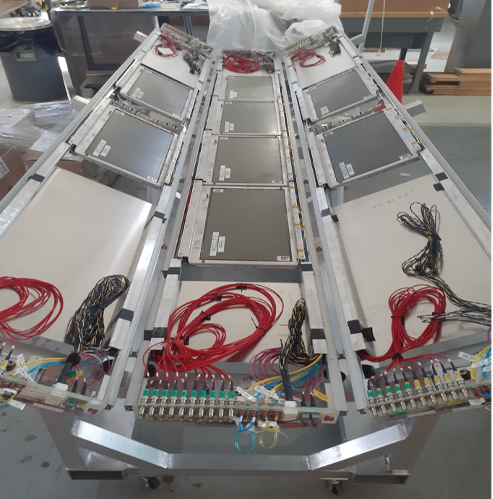
The detector was installed on its mechanical support by the IRFU team in September 2022 (Figs. 5 and 6), before being successfully commissioned with the observation of the first collisions in August 2023. The first phase of data acquisition took place from June to October 2024 with proton-proton collisions at 200 GeV. It will be completed by Au-Au collisions at the same energy the following year.
The final performance of the detector in the global tracking system is currently being analyzed, and will be finalized once the data from the experiment’s other detectors is also available.
This achievement had demonstrated the agility and expertise of CEA in the design and production of Micromegas detectors for high-energy physics experiments. It has also provided an opportunity for a successful collaboration with Los Alamos National Laboratory, Massachusetts Institute of Technology, Stonybrook University, Brookhaven National Laboratory and the MPGD laboratory at CERN.
IRFU physicists are now involved in data collection and analysis over the next few years. A thesis is underway on the measurement of transverse spin asymmetry of neutral pions in proton-proton collisions.
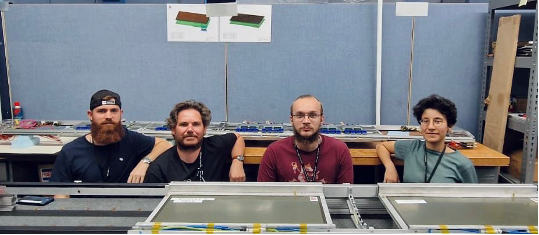
Contacts CEA/IRFU: Audrey FRANCISCO (DPHN), Maxence VANDENBROUCKE (DEDIP)