

The European Spallation Source (ESS) is a neutron source generated by a linear particle accelerator. Located in Lund, Sweden, and bringing together the efforts of 13 European countries, this facility will be the most powerful neutron source in the world. Major advances are expected in the field of research into matter for the benefit of energy, telecommunications, manufacturing, transport, information technology, health and biotechnology. France is involved in the construction and operation of the ESS : At CEA , IRFU is providing 126m of the proton accelerator and IRAMIS/LLB team will deliverthe neutron scattering instruments. After 5 years of assembly at Saclay, the cryomodules installed in the ESS tunnel were cooled to 4K for the first time.
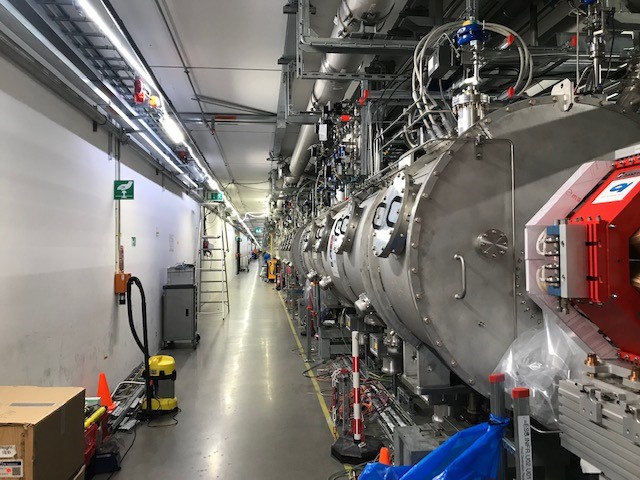
Among other things, CEA built the cryomodules for the accelerator’s high-energy section. These cryomodules are 6.6 metres long, weight 5.5 tons each and contain more than 1,650 part numbers, from the smallest bolt to the largest steel part. It takes 9 weeks to assemble a cryomodule, and 30 cryomodules will be installed in ESS tunnel. Built on the CEA Saclay site, these cryomodules are then transferred by truck to Sweden.
The assembly of a cryomodule involves twelve people from B&S, supported by an Irfu team. The first 29 cryomodules were assembled over a period of 5 years.
For its first day of operation, the superconducting accelerator comprises 27 cryomodules, 14 of which were built by the CEA. They will accelerate protons to an energy of 876 MeV at a power of 2 MW.
The first cooling of these cryomodules went smoothly and with remarkable stability, testifying of the high quality of the preparation of all this complex equipment.
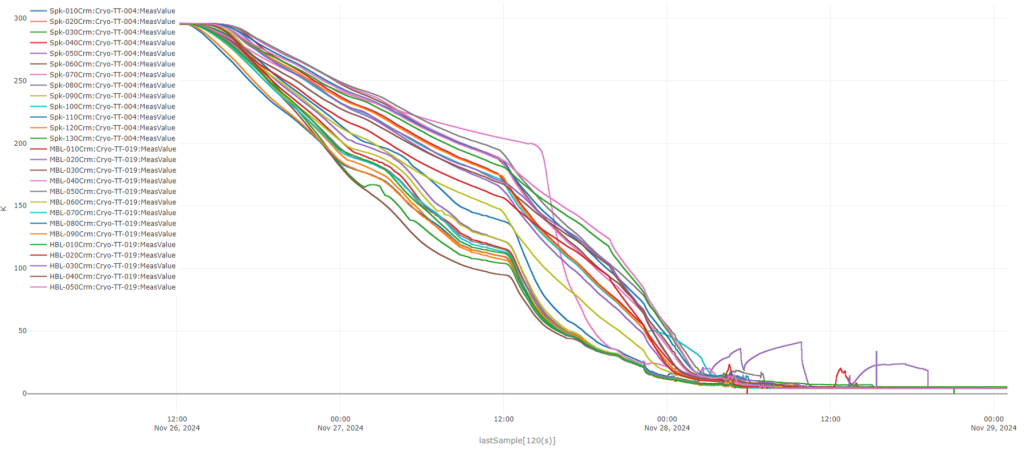
This major milestone is an important step towards the acceleration of the proton beams, scheduled for March 2025, followed by the first protons on the rotating target at the end of 2025, and finally the first neutrons for users in 2027.
Ultimately, the 16 additional cryomodules will enable the proton beam to reach 2 GeV and a power of 5 MW.
A partner since the start of construction of the ESS, CEA has already supplied 60% of Linac’s acceleration capacity, with 126 m.
On the neutron scattering side, while 22 instruments will be housed at the ESS, a series of 15 instruments covering the majority of scientific needs has been selected for the first phase of construction. 5 of these have been designed and are currently being built by teams of physicists and engineers from the LLB (UMR CEA-CNRS), in collaboration with partner laboratories.
Contact : Catherine Madec, Pierre Bosland