


The atomic nucleus is a microscopic object measuring just a few millionths of a millionth of a millimetre. However, advances in experimental methods now enable us to measure their size accurately, even in the case of very short-lived heavy radioactive nuclei. For example, an international collaboration led by GSI in Germany, and including several physicists from IRFU (DPhN and GANIL), has just measured for the first time the variation in charge radii (mainly determined by the proton distribution) of fermium isotopes [1]. Such measurements enable us to learn more about the quantum behaviour of nuclear matter.
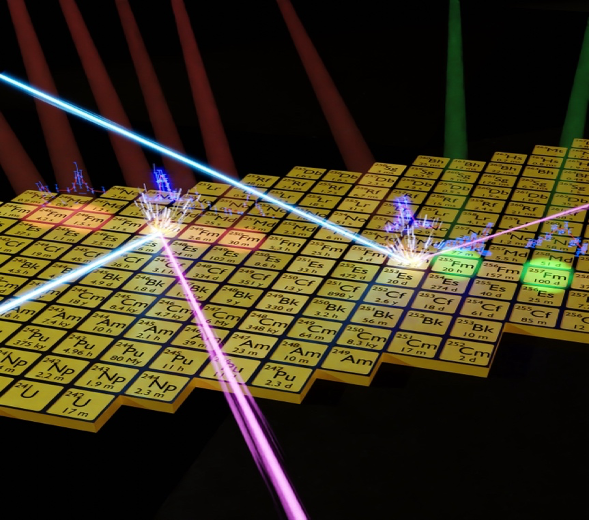
Atomic nuclei are identified by the number of protons (Z) and neutrons (N) that make them up. These particles interact with each other and come together to create the hundreds of stable nuclei and thousands of unstable nuclei discovered to date. But what is the heaviest nucleus that can be created? Or, put another way, what is the maximum combination of protons and neutrons that can be assembled to synthesise a nucleus, even for an infinitesimal amount of time? And what would be the structure of such a nucleus? Nuclear physicists have a number of experimental methods at their disposal to try and answer these questions, including “laser spectroscopy”.
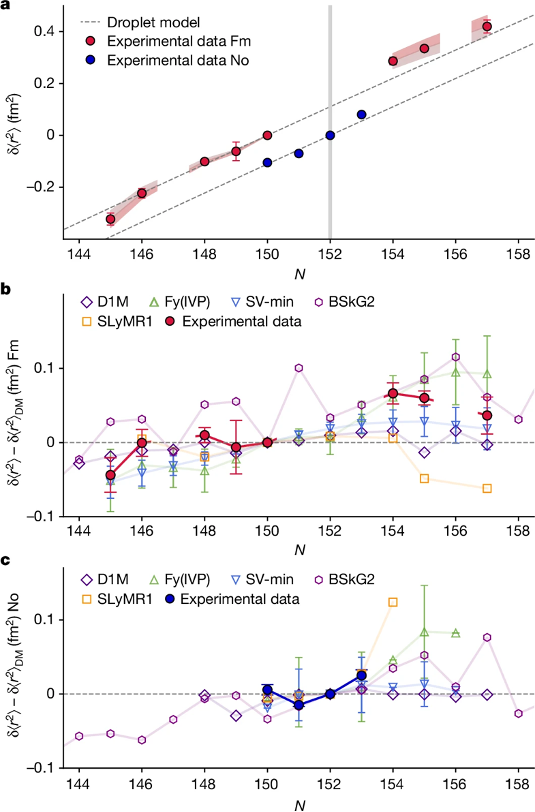
This method involves ionising atoms using lasers to deduce certain properties of the nucleus at their core. More precisely, the wavelength of the laser – i.e. its colour – needed to ionise the atom is characteristic of the atomic structure, which itself contains the imprint of certain nuclear properties. These include the average charge radius of the nucleus, which tells us something about its size. Using this method, physicists can study the variation in nucleus size from one isotope to another, i.e. for the same number of protons, follow the evolution of nucleus size as the number of neutrons is increased or decreased. Laser spectroscopy is a very powerful method because it enables us to determine certain properties of the nucleus (the mean charge radius in this case) by studying atoms directly, and is therefore independent of any particular theoretical modelling of the nucleus with its biases. Although this method is well established, it is only very recently that it has been possible to apply it to heavy nuclei.The low production rates and short lifetimes of heavy nuclei beyond uranium have necessitated cutting-edge technical developments to make the laser spectroscopy method usable for this type of study. Ten years ago, the RADRIS (Radiation Detected Resonance Ionisation Spectroscopy) collaboration at GSI in Germany carried out the first laser spectroscopy of a nobelium isotope (Z = 102) [2]. Today, this same collaboration has achieved the feat of laser spectroscopy of 8 fermium isotopes (Z = 100) and a new nobelium isotope. In addition to the number and mass of nuclei studied, one of the achievements of this work is the combination of experimental methods used to produce these isotopes of fermium and nobelium (direct synthesis and indirect synthesis via fusion-evaporation reactions at the GSI accelerator, and re-irradiation of samples collected from reactors).The results concerning the variation of the charge radius squared are shown in Figure 1. In particular, we observe a fairly regular evolution of the size of the nuclei, close to the behaviour expected from a simple modelling of the nucleus as a liquid drop that grows continuously with the number of particles that make it up (Fig. 1 (a)). In other words, there is no abrupt change in the size of the nucleus due to quantum effects (shell closure) that might have been expected in this area of the nucleus map. To interpret these results, calculations based on microscopic models of the nucleus were carried out, drawing in particular on the unique capabilities of the DPhN theory group in this field. In particular, the mathematical and numerical methods developed at DPhN (SLyMR1 in Fig. 1 (b and c)) make it possible to calculate the various properties characterising the atomic nucleus, including the radius, taking into account the collective correlations resulting from interactions between protons and neutrons. These calculations are consistent with experimental results and raise questions about the quantum behaviour of these heavy nuclei. Indeed, if nuclei with Z > 100 owe their existence only to quantum effects that counterbalance the very strong Coulombic repulsion within them, it would seem that these effects fade as the mass of the nucleus increases. Further experimental studies will therefore be needed to investigate this possible transition to a more macroscopic regime for nuclear matter.
Today, the RADRIS collaboration is already studying a new element: lawrencium (Z = 103). In the longer term, because of the low production rates of heavy nuclei, physicists will have to turn to new-generation facilities. From this point of view, the S3 spectrometer coupled to the high-intensity beams of the new SPIRAL2 accelerator, located at GANIL in Caen, will soon offer new opportunities. In particular, the S3-LEB experimental set-up, recently installed in the S3 room, will enable laser spectroscopy of new elements that were previously inaccessible, thus continuing the programme initiated at GSI.
[1] J. Warbinek et al., Nature 634, 1075 (2024)
[2] M. Laatiaoui et al., Nature 538, 495 (2016)
Contacts Irfu/DPhN: B. Bally, M. Vandebrouck