


LENA (IRFU) and LEPh (IRESNE) Together Towards Nuclear Frugality
The prediction of nuclear properties based on a realistic description of the strong interaction is the main objective of low-energy nuclear theory. One of the problems lies in the numerical cost of solving the Schrödinger equation to predict nuclear properties. Indeed, this cost increases exponentially with the number of neutrons and protons constituting the studied nucleus. Consequently, the ambition to extend theoretical predictions based on first principles to heavy nuclei is limited by high-performance numerical calculation issues. Within the PAN@CEA collaboration (`N-body Problem at CEA`, DRF-DAM-DES), the teams from IRFU and IRESNE have developed dimensionality reduction methods to push the limits of currently achievable calculations.
Modelling the atomic nucleus is necessary to improve our knowledge of the properties of matter and meet the needs for coherent nuclear data (and associated uncertainties) for applications. Concerning nuclear data, the inherently fragmentary nature of experimental data requires them to be completed by a theoretical approach to the problem.
The so-called “from first principles” (ab initio) modelling is an ambitious goal offering, in the long term, the most promising path towards a complete (exhaustiveness of data), coherent (homogeneous formalism without readjustment), and systematically improvable (the effect of approximations is quantifiable) understanding of nuclei. Indeed, this approach is based both on a controlled description of the nuclear interaction at the input of the modelling and on the resolution of the Schrödinger equation for A nucleons based on systematic approximations.
The exact resolution of the A-nucleon problem presents an exponential complexity[1] with respect to the number of nucleons, limiting the application of these methods to light nuclei up to oxygen isotopes (Z=8). However, the physicists from IRFU, alongside a handful of nuclear theory groups around the world, have developed internationally recognized expertise in reducing this cost through the formulation of approximation methods allowing the resolution of the Schrödinger equation with a polynomial cost with respect to A, see Ref. [1] for the particular approximation method used in this work.
These approximation methods are based on two essential common pillars found also in other areas of physics:
- The formalism is expressed in terms of tensors[2] (input data for the Hamiltonian and unknown parameters to be determined through the resolution of the nuclear problem) and tensor networks. Obtaining converged solutions requires increasing the size of these tensors, which can theoretically contain 1014 elements, or even 1021 if the interaction between triplets of nucleons is exactly taken into account.
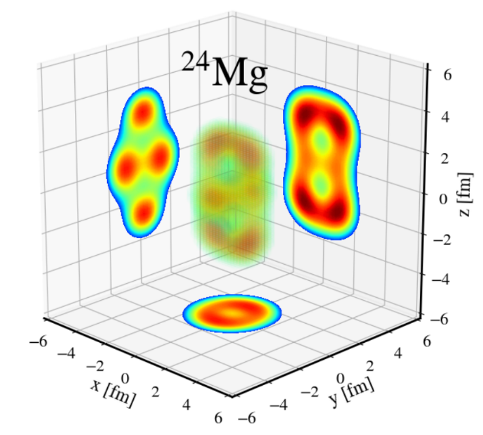
- The success of these approaches is intimately linked to the concept of symmetry breaking, which models the ground state of the nucleus by a deformed state (potentially axial or triaxial, see Figure 1) and paired (i.e., superfluid), allowing the incorporation of long-range effects. These effects, difficult to take into account by traditional methods, are precisely in the energy range of interest for applications.
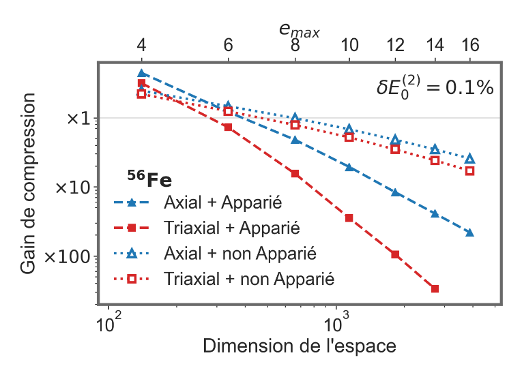
The standard method to reduce the calculation cost consists of exploiting the conservation of nuclear symmetries to maximize the sparsity of these tensors. Indeed, the more they are sparse, i.e., the greater the number of null elements, the more the complexity and storage requirements decrease. However, most nuclei require precisely breaking (temporarily) these symmetries, which makes the problem rapidly intractable numerically as the mass of the nucleus increases. The teams from IRFU and IRESNE have therefore collaborated to develop dimensionality reduction methods in continuity with the pioneering work of IRFU [2] to effectively compress the tensors involved without even needing to build them explicitly and while keeping control of the associated error. This has resulted in compression factors ranging from 5 to 500 (see Figure 2 for the case of 56Fe) depending on the shape and paired or unpaired nature of the nucleus, allowing the limits of currently achievable calculations to be pushed further. For example, the converged calculation of the binding energy of the triaxial and paired 72Kr, requiring a one-particle basis size of the order of 4000 states (i.e., emax=16 on Figure 2), is only possible using the dimensionality reduction method developed in this work.
Contacts: Thomas Duguet (Irfu), Mikael Frosini (Iresne), Pierre Tamagno (Iresne)
[1] A. Tichai, P. Arthuis, T. Duguet, H. Hergert, V. Somá and R. Roth, Phys. Lett. B 786, 195-200 (2018)
[2] A. Tichai, R. Schutski, G. E. Scuseria, T. Duguet, Phys. Rev. C 99, 034320 (2019)
[3] M. Frosini, T. Duguet, P. Tamagno, Eur. Phys. J. A 60, 183 (2024)
[4] M. Frosini, T. Duguet, P. Tamagno, L. Zurek, EPJ Web of Conferences 302, 07014 (2024)
[5] Note Technique – DER/SPRC/LEPh/23-226 DO « Quel modèle théorique du noyau pour quelles observables nucléaires – Etat de l’art des connaissances ».