

A team from the Department of Astrophysics (DAp) has published an analysis combining observations of an interstellar filament with the infrared space observatory James Webb Space Telescope (JWST) and the APEX radiotelescope, located in Chile. These observations make it possible to precisely measure, for the first time, the width of an interstellar filament, the site of star formation, beyond the Gould Belt, and to confirm the existence of a characteristic scale of ≈0.1 pc. This result provides a better understanding of why stars do not form with arbitrary masses.
This study is published in the Astrophysical Journal Letters.
Understanding the complex growth of structures leading to star formation in the cold InterStellar Medium (ISM) of galaxies is central in Astrophysics. To first order at least, the structure of cold interstellar clouds is observed to be scale-free or self-similar, in the sense that all images of molecular clouds tend to be statistically similar, independently of the spatial resolution at which they are obtained. This self-similarity is often attributed to the effect of supersonic turbulence in shaping molecular cloud structure. A fundamental open question, then, is understanding how stars, which are finite-sized bodies, can emerge out of such a scale-free ISM, with a distribution of masses at birth (called initial mass function or IMF) presenting a broad peak around ≈0.3 Msun, just below the mass of our own Sun.
Submillimeter observations of nearby molecular clouds with the Herschel space observatory have provided important clues to this issue, by showing that most stars are born in dense filaments of cold gas at a temperature of ≈10 K. At least in the solar neighborhood, Herschel observations indicate that star-forming filaments all have about the same width, close to ≈0.1 pc. When such filaments reach a critical mass per unit length threshold of about 16 Msun/pc, they can fragment and form stars with a characteristic mass approaching 0.3 Msun, the observed peak of the IMF.
However, the Herschel telescope could resolve the ≈0.1 pc scale by only a relatively modest factor (< 10) in the nearest clouds and was unable to probe the structure of star-forming filaments in more distant clouds, beyond the Gould belt, i.e. the Solar neighborhood (d<0.5 kpc). Consequently, the robustness and scope of the above explanation for the origin of the IMF peak have been called into question.
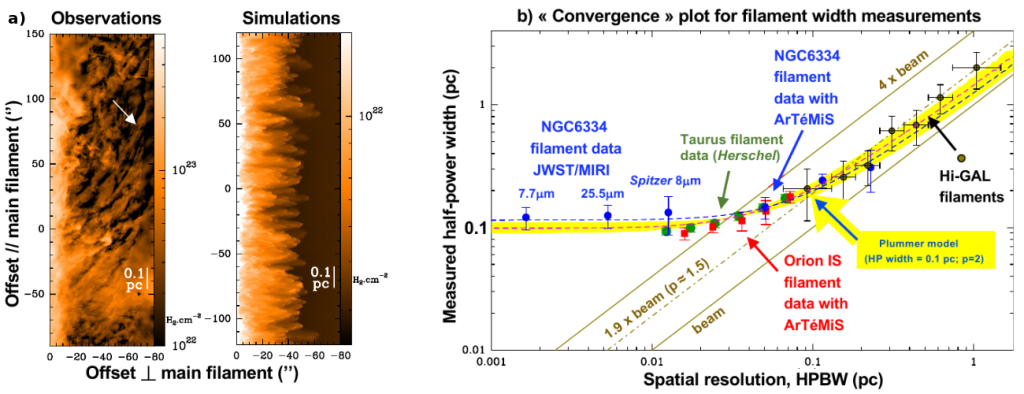
To study the properties of dense filaments and their potential role in the origin of stellar masses beyond nearby clouds, our team has used the MIRI instrument at 7.7 and 25.5 μm on JWST, in combination with the ArTéMiS camera on the APEX telescope, to image the massive filament NGC6334M (at d≈1.3 kpc) and its vicinity at one to two orders of magnitude higher resolution than was possible with Herschel. Filaments such as NGC6334M are so cold and dense that they do not emit significant light at mid-infrared wavelengths but are seen as dark silhouettes by MIRI, in absorption against infrared background emission (cf. figure opposite). The JWST absorption data have revealed the fine structure of the NGC6334M filament with unprecedented detail. A median filament width of 0.12±0.02 pc has been measured at both MIRI wavelengths, resolved by nearly two orders of magnitude by JWST, and consistent with the typical half-power width of Herschel filaments in nearby (d<0.5 kpc) molecular clouds (cf. panel b of the figure below). The JWST data have also revealed the presence of a quasi-periodic pattern of side-filaments with a similar projected spacing of 0.125±0.015 pc (cf. panel c of the figure opposite). Recent numerical magnetohydrodynamic simulations are able to reproduce this characteristic scale and quasi-periodic pattern (cf. panel a of the figure below).
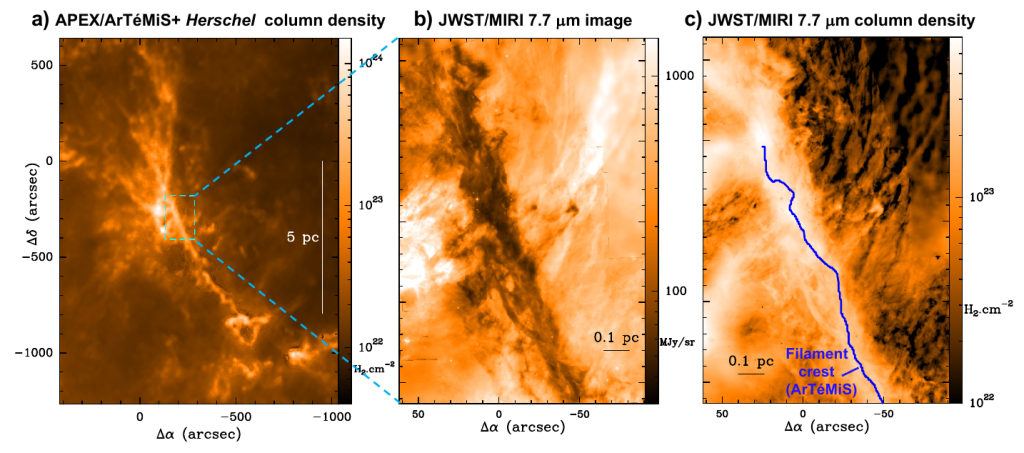
The existence of this characteristic scale of ≈0.1 pc demonstrates that star-forming molecular clouds are not strictly scale-free and supports the suggestion that the peak of the IMF at ≈0.3 Msun may be intimately linked to the filamentary structure of the cold ISM.
Contacts Irfu/DAp: Philippe ANDRÉ and Michael MATTERN.
Reference: “Structure and Fragmentation Scale of a Massive Star-Forming Filament in NGC6334: High-Resolution Mid-Infrared Absorption Imaging with JWST” Ph. André, M. Mattern, D. Arzoumanian et al. 2025, The Astrophysical Journal Letters, in press (DOI, arXiv).
See also: “The CAFFEINE survey with ArTéMiS sheds new light on star formation in dense gas“.