

The spherical proportional counter, invented and developed by a team at DEDIP of IRFU, has been implemented as part of the international NEWS-G experiment. This international collaboration’s main objective is the search for dark matter in the form of very weakly interacting particles, in particular low-mass WIMPs. A WIMP passing through a detector filled with gas would leave a trace of its passage via the recoil of the gas nucleus with which it scattered. Since the signal is extremely faint, the detector must be shielded from cosmic rays and natural radioactivity. This shield is provided by the Laboratoire Souterrain de Modane (LSM), located under 1700 meters of rock beneath the summit of Fréjus.
So far, no experiment has detected these hypothetical particles, but the mass range in which they could exist continues to shrink. Indeed, a non-detection allows scientists to exclude regions of parameter space defined by the particle’s mass and interaction strength with ordinary matter.
In April 2015, NEWS-G recently published new results in Physical Review Letters, based on data collected at LSM during summer 2019. A significant improvement in detector sensitivity to light WIMPs allowed NEWS-G to establish the world’s best experimental limits over a wide mass range between 0.1 and 1.3 GeV.
The Search for Light Dark Matter
Dark matter is essential to understanding the structure and evolution of our universe. Its nature is still unknown, but WIMPs—massive particles interacting only through the weak force and gravity—form a generic class of potential candidates. Despite worldwide efforts through collider experiments, underground searches, and space missions, there is still no evidence of their existence; experiments only provide exclusion limits in terms of interaction signatures as a function of mass.
The NEWS-G Experiment and Its Results
The NEWS-G project aims to extend the search for WIMPs to particularly low masses, down to 0.1 GeV.
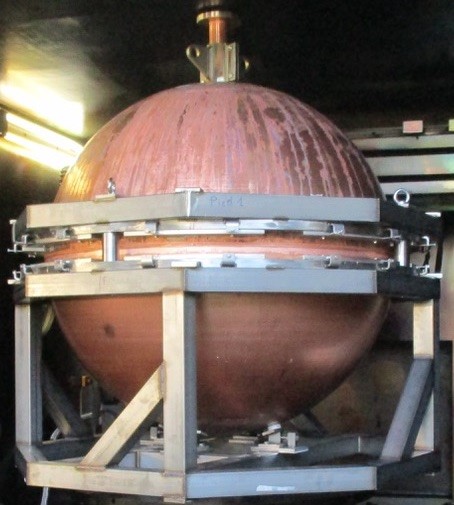
The experiment is based on the use of a spherical proportional counter (SPC), 140 cm in diameter, filled with various gases. This detector is designed to identify elastic scattering events of WIMPs (passing through the detector) on atomic nuclei of the detector gas. Such scattering produces nuclear recoils of very low energy, typically greater than 1 keV. The sphere was built in France using ultra-pure copper (C10100) to minimize background noise from intrinsic material radioactivity.
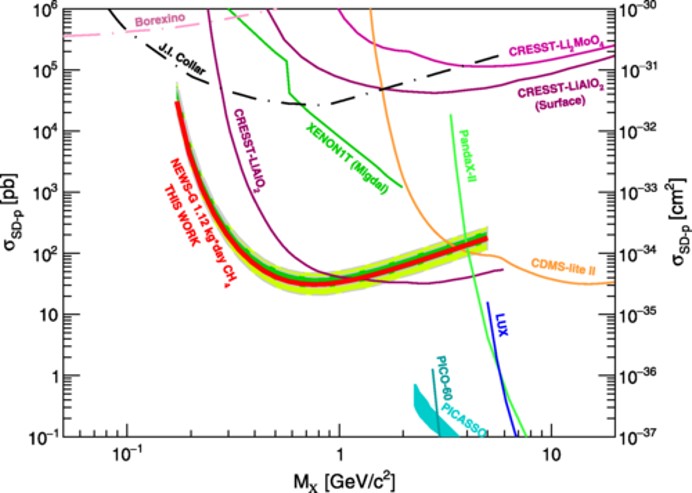
The results shown in figure 1 were obtained during a measurement campaign at the Laboratoire Souterrain de Modane (LSM). For these measurements, the sphere was filled with pure methane (CH₄) at a pressure of 135 mbar. This hydrogen-rich gas enhances the nuclear recoil signal of the target nuclei.
Figure 1 illustrates the sensitivity (linked to the probability of detecting an interaction) as a function of WIMP mass, compared with results from other international projects. The red curve corresponds to the NEWS-G results and represents the current best limits for WIMP production in the energy range 0.1 to 1.3 GeV.
The Strategy for Direct WIMP Searches
Direct WIMP searches rely on detecting nuclear recoils induced by elastic scattering with WIMPs. These rare events produce very small ionization energies, on the order of keV or less, which are difficult to detect. This is why it is crucial to determine precisely the amount of recoil energy converted into detectable ionization.
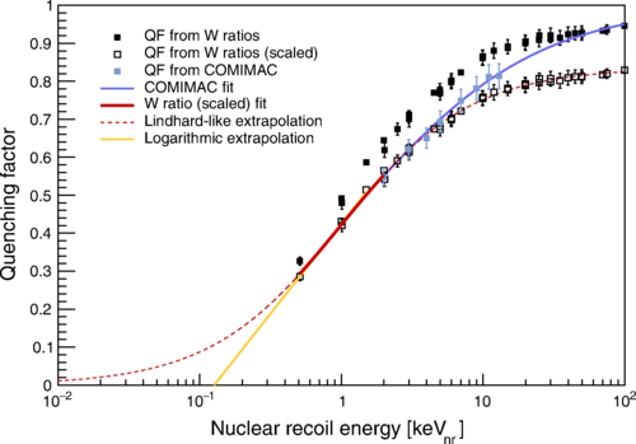
This exceptional result (Fig. 1) required additional measurements to quantify the fraction of nuclear recoil energy that appears as detectable ionization. After a nucleus is struck, only a fraction of its recoil energy is released in the form of ionization. This fraction is called the quenching factor (QF). Measuring QF in the keV range is challenging because the ion’s kinetic energy must be precisely determined. While QF approaches 1 (~100%) at high energies, it decreases significantly at low energies, particularly below a few keV—the typical energy range for nuclear recoils induced by WIMPs in the NEWS-G detector.
In this context, a collaboration between our team and CNRS-LPSC in Grenoble was established to carry out these complex measurements. They were performed using the COMIMAC device, a detector developed at DEDIP, coupled to a low-energy accelerator at LPSC capable of producing ions with energies similar to nuclear recoils.
Figure 2 shows the quenching factor curve obtained with COMIMAC (in blue), compared to other experimental results from nuclear reactors as well as evaluations from numerical simulations.
These data allow a better constraint of the detector response at low energy and refine the analysis of NEWS-G results.
These data allow a better constraint of the detector response at low energy and refine the analysis of NEWS-G results.
This study by the NEWS-G experiment sets even more precise limits on possible interactions between low-mass WIMPs and ordinary matter, bringing us closer to understanding this mysterious component that makes up most of the universe.
The detector is currently in operation at the underground SNOLAB facility (Canada) for a new data-taking campaign, aiming to further reduce the exclusion region below 0.1 GeV.
Contact Irfu: Ioannis GIOMATARIS