

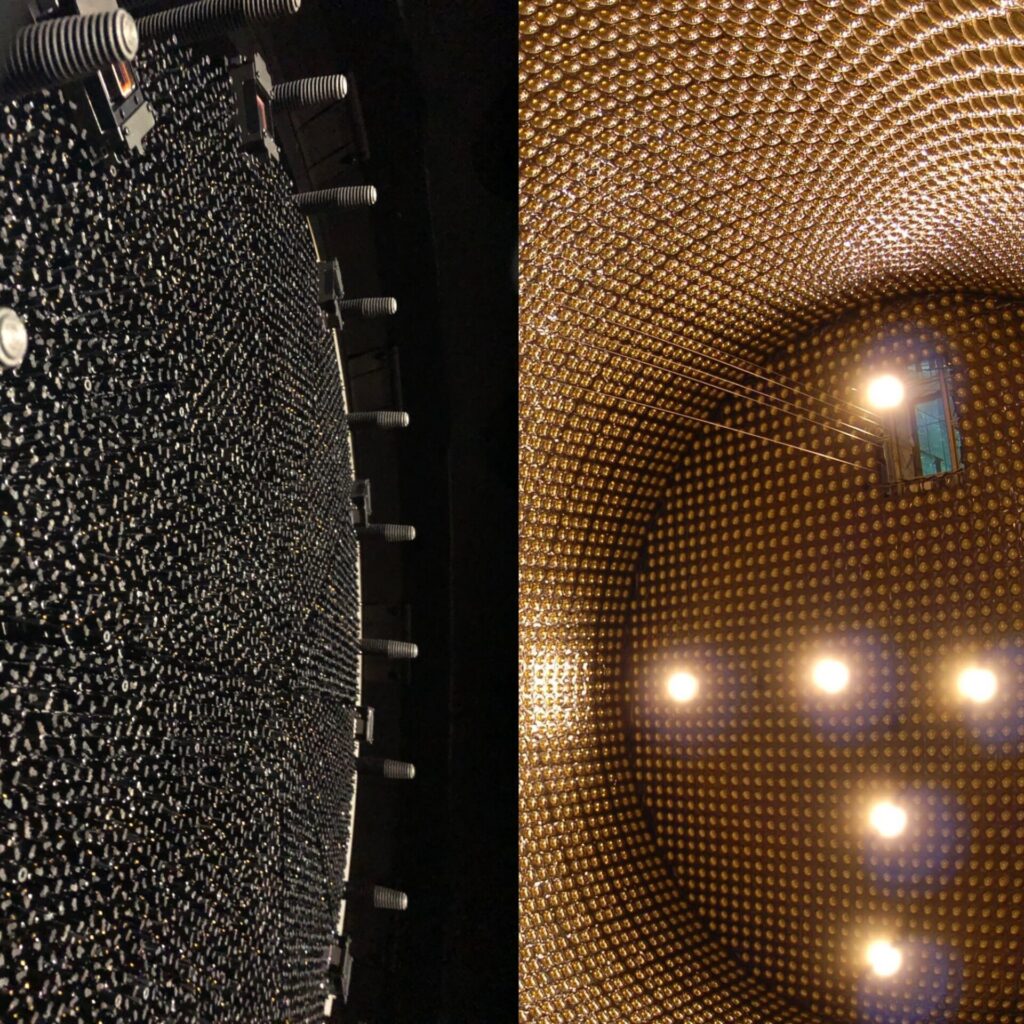
The DESI collaboration has just published two studies, one of them led by IRFU, focusing on the determination of the neutrino mass. These studies use cosmological data from large surveys of galaxies and quasars as well as the cosmic microwave background. The results confirm that within the framework of extensions to the standard cosmological model, the sum of neutrino masses takes on positive values consistent with the limits set by particle physics experiments.
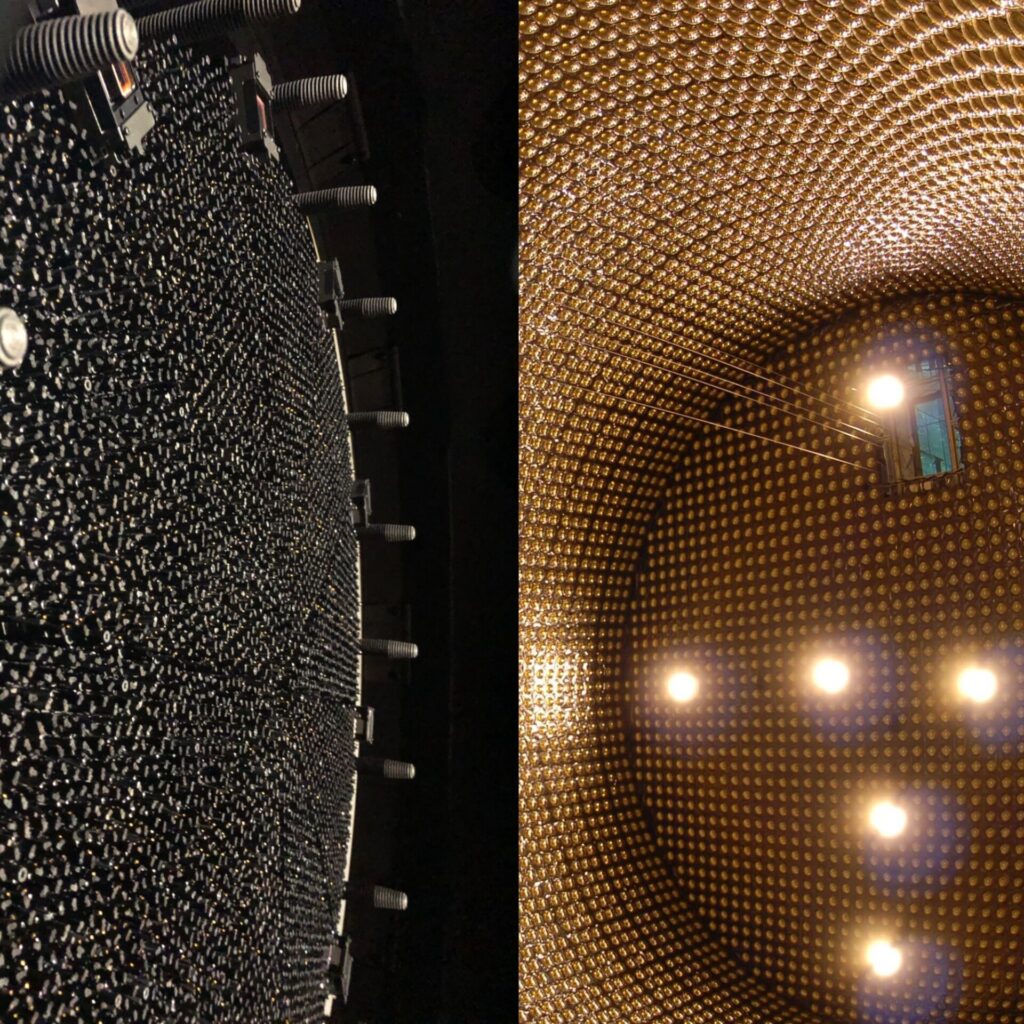
Cosmological neutrinos, created during the Big Bang, are extremely abundant in the Universe: about 360 per cm³, almost as many as photons. They contribute in two ways to the evolution of the Universe, which is expanding and cooling as cosmic time flows.
On one hand, because of the expansion of the Universe, neutrinos lose energy. They gradually transition from being relativistic particles to non-relativistic ones, at a moment in cosmic history that depends directly on their mass. This transition affects the geometry of the Universe: by comparing its size before this transition, measured with the cosmic microwave background, to its size after, measured with large galaxy and quasar surveys such as DESI, one can deduce the neutrino mass.
On the other hand, by propagating at relativistic speeds for billions of years, neutrinos slow down the gravitational collapses that give rise to galaxies, galaxy clusters, and hydrogen filaments. This effect can notably be detected by studying quasar Lyman-alpha forests, which allow these hydrogen filaments to be mapped by measuring hydrogen absorption in the spectra of quasars observed by DESI.
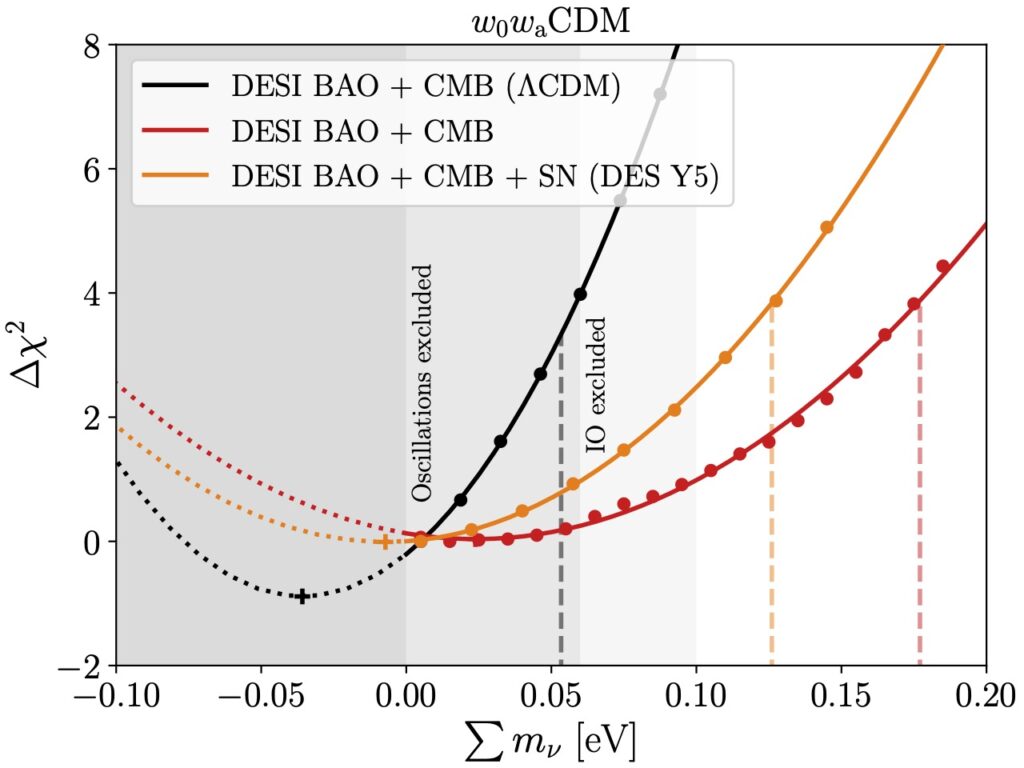
The DESI team at IRFU carried out a study (D. Chebat et al., arXiv) on the neutrino mass combining results from the galaxy and quasar surveys of DESI, the analysis of Lyman-alpha forests from the SDSS/eBOSS survey, and the measurement of the cosmic microwave background from the Planck satellite and the ground-based Atacama Cosmology Telescope (ACT). This combination establishes an extremely tight upper limit on neutrino mass (Σmν < 0.053 eV at 95% confidence level). The analysis highlights that this limit is artificially low due to the tension between DESI measurements and those of the cosmic microwave background. Once the model is relaxed—for instance, by introducing a dark energy that evolves with cosmic time—the obtained limit is higher (Σmν < 0.177 eV, see Fig. 1). The most probable value of the neutrino mass then becomes positive, and the upper bound on the sum of masses falls into agreement with the lower limits set by parameters measured from neutrino oscillations (around 0.06 eV).
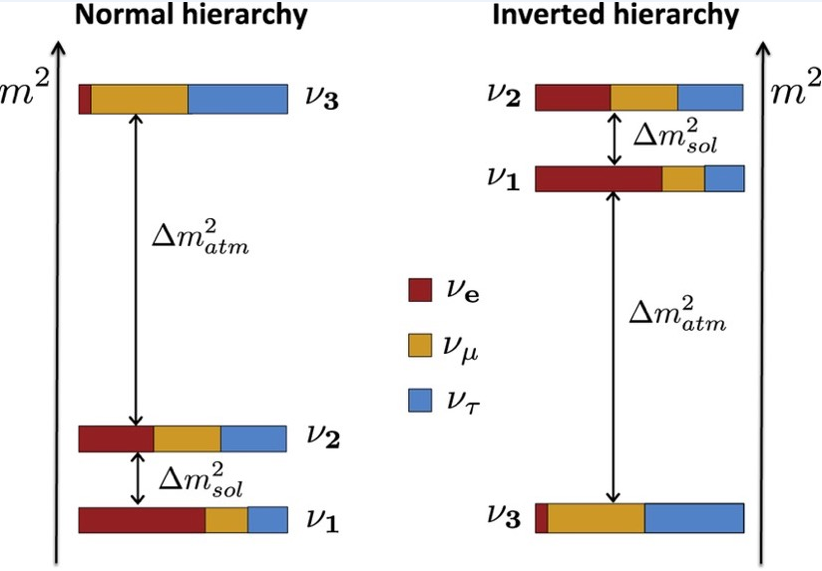
Flavor oscillations observed in atmospheric and solar neutrino fluxes only allow the measurement of differences of squared masses, not the absolute neutrino mass. This leaves two possibilities for the mass ordering, corresponding to the “inverted” and “normal” hierarchies. In the case where the lightest mass is nearly zero, the sum of neutrino masses takes its minimum value. In the inverted hierarchy, the dominant squared mass difference term counts twice; in the normal hierarchy, only once. In practice, this leads to a mass sum of at least 0.10 eV for the inverted hierarchy and 0.06 eV for the normal hierarchy.
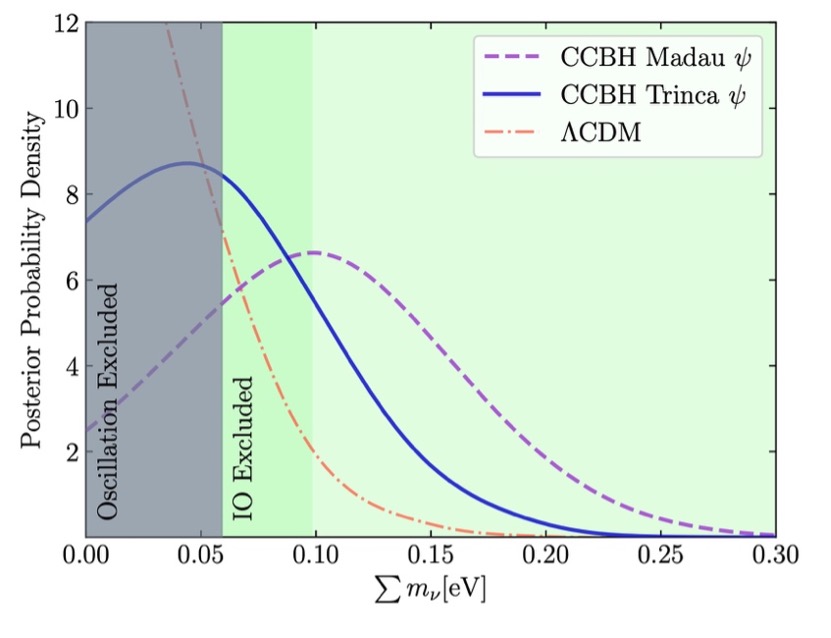
In parallel, the DESI collaboration has just published in PRL (S. Ahlen et al., arXiv) a study showing that DESI and cosmic microwave background data can be interpreted as a signal of conversion of ordinary matter into dark energy. In this “CCBH” model (Cosmologically Coupled Black Hole), black holes are coupled to the cosmological expansion of the Universe and act as dark energy from this perspective. The formation of black holes during the collapse of massive stars—made of ordinary matter—thus effectively resembles a conversion of matter into dark energy. In this framework, the results on neutrino mass depend on the star formation rate, and the most probable value of the sum of neutrino masses lies in the positive-mass region (see Fig. 2). More generally, any model that converts enough matter into dark energy during cosmic evolution exhibits this property.
The determination of the sum of neutrino masses from astrophysical observations depends on the cosmological model used to describe the Universe. The recent tensions observed between different probes point to the need for an evolution of the concordance cosmological model. Fortunately, within such a framework, the sum of neutrino masses takes on values consistent with particle physics measurements, and the mystery of the neutrino mass value could soon be unraveled thanks to the combined efforts of these two fields of fundamental physics.
DESI
DESI (Dark Energy Spectroscopic Instrument) is a large spectroscopic survey of galaxies and quasars, conducted with the 4-meter Mayall telescope at Kitt Peak Observatory (Arizona). DESI began observations in May 2021 and, in April 2025, published the cosmological analysis of its first three years of data. DESI simultaneously measures the light spectra of 5,000 astrophysical objects at each telescope pointing, thus mapping the Universe in three dimensions through measurements of each object’s redshift. The spectra of the most distant quasars also make it possible to measure the positions of intergalactic hydrogen clouds through the hydrogen absorption lines that appear in these spectra as “Lyman-alpha forests.”
Contact: Christophe Yeche, Domitille Chebat, Etienne Burtin
References:
Cosmological neutrino mass: a frequentist overview in light of DESI, D. Chebat et al. soumis à JCAP, https://arxiv.org/pdf/2507.12401
Positive Neutrino Masses with DESI DR2 via Matter Conversion to Dark Energy publié sur Physical Review Letter https://journals.aps.org/prl/abstract/10.1103/yb2k-kn7h